Credit: By ScaccabarozziInter - Own work, CC BY-SA 4.0, https://commons.wikimedia.org/w/index.php?curid=122637960
Background
Synopsis: Highly alkaline soda lakes may have been the source for phosphorus which is an element needed for important biomolecules. These unique bodies of water could have supported the origin of all life on Earth.
Phosphorus and Early Life
- Phosphorus is one of life’s most critical ingredients, needed to form DNA, RNA, and the energy carrier ATP.
- But on early Earth, most phosphorus was stuck in rocks and minerals, unavailable in the watery environment where life was starting to emerge.
- A previous EarthDate, P is for Life, explained the role of meteorites and lightning to solve this “phosphorus problem,” the struggle that early life would have to find enough phosphorus.
- Meteorites that bombarded Earth delivered rare phosphorus minerals called phosphides, which react with water to release biologically useful phosphorus.
- Lightning may have produced similar minerals in glassy fulgurites, and with ten times more lightning on early Earth than today, this could have been an important source.
- These discoveries solve part of the puzzle by showing how phosphorus first entered Earth’s chemical pantry.
- But a new question remained. Once it was here, where could it accumulate in high enough amounts to spark life’s first reactions?
- Soda lakes may be the answer.
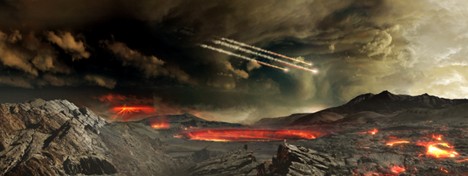
Asteroid impacts may have seeded Earth with phosphorus, later concentrated in soda lakes to fuel life’s first steps.
Credit: By NASA's Goddard Space Flight Center Conceptual Image Lab - Flickr, Public Domain, https://commons.wikimedia.org/w/index.php?curid=45854993
- There are few soda lakes around the world, but they all share some common features and characteristics.
- The name “soda” refers to the chemical sodium carbonate (Na2CO3) that creates a very alkaline or high pH water. The high alkalinity is due to the high concentration of carbonate in the lakes.
- Soda lakes are endorheic, or closed basins. Water flows in, but it has no outlet, so the only way water leaves is through evaporation.
- Calcium ions (Ca2+), carbonate ions (CO32-) and phosphate ions (PO43-) enter the lake as rocks dissolve through weathering. What happens next is a delicate balance, almost like a dance, between these partners.
- Calcium likes to “dance” with both carbonate and phosphate. But in soda lakes, there’s far more carbonate at the party than phosphate.
- In most lakes and oceans, calcium and carbonate quickly pair up and leave the floor together, forming insoluble calcium carbonate that sinks to
the bottom. This happens because calcium carbonate is much less soluble than calcium phosphate, so calcium is pulled away by carbonate first and leaves phosphate behind.
- That leaves phosphate without a partner. As more ions arrive, calcium keeps getting swept away by carbonate, leaving phosphate to remain free and floating in the water.
- The result is that soda lakes become rare places where dissolved phosphate can build up to exceptionally high levels.
Early Research
- In 2019 and 2020, researchers began looking at modern soda lakes as modern examples of what early Earth might have looked like.
- Laboratory experiments confirmed the dance. In waters with abundant carbonate, calcium pairs off with it first, leaving phosphate to linger at much higher levels than in ordinary lakes or oceans.
- Models confirmed that in closed-basin soda lakes, evaporation would further concentrate these dissolved ions.
- This was the first solid evidence that soda lakes could provide the high phosphate concentrations needed for key prebiotic reactions, like making nucleotides for RNA. In simpler terms, these lakes had enough free phosphorus to help build the first pieces of life’s genetic material.
- But there was a glitch in the model. In small soda lakes, these concentrations tended to be short-lived, spiking during evaporation or seasonal cycles before dropping again. If these lakes were the hot beds of life, the phosphate concentrations would need to be sustained for long periods.
- Field work in some small soda lakes located in British Columbia confirmed the model. The concentration of phosphate did rise and fall dramatically with the seasons.
New Modeling
- In 2025, another group of researchers attempted to tackle this problem with new modeling focused on large endorheic lakes.
- Their results showed that size matters. In larger lakes, phosphorus wasn’t just concentrated in short bursts. Instead, inflowing rivers and the slow weathering of rocks could replenish phosphorus steadily, even while biology or minerals removed some of it.
- The chemistry of carbonate still did its job of tying up calcium, so phosphate remained free in the water. But in big basins, the water volume and long residence time buffered the swings, allowing phosphate levels to stay high for thousands of years.
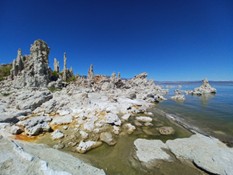
- Modern Mono Lake in California serves as a proof of concept. It maintains high phosphorus concentrations despite supporting a thriving ecosystem. Mono Lake is too salty and alkaline for fish, but it does contain:
- Brine shrimp (Artemia monica) – These are tiny crustaceans that thrive in the lake by the trillions, feeding on algae. They are a keystone species in the food web.
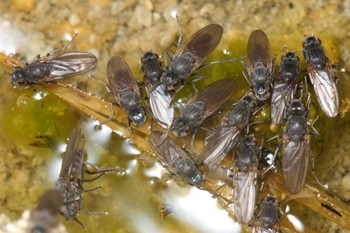
- Alkali flies (Ephydra hians) – These insects can dive under the lakes’ surface in air bubbles to graze on algae. Native peoples once collected the pupae as a protein-rich food.
- The presence of these organisms in the diverse ecosystem of Mono Lake shows that large soda lakes can both fuel life and keep phosphorus available.
- This research shifted the picture. Instead of short-lived “hot spots,” as proposed by Charles Darwin, Earth’s first chemical pantry may have been expansive, stable soda lakes, capable of storing phosphorus long enough for life’s first steps.
Credit: By Judy Gallagher - https://www.flickr.com/photos/52450054@N04/12355839284/, CC BY 2.0, https://commons.wikimedia.org/w/index.php?curid=55251606
Why It Matters
- Not every environment on early Earth could nurture life’s chemistry. Soda lakes highlight how the setting itself may have been as important as the ingredients.
- The research suggests that life may not have started in tiny puddles or vast oceans, but in rare, unusual lakes with just the right balance of conditions.
- By studying modern soda lakes, we glimpse the possible stages where life’s first reactions played out billions of years ago.
- If these lakes could stockpile phosphorus on Earth, similar alkaline lakes elsewhere in the solar system might also be places to look for life.
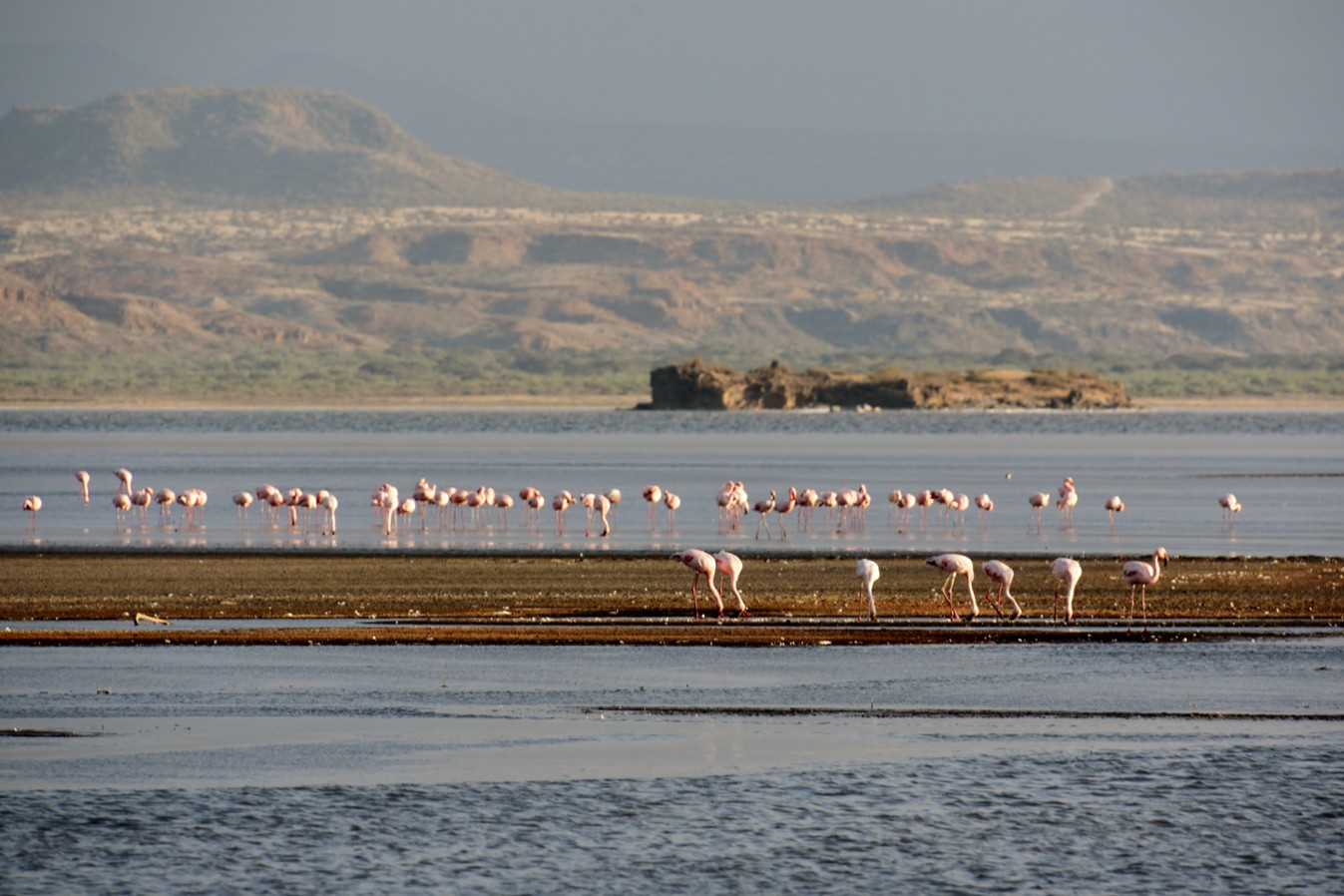
Flamingos wade in Lake Natron, a soda lake in northern Tanzania. Soda lakes like this one are found around the world today, and on early Earth there were likely many more, offering rich chemical settings where life could have begun.
Credit: By Richard Mortel from Riyadh, Saudi Arabia - Flamingos at Lake Natron (3), CC BY 2.0, https://commons.wikimedia.org/w/index.php?curid=69795887
Unanswered Questions
- While soda lakes help explain how phosphorus could have accumulated for life’s first reactions, many mysteries remain.
- Scientists are still asking how widespread these lakes were on early Earth and whether there were enough of them to play a global role.
- They also wonder if soda lakes supplied other crucial ingredients like carbon, nitrogen, and trace metal, in addition to phosphorus, or if those elements came from different environments.
- Another question is time. Were these lakes stable for thousands of years, or were they too often disrupted by climate swings, volcanic eruptions, or floods?
- And looking beyond Earth, researchers are now considering whether Marian lakes or icy moon basins could have created similar phosphorus-rich settings where life might emerge.
- Whether on Earth or beyond, soda lakes remind us that life’s beginnings may have depended not only on the right elements, but also on the rare places where they could come together and endure.
EarthNote: Newfound Life in an Ancient Lake
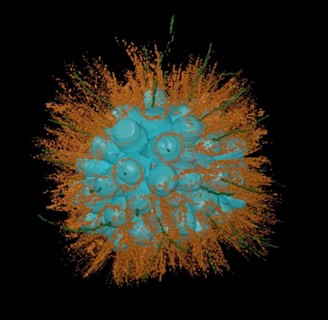
Mono Lake doesn’t just hold lessons about chemistry. In 2022, scientists discovered a new species of microorganism there, Barroeca monosierra. This tiny single-celled organism lives in large colonies, surrounded by bacteria in a kind of primitive community. It thrives in Mono Lake’s harsh waters, loaded with salt, carbonate, and other dissolved minerals.
Credit: By Guillermo Carvajal. Credit/Original photo by: Davis Laundon and Pawel Burkhardt, Sars Centre, Norway / Kent McDonald and Nicole King, UC Berkeley - https://commons.wikimedia.org/w/index.php?curid=153904774
Episode Script:
Charles Darwin proposed that life on Earth may have started in bodies of highly alkaline water called soda lakes. New research suggests he may have been right.
You might remember from a prior EarthDate that phosphorus is an essential building block for DNA, RNA, and the energy carrier for cells, ATP. Without phosphorus, there is no life.
Soda lakes are some of the few places on Earth where phosphorus is readily available, rather than bound up in rocks.
Nearly all these lakes around the world are closed basins. Water enters, but there is no outlet.
As rivers flow toward a soda lake, running water leaches minerals out of the rocks it passes over, notably calcium and phosphorus. These then concentrate in the lake.
Normally, phosphorus would bond with dissolved carbonate compounds in the lake water and sink out. But calcium bonds more readily with carbonate than phosphorus, leaving the phosphorus in a pure form. Evaporation further concentrates it.
In small soda lakes, the level of phosphorus rises and falls with the rains, and the amount of river inflow. But new studies on larger closed basins show that phosphorous concentrations can remain high year-round, indefinitely…