
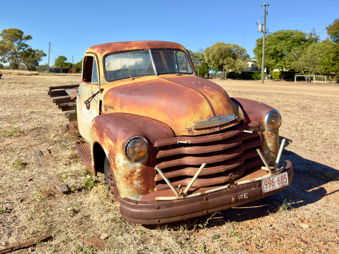
Credit: By Chris Olszewski - Own work, CC BY-SA 4.0, https://commons.wikimedia.org/w/index.php?curid=153940909
Background
Synopsis: Rust is a familiar sight on Earth, forming wherever iron meets oxygen and water. Scientists have now detected the same iron oxide on the Moon, a place long thought too dry and airless for such reactions. How this rust formed remains an open question.
Rust on Earth
- Rust on cars, corrosion on bridge supports, and decay of metal fencing are familiar sights. Each is visible evidence of the formation of iron oxide, commonly called rust.
- When metals containing iron are exposed to water, oxygen in the environment reacts with the iron, producing a red, flakey, and gritty substance that is often despised and costs billions of dollars to prevent or repair.
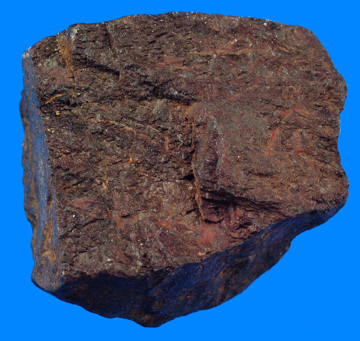
- While rust is familiar on manufactured materials, iron oxides also occur naturally in the form of iron-rich rocks such as hematite and magnetite.
- These rocks, known as iron ores, vary in color from red and brown to black and even silver, and much of this ore is used to make steel.
- Iron and iron ores make up approximately five percent of Earth’s crust.
- Natural iron ores form through many pathways, including sedimentary, volcanic, and metamorphic processes.
- In some cases, surface weathering produces iron oxides through reactions similar to the rust and corrosion seen on man-made materials.
- But strangely, rust has recently been found in a surprising location: the Moon. How could iron oxide form in a location without oxygen or liquid water?
Credit: By Darla Sondrol - https://geodil.dperkins.org/h/1309.html, CC0, https://commons.wikimedia.org/w/index.php?curid=163482829
Luna Elements
- Unlike Earth, the moon does not have an atmosphere with air to breathe.
- Instead, it has an extremely thin exosphere made up of gases such as helium, neon, and argon, along with tiny amounts of hydrogen.
- Cold nighttime temperatures cause particles in the exosphere to settle toward the surface. When sunlight returns, interactions with solar radiation and the solar wind, which is an invisible stream of charged particles from the Sun, cause these particles to rise again.
- The presence of solar wind also makes the discovery of rust even more unexpected.
- Solar wind supplies a constant stream of hydrogen to the Moon’s surface. Hydrogen acts as a reducing agent, meaning it donates electrons to other elements or compounds.
- Oxidation, by contrast, causes substances such as iron to lose electrons. The abundance of hydrogen should therefore make oxidation difficult rather than promote it.
- The lack of a substantial atmosphere and the steady supply of hydrogen from the solar wind should make rust formation on the Moon’s surface unlikely. And yet, evidence suggests that rust is present anyway.
Finding Hematite on the Moon
- Chemically, hematite is iron (III) oxide or Fe2O3, and forms when iron is exposed to oxygen, forming this stable compound. This is the same chemical formula as common rust.
- In 2008, India’s Chandrayaan-1 probe used a NASA Moon Mineralogical Mapper, M3 for short, to explore the minerals present on the lunar surface.
- Just as a barcode scanner can identify a product by its pattern of black and white lines, scientists can identify minerals by the pattern of light they absorb.
- When sunlight reflects off the Moon, hematite removes a very specific color of near-infrared light, leaving behind a telling gap that stands out from the Moon’s otherwise gray, rocky surface.
- This was the first evidence that hematite was present.
- Evidence for rust on the Moon has not come from orbit alone. In 2025, lunar samples returned to Earth by China’s Chang’e-6 mission provided direct physical confirmation that highly oxidized iron minerals exist on the Moon’s surface.
- A previous EarthDate, Chinese Moon Missions, followed the progress of the Chang’e missions which have expanded access to regions of the Moon that had never been sampled before.
- Chang’e-6 collected material from the South Pole – Aitken Basin, one of the largest and oldest impact basins in the solar system. This region has experienced repeated high-energy impacts over billions of years, making it an ideal place to study how extreme events alter lunar materials.
- Within these returned samples, researchers identified microscopic grains of hematite along with other oxidized iron compounds.
- Detailed laboratory analysis confirmed that these minerals formed on the Moon itself and were not introduced after the samples arrived on Earth.
- Their presence supports earlier orbital detections and shows that oxidation can occur on the lunar surface, even in an environment long thought to be chemically inactive.
Ancient Impacts and Lunar Rust
- The hematite found in samples from the South Pole – Aitken Basin may not have formed under the same conditions that operate on the Moon today.
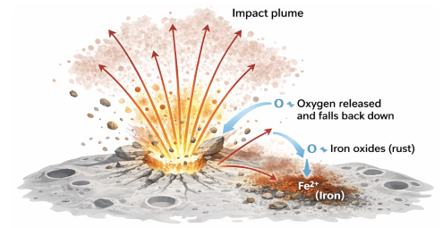
- The South Pole – Aitken Basin is the result of enormous impacts early in the Moon’s history, when collisions released vast amounts of energy.
- These impacts would have briefly vaporized surface materials, creating hot clouds of gas rich in oxygen.
- In these short-lived environments, iron released from lunar minerals could react with oxygen before cooling and condensing back onto the surface.
- This process could produce microscopic grains of hematite along with other iron oxides, which were later buried and preserved in the lunar soil.
- These findings suggest that some rust on the Moon may record violent events from billions of years ago, rather than ongoing surface processes alone.
- While ancient impacts may explain how some hematite formed early in lunar history, they do not explain why signs of oxidation are still detected across the Moon today.
Credit: Illustration by ChatGPT (AI-generated), based on scientific concepts reported by researchers at the Institute of Geochemistry, Chinese Academy of Sciences.
Earth's Magnetosphere
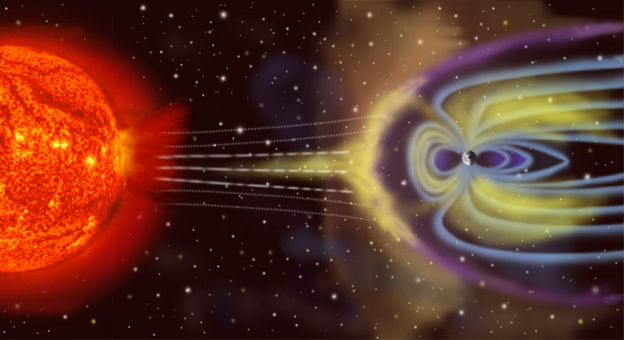
- Earth is surrounded by an invisible magnetic field called the magnetosphere. (Life on a Giant Magnet). This magnetic shield deflects most of the charged particles streaming outward from the Sun, collectively known as the solar wind.
- Without this protection, those high energy particles would directly strike Earth’s atmosphere and surface.
- Earth’s magnetic field behaves much like a giant bar magnet, with invisible field lines extending far into space.
- As the solar wind approaches Earth, these field lines push most of the charged particles aside, forcing them to flow around the planet rather than collide with it head-on.
- This interaction shapes a long, stretched region of Earth’s magnetosphere that trails behind the planet as it moves through space, known as the magnetotail.
Credit: By NASA - https://www.esa.int/ESA_Multimedia/Images/2007/10/The_Sun-Earth_connection, Public Domain, https://commons.wikimedia.org/w/index.php?curid=192450
Earth's Ionosphere
- Earth’s atmosphere is composed of layers with varying concentrations of gases and temperatures.
- Within the mesosphere and thermosphere, sunlight can remove electrons from some atoms, creating electrically charged particles.
- As a result of their charged nature, these particles are affected by electric and magnetic forces.
- The most abundant ions in the ionosphere include O+, O2+, and NO+.
The Earth - Moon Connection
- Earth’s magnetotail stretches into a teardrop shape on the night side of Earth, extending away from the sun.
- The exact shape and size of this tail is affected by the strength of the solar winds but estimates predict that the tail typically extends to at least two million kilometers (3,219,000 miles) into space, always remaining on the night side of Earth.
- The magnetotail is not empty but contains the charged particles that have escaped from Earth’s upper atmosphere.
- For most of the month, both Earth and the Moon are exposed to the solar wind, which delivers a steady stream of hydrogen that tends to counteract oxidation.
- But during the full Moon, Earth moves directly between the Sun and the Moon.
- As the Moon passes through Earth’s shadow, much of the solar wind is blocked.
- At the same time, the Moon travels through the magnetotail, where it is exposed to particles that once belonged to Earth’s atmosphere.
- For several days each month, the Moon is struck by oxygen-rich ions from Earth while receiving far less hydrogen from the Sun.
The Perfect Mix
- This brief but repeated imbalance creates unusual chemical conditions on the lunar surface.
- Oxygen ions can embed themselves in the upper layers of lunar soil and react with iron-rich minerals.
- Laboratory experiments simulating these conditions show that high-energy oxygen ions can transform lunar minerals into hematite, while renewed exposure to hydrogen can reverse the process.
- Together, these findings suggest that the Moon undergoes subtle but ongoing chemical changes as it moves through Earth’s magnetotail, recording an exchange between the two worlds.
Clues, Not Conclusions
- The discovery of hematite on the Moon shows that oxidation can occur even in an airless world. Evidence from orbit, returned samples, and laboratory experiments suggests that rust on the Moon may form through more than one pathway, from ancient impact events to ongoing interactions with Earth’s magnetotail.
- What scientists do not yet know is how common each process is, how quickly these reactions occur, or how long their chemical signatures last. As new samples are returned and new missions explore the unexplored regions of the Moon, these questions remain open.
- So, when we see rust on cars, bridges, and fences, we are seeing a reminder that even the most familiar processes can behave in unexpected ways beyond our planet.
Episode Script
Rust is common on Earth. It shouldn’t exist on the moon. But somehow, it does.
Rust is just the common name for iron oxide. Iron that has bonded to oxygen.
The moon, however, has no oxygen. Yet lunar rovers have recovered grains of iron oxide in lunar soil. How could they have gotten there?
One possibility is from Earth. Or rather, from our atmosphere.
The magnetic field of our planet, called its magnetosphere, surrounds Earth like an invisible force field.
The sun produces a solar wind of charged particles that flows outward into the solar system.
When it encounters our magnetosphere, it deflects around Earth. The charged particles flow around us and deep into space, in a so-called magnetotail that stretches three million miles behind Earth.
As the charged particles pass, they strip off some oxygen ions from the upper reaches of our atmosphere, and carry them into the long magnetotail.
Each month during the full moon, Earth is between the moon and the Sun, which may shelter the moon from solar wind, and bathe it in oxygen from Earth’s magnetotail.
Scientists believe that when these oxygen ions strike the moon’s surface, they bond with iron in the lunar soil to form, yes, tiny particles of rust.
This is still a hypothesis. But it’s important because it highlights how little we know about our closest celestial neighbor… where humans might soon spend a bit more time.