
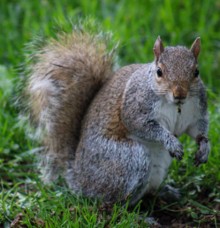
Credit: By Boaventuravinicius - Own work, CC BY 4.0, https://commons.wikimedia.org/w/index.php?curid=166372591
Background
Synopsis: Squirrels rely on remarkable spatial memory to recover thousands of hidden food caches, but scientists are still working out how their brains support this seasonal challenge. In other mammals, like shrews, brains physically shrink and regrow as conditions change. Together, these animals show that survival depends not just on behavior, but on brains that can adapt to changing seasons.
Stocking the Cupboards
- Squirrels are renowned for gathering nuts and burying them to eat later. This behavior has been documented for hundreds of years.
- More than 200 species of ground squirrels, tree squirrels, and flying squirrels rely on nuts, seeds, and fruits as a major food source.
- During the growing season, they “squirrel away” food, either storing it in one central location or scattering it across many sites.
- These hidden food stores are called caches, and the strategies are known as larder caching (one place) or scatter caching (many places).
- A single squirrel may bury as many as 3,000 nuts in a season, spread across dozens of locations.
- But once the landscape changes as leaves fall and snow covers the ground, how do they find them again?
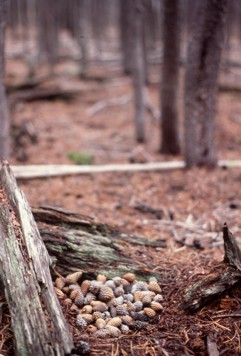
Credit: nps.gov; squirrel image
Spatial Memories
- Where and how squirrels store food often depends on habitat, predators, and food availability
- Scatter caching, while riskier, spreads out resources and reduces the chance of losing everything at once.
- Recovering those buried nuts is not random but relies heavily on memory.
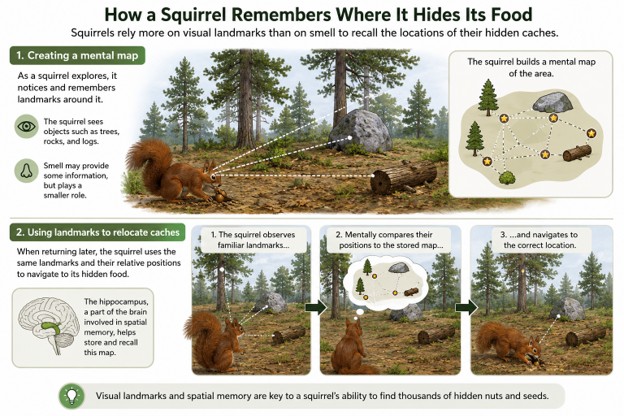
- While smell can help, studies suggest squirrels depend more on visual and spatial cues.
- Landmarks such trees, rocks, and even the spacing between objects help guide them back to the cache.
- Squirrels may revisit a site and rebury nuts, reinforcing memory of the location.
- They even engage in deceptive behaviors, such as fake digging, to mislead competitors.
- Observations show squirrels can move efficiently between cache sites without retracing their steps, suggesting they form a cognitive map of their environment
Inside the Squirrel Brain
- This spatial ability is linked to the hippocampus, a region involved in memory and navigation.
- Compared to some other rodents, squirrels have a relatively large hippocampus.
- Studies have also found:
- High levels of neuron growth (neurogenesis).
- Less age-related decline in these neurons compared to species like chipmunks.
- These traits likely support the intense memory demands of locating scattered food caches.
Do Squirrels Get “Smarter” in the Fall?
- Some scientists have proposed that squirrel brains change with the seasons, especially during peak caching periods in autumn.
- However, research findings are mixed:
- Some studies found no clear seasonal increase in brain size
- Others suggest an increase in neuron turnover or activity, rather than overall growth
- This means the brain may not be getting bigger, but it may be functioning differently, with changes in connections and activity that support memory.
- Scientists are still working out exactly how squirrel brains respond to seasonal demands.
- To better understand what seasonal brain change might look like, scientists have turned to other mammals where the evidence is clearer.
A Broader Pattern: Brains That Change with the Seasons
- Seasonal adaptations are a familiar theme in many EarthDate episodes, including Why Fish Don’t Freeze, Frogsicles, and Not a Creature Was Stirring. But in some mammals, the adaptation goes even further, affecting the brain itself.
- While evidence for seasonal brain changes in squirrels remains uncertain, other mammals, including shrews, European moles, and weasels, show clear and measurable changes in brain size.
- This difference is tied to energy. These animals have extremely high metabolic rates and must eat frequently to survive. Unlike many species, they cannot hibernate during the winter
- As food becomes scarce, they reduce energy demands by shrinking both their bodies and their brains in a process known as Dehnel’s phenomenon, first described in 1949.
- Recent research from the Max Planck Institute of Animal Behavior has revealed how this happens. Using MRI scans, scientists observed that shrew brains shrink by around 10% or more between summer and winter.
- Rather than losing large numbers of brain cells, the shrinkage is driven in part by reversible water loss within cells, allowing brain tissue to contract without permanent damage.
- In most animals, this kind of shrinkage would be harmful. But in shrews, the cells remain viable, and the brain reorganizes itself.
- By spring, both the body and brain size increase again, restoring much of what was lost during winter.
- While scientists are still working out exactly how squirrel brains respond to seasonal demands, shrews show that mammal brains can undergo dramatic, reversible physical changes in response to the environment.
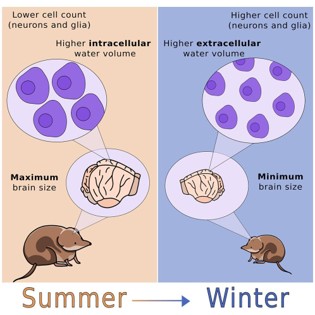
Credit: Figure reproduced from Baldoni et al., Current Biology (2025). Used with permission.
A Broader Impact of the Research: Human Brain Function
- These findings don’t just change how we understand animals but may also reshape how we think about the human brain.
- That a mammal as small as a shrew can lose a significant portion of its brain volume and recover is remarkable.
- Researchers are still investigating the mechanisms behind this process, but evidence points to changes in genes and proteins involved in regulating water balance within cells.
- Some of these same biological pathways are also active in human brains, particularly in certain neurological diseases.
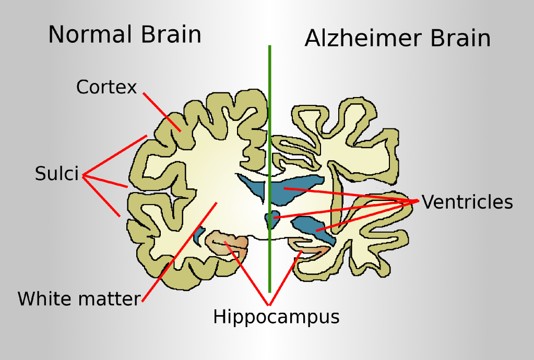
- In humans, brain shrinkage, seen in conditions such as Alzheimer’s disease, Parkinson’s disease, and Amyotrophic Lateral Sclerosis (ALS), is associated with cell damage and loss of function.
- Unlike shrews, this loss is not reversible.
- Understanding how shrews protect and restore their brain tissue could one day offer insights into treating or even reversing damage in the human brain.
Credit: By Garrondo - Own work, Public Domain, https://commons.wikimedia.org/w/index.php?curid=4387759
The Biology of Survival
- As seasons shift and resources grow scarce, animals must adapt in ways we’re only beginning to understand.
- From squirrels mapping hidden food to shrews reshaping their brains, survival isn’t just about behavior. It is built into the biology of the brain itself.
Episode Script
Have you ever wondered how squirrels find the nuts they hid months before?
A typical squirrel can store 3,000 of them in a fall season, in dozens of locations. It seems almost impossible that they could remember them. But they do.
There are 200 species of ground squirrel, tree squirrel and flying squirrel that rely on stored seeds and nuts.
To do that, they need to return to them even after leaves fall and snow covers the ground. How do they do it?
Smell plays a role. But sight and memory are more important.
Squirrels build a mental map of their surroundings: a tree trunk, a large rock, a fallen log, a fence post.
Then they remember the changing spatial relationships between those landmarks when viewed from their different food hiding places.
Some scientists have wondered if a squirrel’s brain grows to meet the season’s mental demands.
Because there are other rodents -- shrews, European moles and weasels – whose brains contract 10% in winter when food is scarce, then expand again in spring, with no impact on function.
But most research suggests a squirrel’s heightened spatial memory is linked to its larger than normal hippocampus, a part of the brain involved in learning and navigation.
They’ve also shown more neuron growth, and less age-related mental decline.
To fuel this acuity, squirrels require a lot of calories – which ironically means they must hide more nuts to help them find the others!