
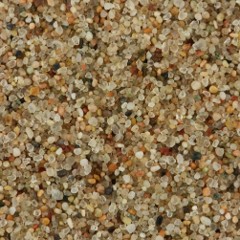
Credit: By Siim Sepp - Own work, CC BY-SA 3.0, https://commons.wikimedia.org/w/index.php?curid=17276362
Background
Synopsis: Sand covers beaches, deserts, and riverbeds across the planet, but most of it is unsuitable for modern uses. Only certain sands have the right properties for construction, glassmaking, and energy production. Those grains are the result of long geologic processes that concentrate the “right” kind of sand.
Lots of Sand, but....
- At the ocean on a sunny, summer day, sand is everywhere. There is enough to build a tall sandcastle, dig a moat, and still have grains blown into your lunch by the wind.
- The Sahara Desert holds an ocean of sand that stretches across nearly a fourth of the African continent.
- Rivers and creeks carry sand downstream, where it settles along banks and bars, shaping channels and providing habitat for many organisms.
- With so much sand across beaches, deserts, and riverbeds, it might seem like there could never be a shortage.
- But sand is not just sand. Each grain carries a history of where it formed, how it was transported, and what minerals it contains.
- The shape, strength, and composition of those grains determines whether the sand is useful for building roads, making glass, or producing energy.
- Desert sands are often too smooth and rounded to bind well in concrete.
- Many beach and river sands contain mixtures of minerals that are unsuitable for making high-quality glass.
- Only a small fraction of Earth’s sand, made mostly of durable quartz grains with the right size and shape, can be used for construction materials or specialized industrial uses.
- So even on a planet covered with sand, the sand needed to build modern infrastructure is far less common than it appears.
What Makes the Right Sand?
The “right” sand depends on the requirements of specific application. Important factors include composition, grain shape, grain size, impurities, and strength.
- Composition:
- As described in a previous EarthDate, Cities Made of Sand, high-silica quartz is especially valuable because quartz is hard, chemically stable, and resistant to weathering.
- Some of the purest silica sands, used to manufacture computer chips and microprocessors, must contain more than 99% silicon dioxide (SiO2).
- Clay minerals, often mixed with sand deposits, retain moisture and can weaken concrete, causing it to shrink and crack as it dries.
- Feldspar, a common aluminum-silicate mineral found in many sands, can influence glass production. Small amounts can help lower melting temperatures and control viscosity of the glass, but too much can introduce unwanted color or reduce clarity needed for certain types of glass.
- Grain Shape:
- Grain shape plays an important role in how sand behaves in different materials.
- Angular grains interlock with one another, helping concrete form a strong, rigid structure.
- Desert sands, which have been blown and weathered by wind for long periods, often become smooth and rounded. These grains slide past each other easily and do not bind well in concrete.
- In contrast, the slightly rounded but strong grains, used as hydraulic fracture sand, help prop open tiny fractures in deep shale layers, allowing oil or gas molecules to flow around them.
- Grain Size and Sorting:
- Some applications require sand grains that can withstand enormous pressure.
- Frac sand, for example, must resist crushing under the weight of deep rock layers thousands of feet underground.
- For some uses, properties of high quartz purity, the right grain shape, a narrow size range, and strong grains must all occur together. As a result, only certain geologic environments produce the sand needed for modern industry.
- Many of the world’s beaches and deserts contain vast quantities of sand, but very little of it meets these strict requirements.
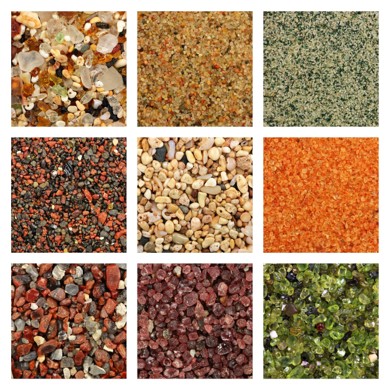
1. Glass sand from Kauai, Hawaii
2. Dune sand from the Gobi Desert
3. Quartz sand with green glauconite from Estonia
4. Volcanic sand with reddish weathered basalt from Maui, Hawaii
5. Biogenic coral sand from Molokai, Hawaii
6. Coral pink sand dunes from Utah
7. Volcanic glass sand from California
8. Garnet sand from Emerald Creek, Idaho
9. Olivine sand from Papakolea, Hawaii.
Credit: By Siim Sepp (Sandatlas) - Own work, CC BY-SA 3.0, https://commons.wikimedia.org/w/index.php?curid=22300680.
Where Does the Right Sand Form?
- The sand suitable for modern industry does not form everywhere. It develops only where geologic processes have weathered, transported, and sorted minerals in ways that concentrate durable quartz grains.
- Ancient Sandstones
- Some of the best sources of industrial sand come from ancient sandstone deposits that formed hundreds of millions of years ago. Over long periods of weathering and transport, weaker minerals break down while durable quartz grains survive and accumulate.
- These sands may later become buried and cemented into sandstone, then uplifted and mined millions of years later.
- Some of the most important industrial sand deposits in North America come from the Cambrian and Ordovician sandstones in the Upper Midwest, including Wisconsin and Minnesota.
- River and Stream Systems
- Flowing water acts like a natural sorting machine.
- Rivers carry sediment downstream, gradually separating grains by size, density, and durability.
- Softer minerals break apart while stronger quartz grains survive repeated collisions and transport.
- Over time, grains become rounded and river systems can concentrate well-sorted quartz sand in bars, floodplains, and delta deposits.
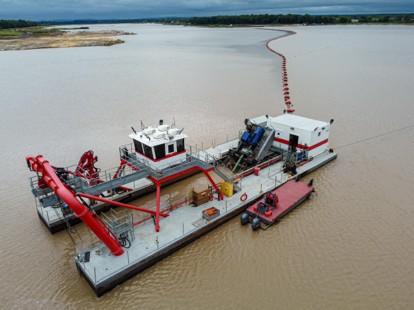
Credit: By Wikideas1 - Own work, CC0, https://commons.wikimedia.org/w/index.php?curid=151599396.
- Glacial Deposits
- Glaciers also help create high-quality sand deposits.
- As glaciers move across bedrock, they crush rock into fragments that are later sorted by meltwater streams.
- These meltwater rivers often deposit thick layers of well-sorted sand and gravel known as outwash deposits.
- Some of these deposits contain the strong, uniform quartz grains needed for industrial sand.
- Coastal Environments
- Waves and tides along coastlines continually rework sand, washing away finer sediments and concentrating durable grains.
- Over time, this repeated sorting can produce beaches rich in quartz sand.
- However, many beach sands contain mixtures of minerals, shells, or salts that limit their usefulness for industrial applications.
- Because these specialized geologic conditions occur only in certain places, the sand needed for industry is far less common than the sand covering beaches and deserts around the world.
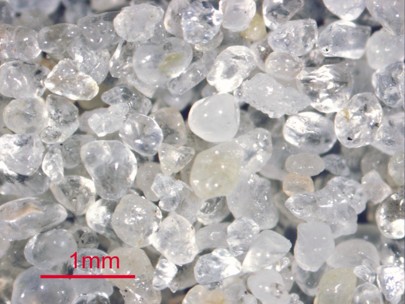
Credit: By James St. John - https://www.flickr.com/photos/47445767@N05/50054636463/, CC BY 2.0, https://commons.wikimedia.org/w/index.php?curid=95005657.
Sands One-Way Voyage
- Demand for the right kind of sand has increased dramatically as cities expand and new technologies develop.
- In just the past two decades, China has used more sand to build cities and infrastructure than most countries used in the entire twentieth century.
- Much of the sand used in modern industry becomes locked into materials or environments where it can no longer move through natural sediment cycles.
- Sand grains mixed into concrete become part of roads, bridges, buildings, and dams that may stand for decades or centuries.
- Other sand becomes part of glass used in windows, bottles, and fiber-optic cables that carry information around the world.
- Some sand is injected deep underground during hydraulic fracturing, where the grains remain trapped in rock layers thousands of feet beneath the surface.
- In each of these cases, sand leaves the natural system of weathering, erosion, and transport that once moved those grains across landscapes and into rivers and oceans.
- Yet the natural processes that create and concentrate these grains operate slowly. Weathering breaks down rock, rivers carry sediment, and waves and currents sort the grains over thousands to millions of years.
- So even on a planet covered with sand, only certain grains have the right properties to build the materials to shape our modern world.
Episode Script
Sand is incredibly common. There are oceans of it – in oceans, and deserts too. But, for our purposes, that’s not the right kind of sand.
We use sand in concrete, to make bridges and roads, buildings, houses and power plants. We use it in glassmaking, for windows, computer chips, solar panels and much more. We use it for hydraulic fracturing, to prop open cracks in shale deposits so oil and gas can flow.
In all, we use billions of tons of sand every year. But only a certain kind will do.
Beach sand is often mixed with salt. If used in concrete, it can corrode the reinforcing steel. And the grains of beach sand, and especially desert sand, are often rounded by waves or wind. Concrete needs angular grains that lock together. Hydraulic fracturing needs hard grains that can withstand pressure. And glassmaking needs almost pure quartz.
That means, for most uses, the ideal sand is angular, well-sorted quartz. And that’s only found in a few places.
Rivers and streams are natural sorting machines. They break down and wash out weaker minerals, leaving quartz sand in bars and banks, which can be dredged or mined. Through time, many of these quartz sand deposits were lithified into sandstone, which today can be ground back into sand.
Our demand is so great that this once common material is becoming scarce, spawning a lucrative international trade -- for the right kind of sand.