
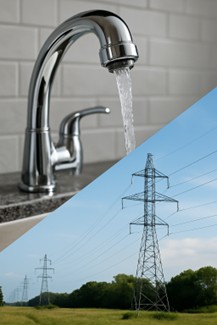
Credit: Image created by L. Kistler using OpenAI’s DALL·E, based on original concept and direction.
Background
Synopsis: Freshwater and energy are two of our most essential resources and they depend on one another at every step. As demand rises, innovations in recycling, smarter utilities, and low-water energy sources help protect both systems.
Earth’s Water Mix
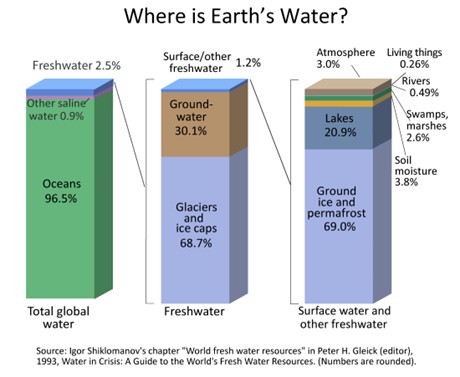
- Earth is often called the “blue planet,” yet most of that blue comes from saltwater that we can’t drink or use to grow crops. Oceans cover more than 70% of the surface and hold nearly 97.5% of all water on Earth.
- That leaves only 2.5% as freshwater, and most of that is locked away or buried deep underground. About two-thirds of Earth’s freshwater is frozen in glaciers and ice caps. Another 30% lies hidden underground in aquifers that can take thousands of years to refill.
- So where does that leave the water we can actually reach? Less than 1.2% of all freshwater sits on the surface. Even there, most of it is either frozen in permafrost or trapped in soil.
- Lakes hold about one-fifth of it and the air carries a few drops as vapor and clouds. All the world’s rivers together make up less than 0.05%!
- Every plant, animal, and human contain water, but the total is just a quarter of one percent of surface freshwater, a microscopic fraction of Earth’s total supply.
- It’s a humbling reminder that our “blue planet” looks full, but only a tiny trickle of that water is truly available to sustain life.
Credit: https://www.usgs.gov/water-science-school/science/where-earths-water
Freshwater Demands
- For all its scarcity, freshwater sustains nearly everything we do. Each person on Earth relies on it daily for drinking, cleaning, growing food, producing goods, and generating power. But our uses are not evenly spread across the globe.
- Worldwide, about 70% of freshwater goes into agriculture to irrigate fields of grain, fruit, and vegetables, and to water livestock.
- In hot, dry regions like the American West, the Middle East, and northern Africa, that percentage can climb even higher, as rainfall alone can’t support farming.
- Industry uses roughly 20%, devouring water for cleaning, dissolving, and manufacturing everything from paper to steel to semiconductors.
- In wetter regions, such as northern Europe or the eastern United States, industrial demand can exceed agricultural use.
- The remaining 10% supports homes and communities for drinking, cooking, and sanitation.
- In developing countries, rapidly expanding cities are pushing water systems to their limits and draining aquifers faster than nature can fill them.
- Freshwater shapes economies, diets, and infrastructure. It even influences where civilizations rise and thrive. But getting water where we need it, in a form we can use, comes at a cost. That cost is energy.
- Worldwide, about 70% of freshwater goes into agriculture to irrigate fields of grain, fruit, and vegetables, and to water livestock.
Clean Water Requires Energy
- Before water ever reaches a faucet, it has already used a surprising amount of energy.
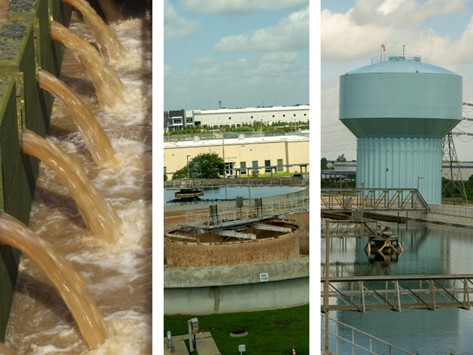
- Water may be stored in reservoirs or deep underground aquifers and must be transported across long distances or pumped to the surface. In regions with large elevation changes, the task becomes especially energy intensive.
- For example, some water delivered to southern California must be pumped 2,882 feet (878 m) over the Tehachapi Mountains.
- Once collected, water must be treated and purified through filtration, chemical disinfection, or biological processes.
- In coastal cities or arid regions, seawater is converted to freshwater through desalination, a process that can require 10-20 times more energy than traditional treatment.
- Pressurized pipes then move water through distribution systems to homes and businesses.
- After use, it travels to wastewater treatment plants, where it is filtered and disinfected again before returning to the environment.
- Taken together, these steps make water systems one of the largest energy consumers in many communities, responsible for 30-40 percent of local government energy use.
- Heating water in homes and businesses adds even more energy demand.
- Water requires energy at every stage, and energy depends on water in return, binding the two in a cycle that runs through nearly every part of modern life.
- Water may be stored in reservoirs or deep underground aquifers and must be transported across long distances or pumped to the surface. In regions with large elevation changes, the task becomes especially energy intensive.
Credit: Grey Johnson, Switch Energy Alliance, 2025, with permission
Energy Requires Clean Water
- Just as we use energy to move and treat water, we also use water to make energy. Many of the systems that power our modern world rely on steady and reliable water supplies to operate.
- In exploring the connection, it is important to distinguish water withdrawal versus water consumption.
- When water is withdrawn, it is taken from a river, lake, or aquifer and later returned, often slightly warmer after treatment.
- When water is consumed, it is lost to evaporation or injected deep underground and does not immediately re-enter the environment it came from.
- Energy systems do both, consume and withdraw, but at very different scales depending on the technology.
- Thermoelectric power plants, including coal, natural gas, and nuclear facilities, use water to create steam that turns turbines and to cool equipment once electricity is generated.
- These plants withdraw large volumes of water from rivers, lakes, or oceans and then return most of it to the source.
- Some of the water is lost through consumption, mainly by evaporation as warm water cools inside towers or open channels.
- Depending on the technology and cooling method, producing a single kilowatt-hour (a 100 watt light bulb running for 10 hours) of electricity can require several liters of water.
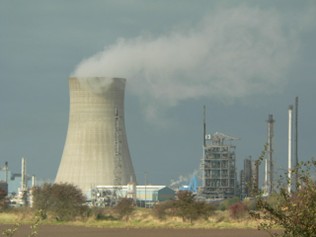
Cooling towers are often associated with nuclear plants, but this familiar design is also used at natural gas and other thermoelectric power stations. This tower serves the Saltend Power Station in East Yorkshire, a combined-cycle natural gas plant that supplies electricity and steam for nearby industries.
Credit: By Gaz Watts, CC BY-SA 2.0, https://commons.wikimedia.org/w/index.php?curid=12414376
- Hydropower relies entirely on water as it captures the energy of flowing rivers. It does not withdraw water to use it elsewhere, but reservoirs can lose significant amounts to evaporation, especially in hot and dry regions. This makes hydropower both reliable and sensitive to drought and seasonal flows.
- Biofuels place another kind of demand on water. Growing crops such as corn or sugarcane for fuel requires extensive irrigation in many regions, making biofuels some of the most water-intensive energy sources on Earth.
- Water also plays a role in extracting and processing fossil fuels.
- Drilling, hydraulic fracturing, and refining oil and natural gas all require water.
- Mining coal or metals for power systems relies on groundwater pumping and dust control.
- Geothermal energy uses water from deep underground to produce steam, which is often cooled and returned to the reservoir in a mostly closed loop.
- Water cools equipment, transfers heat, and supports fuel production across many energy systems. Some of it returns to rivers or aquifers, and some is lost. This makes it clear that energy production requires substantial water, just as water delivery depends on energy.
- In exploring the connection, it is important to distinguish water withdrawal versus water consumption.
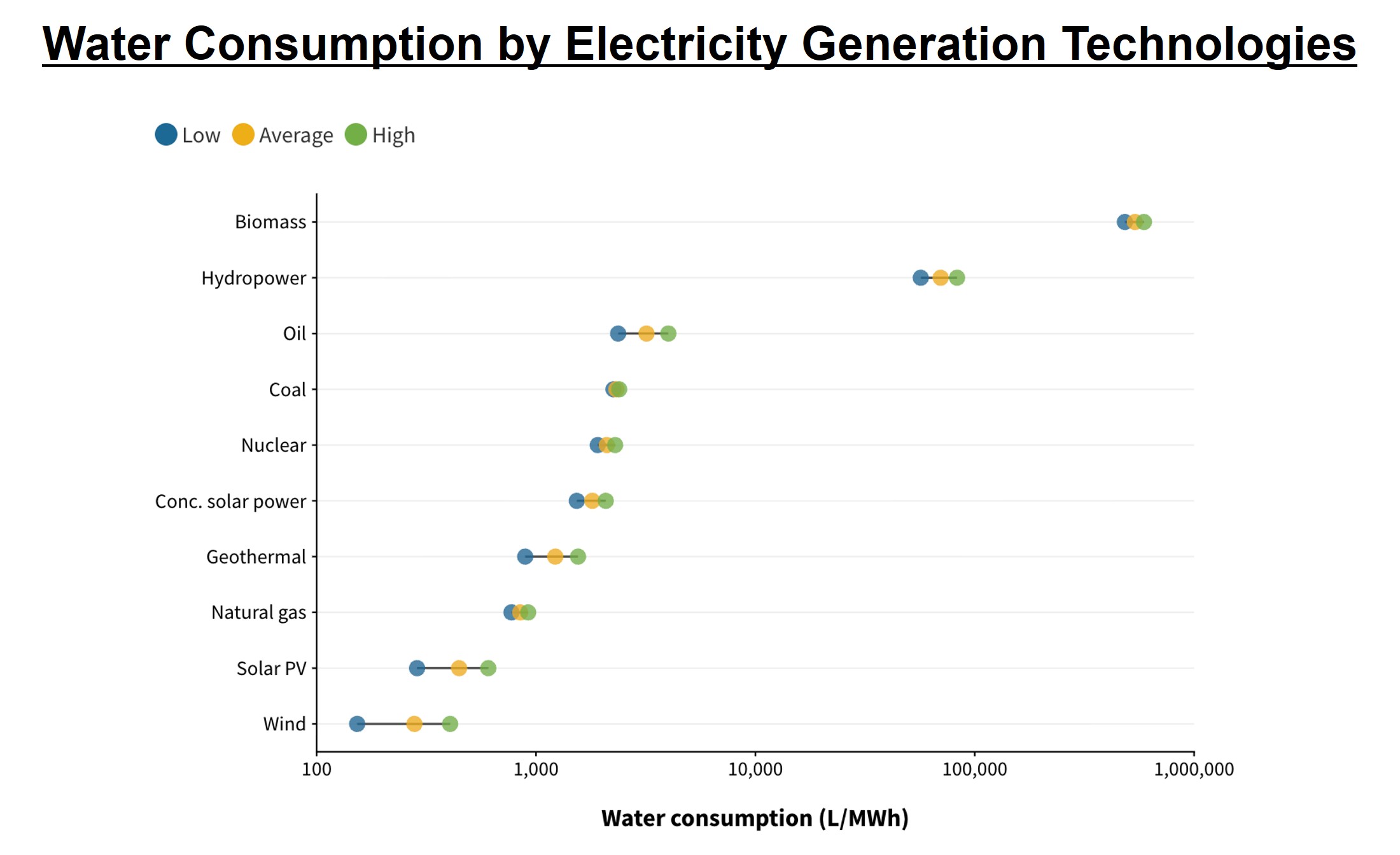
Credit: Source: Lin et al. (2019); Boston University for Global Sustainability | visualizingenergy.org | CC BY 4.0
Water and Energy Worries
- Because energy systems need water and water systems need energy, problems in one often create challenges in the other. This interdependence can make both resources vulnerable during periods of stress.
- Extended drought reduces river flows and reservoir storage, which can limit hydropower output and restrict cooling water supplies for thermoelectric power plants.
- In very dry conditions, some facilities must reduce generation or shut down temporarily to avoid overheating equipment or harming aquatic ecosystems.
- At the same time, drought increases demand for electricity to pump groundwater and move water across long distances, further straining energy systems.
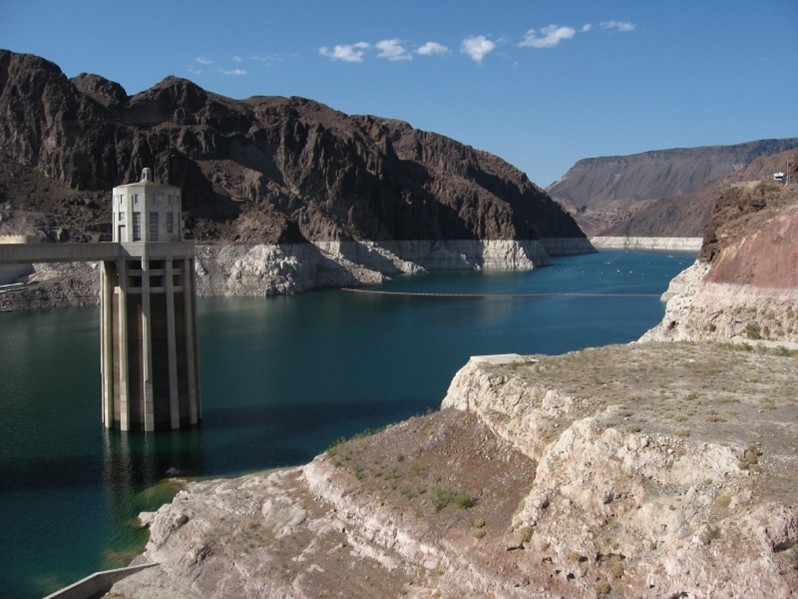
The white “bathtub ring” around Lake Mead marks how far water levels have dropped during prolonged drought in the Colorado River Basin. Lower lake levels reduce the water pressure needed to drive turbines at Hoover Dam, decreasing electricity generation and showing how water shortages can affect power supplies.
Credit: By Ken Lund, CC BY-SA 2.0, https://commons.wikimedia.org/w/index.php?curid=70178456
- Heat waves create similar pressures. Higher air and water temperatures reduce the efficiency of power plant cooling systems, while electricity demand rises for air conditioning.
- Warm water discharged from cooling systems may exceed environmental temperature limits, requiring power plants to scale back operations.
- Another emerging factor is the rapid growth of data centers, which support cloud computing and artificial intelligence.
- These facilities consume large amounts of electricity and often require water for cooling, adding demand in regions where water resources are already stretched.
- As digital storage and computing needs expand, communities and utilities are increasingly weighing the tradeoffs among water availability, energy capacity, and economic development.
- Extreme weather events can also disrupt water and energy systems.
- Floods, hurricanes, and severe storms can damage transmission lines, substations, pipelines, and water treatment plants.
- If power is lost, pumps, treatment facilities, and distribution systems can shut down, affecting both drinking water supply and wastewater treatment.
- Infrastructure age adds another layer of vulnerability. Many regions rely on water delivery and power systems built decades ago, and upgrades are costly.
- Regions that depend on a single water source or a single type of power plant face greater risk than those with diversified supplies and modernized infrastructure.
- Together, these factors show that secure water supply and reliable energy production go hand in hand. Stress in one system quickly affects the other, especially in areas dealing with population growth, shifting climate patterns, or aging facilities.
- Extended drought reduces river flows and reservoir storage, which can limit hydropower output and restrict cooling water supplies for thermoelectric power plants.
Managing Water and Energy
- Recognizing how tightly water and energy are linked is the first step. The next is finding practical ways to use both more wisely.
- Recycling water can significantly reduce energy use.
- Moving and treating freshwater often requires large amounts of electricity, especially when water must be pumped from deep aquifers or transported long distances.
- Reusing water on site, or close to where it is needed, cuts the energy required for pumping and distribution.
- For example, recycled water used for irrigation or toilet flushing does not need to be treated to drinking-water standards, saving both energy and cost.
- While treating wastewater for reuse does require power, it generally uses less energy than extracting, transporting, and treating new supplies, making water recycling an effective strategy for conserving both water and energy.

This rooftop wetland garden at San Francisco’s Transbay Transit Center treats greywater for reuse in toilets, reducing the need to pump and purify new water. By recycling water on-site, the building lowers both water demand and the energy required to deliver it. It offers a real-world example of how smart design supports the water-energy connection.
Credit: By Pi.1415926535 - Own work, CC BY-SA 3.0, https://commons.wikimedia.org/w/index.php?curid=73500490
- Utilities and municipalities can invest in infrastructure upgrades aimed to prevent water leaks and to better manage energy at water treatment plants.
- Water utilities are increasingly adopting digital tools and smart infrastructure to improve efficiency and reliability.
- Today’s systems use technologies such as smart sensors, artificial intelligence, and automated pumping controls to monitor conditions in real time, predict problems before they occur, and optimize water movement and treatment.
- These innovations reduce energy use, extend equipment life, limit service disruptions, and help utilities manage water more sustainably. By shifting from manual processes to data-driven operations, the water sector is becoming more resilient and better prepared for changing demands.
Electricity Production and Water
- As utilities modernize to conserve water and energy, power plants are also evolving, especially in how they cool equipment and manage water needs.
- Older once-through cooling systems pull large volumes of water from rivers, lakes, or oceans, run it through the plant once, and release it back at a warmer temperature. This method withdraws enormous amounts of water and can harm aquatic life. Plants using this technology are more vulnerable during drought.
- Modern closed-cycle (recirculating) systems reuse the same water repeatedly. They withdraw up to 95% less water, although some water is lost through evaporation in cooling towers. Because they rely less on constant water supply, they improve reliability and reduce environmental impacts.
- Dry cooling systems take the next step by using air instead of water to cool steam. These systems use near-zero water, making them especially useful in arid areas. Although they can slightly reduce plant efficiency in hot weather, dry and hybrid cooling systems dramatically cut water demand and make power generation more resilient in drought-prone regions.
- By upgrading cooling systems, power plants can significantly reduce water withdrawals, protect aquatic ecosystems, and lower the energy risks associated with water shortages. Better cooling technology is one of the most effective strategies for reducing water demand in the power sector and supporting reliable electricity production in regions facing water constraints.
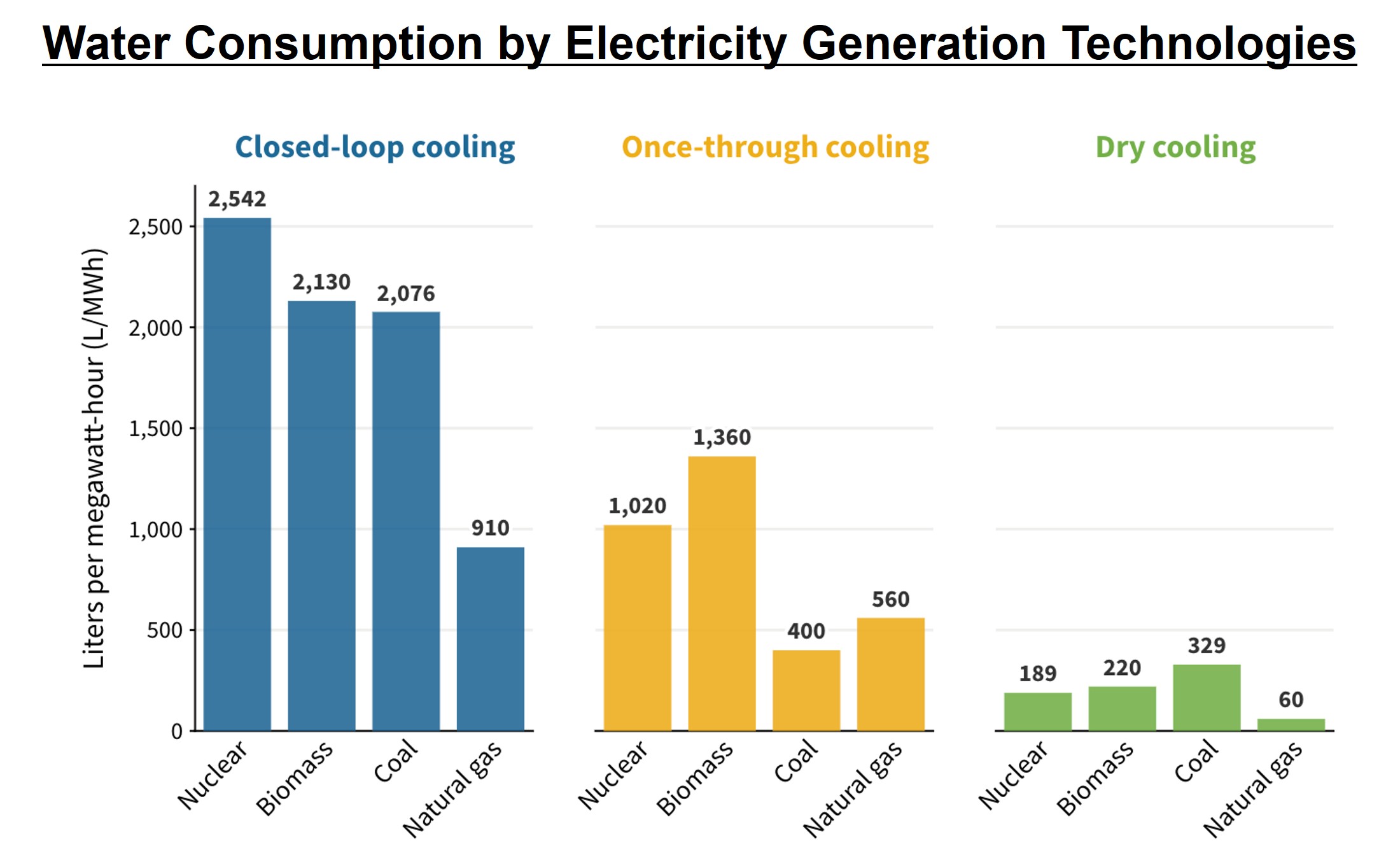
Water use in thermoelectric plants depends on the cooling system. Once-through cooling withdraws large volumes and returns warmed water; closed-loop systems reduce withdrawals but lose water to evaporation; dry cooling uses minimal water but is less efficient.
Credit: Source: Jin et al. (2019); Boston University for Global Sustainability | visualizingenergy.org | CC BY 4.0
- In contrast, solar panels and onshore wind turbines require far less water during electricity generation than conventional power plants that rely on steam and cooling systems.
- Some solar facilities do use small amounts of water to wash dust from panels, but many rely on rainfall, dry cleaning methods, or robotic systems, keeping operational water use very low.
- Over their full life cycle, solar and wind systems do require water during mining and manufacturing of materials such as silicon, steel, and copper. However, this water use occurs largely upfront and is not repeated continuously over decades of operation.
- By shifting electricity generation toward wind and solar, regions can significantly reduce long-term water withdrawals tied to power production, freeing freshwater for food production, ecosystems, and human consumption.
Water and energy are inseparable with each fueling the other. New technology and smarter planning help conserve water, save energy, and build more reliable systems. By managing both resources together, we ensure they remain available for the future.
Episode Script:
Our modern supplies of water and energy are miraculous – and tightly interlinked.
Only 3% of Earth’s water is fresh. And 99% of that is frozen in glaciers or stuck underground. That means just 1% of fresh water is on the surface where we can easily access it – for agriculture, mining, industry and our consumption.
To get that water to us requires energy. First it’s pumped, sometimes over long distances, from a reservoir or river to a water treatment plant. There, it’s filtered, purified and chlorinated.
It then flows to our houses and factories. When we’re done with it, it goes into a wastewater treatment system, where it’s cleaned again and discharged.
Because water is heavy, moving it through these processes can consume 40% of a city’s electricity. And to make all that energy requires – yes – water.
Oil and gas wells use water, in drilling mud and to fracture rock.
Coal, natural gas, and nuclear powerplants boil water into steam to turn a generator, while water cools the plant.
The generators in hydroelectric dams turn under the power of water.
Even solar farms use water, to wash their panels. Wind turbines don’t use water directly, but the factories and smelters that make their parts and steel certainly do.
And to get them that water… takes energy. We rely entirely on both. And couldn’t have one without the other. I’m Scott Tinker.