
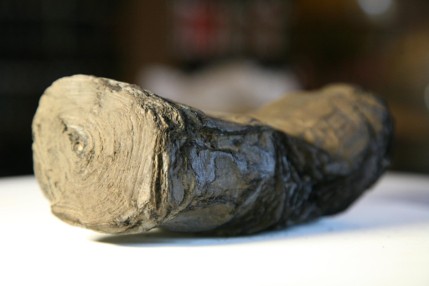
Credit: Courtesy of EducLab, University of Kentucky
Background
Synopsis: Buried beneath volcanic ash during the Eruption of Mount Vesuvius, hundreds of ancient scrolls from Herculaneum remained unreadable for nearly 2,000 years. Today, advances in imaging technology, computer science, and artificial intelligence are allowing researchers to virtually unwrap and decipher the fragile texts without physically opening them. Modern technologies are transforming how archaeologists study the ancient world.
Charred Hidden Words
- Archeologists study past civilizations through the objects and landscapes people leave behind. One of the most famous examples is the eruption of Mt. Vesuvius, which buried the Roman city of Pompeii beneath ash and pumice.
- Previous EarthDate episodes explored both the destruction of Pompeii (Pompeii: The Destruction) and the discoveries revealed during centuries of excavation (Pompeii: The Resurrection).
- But Pompeii was not the only community destroyed by the eruption. Nearby towns, villas, and farming communities were also buried, including the wealthy seaside city of Herculaneum, a favorite of the Roman elite.
- Among the ruins of Herculaneum, archeologists uncovered something extraordinary: hundreds of ancient scrolls stored within a large villa believed by some researchers to have belonged to Julius Caesar’s father-in-law.
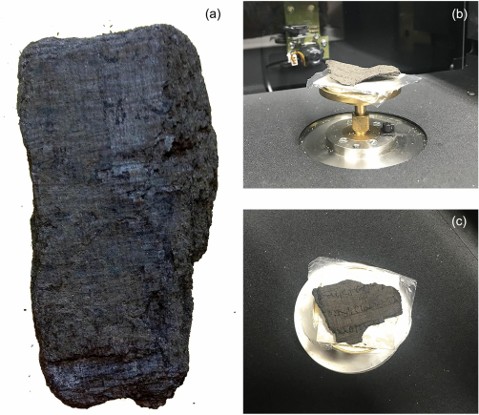
- The intense heat of the eruption carbonized the scrolls, turning them into fragile black cylinders.
- For centuries, attempts to open the scrolls often damaged or destroyed them. Their hidden words remained unreadable.
- But today, new technology, including artificial intelligence, may finally help scientists uncover what has been locked inside for nearly 2,000 years.
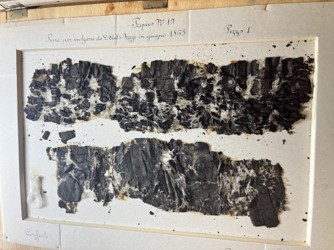
Credit: Courtesy of Vesuvius Challenge©
From Dirt to Data
- Movies often portray archeologists as dirt-covered explorers carefully brushing soil from buried treasures.
- And while excavation and observation remain important, modern archeology now depends on technologies that allow scientists to see beneath the surface without disturbing what lies below.
- One of the most important advances was radiocarbon dating, which allows researchers to estimate the age of once-living materials up to roughly 60,000 years old.
- All living organisms absorb carbon, including a small amount of radioactive carbon-14.
- After death, that carbon slowly decays at a predictable rate, allowing scientists to estimate how long ago the organism lived.
- Other technologies help archeologists investigate sites without excavation at all.
- CT scanning creates detailed cross-sectional images of objects and remains, allowing scientists to look inside fragile artifacts without opening or damaging them.
- The technology is often used to study mummies and other delicate finds, revealing bones, tissues, and hidden structures in three dimensions.
- Ground penetrating radar, or GPR, sends electromagnetic pulses into the ground and measures the returning signals.
- These reflections can reveal buried walls, tombs, and other underground structures before archeologists ever begin digging.
- The image is not three-dimensional, but it does identify irregular patterns or general shapes.
- The EarthDate episode Mystery of Pyramids Solved explored how GPR helped scientists investigate hidden structures beneath pyramids.
- LiDAR, which stands for Light Detection and Ranging, has transformed archeology on a much larger scale.
- Aircraft equipped with lasers scan the ground below and measure hundreds of millions of points to create detailed maps of the landscape.
- In heavily forested regions, LiDAR has revealed roads, terraces, pyramids, and entire ancient cities hidden beneath dense vegetation.
- This technology has been very successful in finding structures in dense, forested areas.
- The EarthDate episode Swamp Architects highlighted how LiDAR uncovered ancient earthworks concealed beneath wetlands.
- Together, these technologies have changed archeology from a field focused mainly on excavation into one increasingly driven by imaging, mapping, and data analysis.
- And now, archeologists are adding another tool to the list: artificial intelligence.
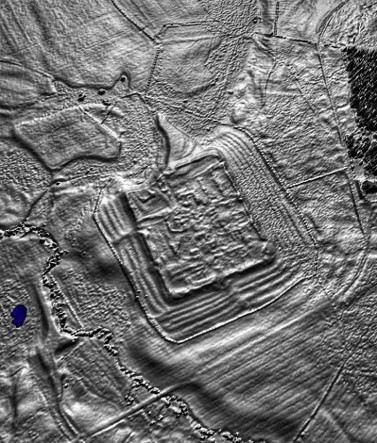
Credit: By Dr John Wells - Own work, CC BY 4.0, https://commons.wikimedia.org/w/index.php?curid=177658187
Opening the Impossible Scrolls
- The Villa of Papyri in Herculaneum was excavated during the 18th century and revealed statues, mosaics, frescoes, and marble busts preserved beneath volcanic debris of Mount Vesuvius.
- But the villa’s greatest treasure was not artwork. It was a buried library containing hundreds of carbonized papyrus scrolls.
- The villa is believed by some historians to have belonged to Lucius Calpurnius Piso Caesonius, the father-in-law of Julius Caesar. Piso was associated with the followers of the Greek philosopher Epicurus.
- Researchers immediately wondered what knowledge might be hidden within the scrolls. Could they contain lost philosophical writings or works that vanished from the ancient world centuries ago? Perhaps even works unknown to modern historians?
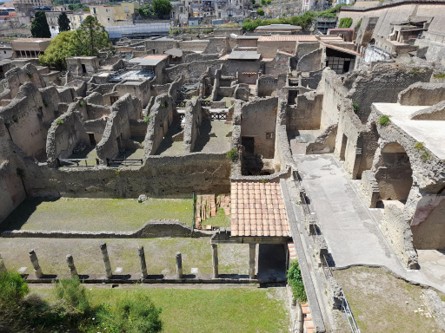
Credit: By Argo Navis - Own work, CC BY-SA 4.0, https://commons.wikimedia.org/w/index.php?curid=142960842
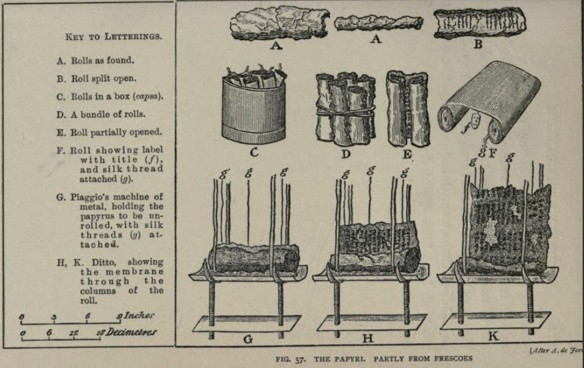
- For more than 250 years, researchers have tried nearly every method imaginable to open the fragile scrolls.
- Some were carefully unwound with silk thread attached to specialized machines.
- Others were treated with chemicals or physically sliced apart.
- Many were damaged or destroyed in the process.
- Still, by the late 20th century, hundreds of scrolls remained unopened.
Credit: By Ethel Ross Barker - https://archive.org/stream/buriedherculaneu00barkuoft#page/170/mode/2up, Public Domain, https://commons.wikimedia.org/w/index.php?curid=63432668
- Dr. Brent Seales, a computer scientist at the University of Kentucky, believed the scrolls could be opened virtually rather than physically.
- Seales’ team scanned unopened scrolls using powerful X-ray tomography imaging at a synchrotron facility, producing extremely detailed 3-dimensional images of the tightly compressed papyrus layers hidden inside.
- Software then digitally separated the twisted layers of papyrus in a process called segmentation.
- Once isolated, the layers could be mathematically flattened, as though the scroll had been digitally unrolled.
- But another challenge remained.
- The ancient ink was carbon-based and the papyrus itself had also been carbonized by volcanic heat.
- Detecting hidden writing required identifying subtle texture and density differences within the material.
- Solving the mystery would require more than archeology alone. It would require physicists, computer scientists, imaging specialists, papyrologists, and artificial intelligence working together.
Credit: By Sara Stabile, Francesca Palermo, Inna Bukreeva, Daniela Mele, Vincenzo Formoso, Roberto Bartolino & Alessia Cedola - https://www.nature.com/articles/s41598-020-80458-z, CC BY 4.0, https://commons.wikimedia.org/w/index.php?curid=129672864
The Vesuvius Challenge
- In 2023, researchers expanded the effort through an open global competition called the Vesuvius Challenge.
- The program released scan data from the scrolls to the public and encouraged programmers, engineers, students, and AI researchers around the world to help solve the ink-detection problem.
- More than one million dollars in prize money was offered to accelerate progress and encourage collaboration.
- Participants used machine learning and computer vision techniques to search the scans for hidden traces of ink within the digitally flattened papyrus surfaces.
- The challenge was not simply translating ancient Greek. First, the software had to determine where writing existed within the scans.
- Breakthroughs came quickly.
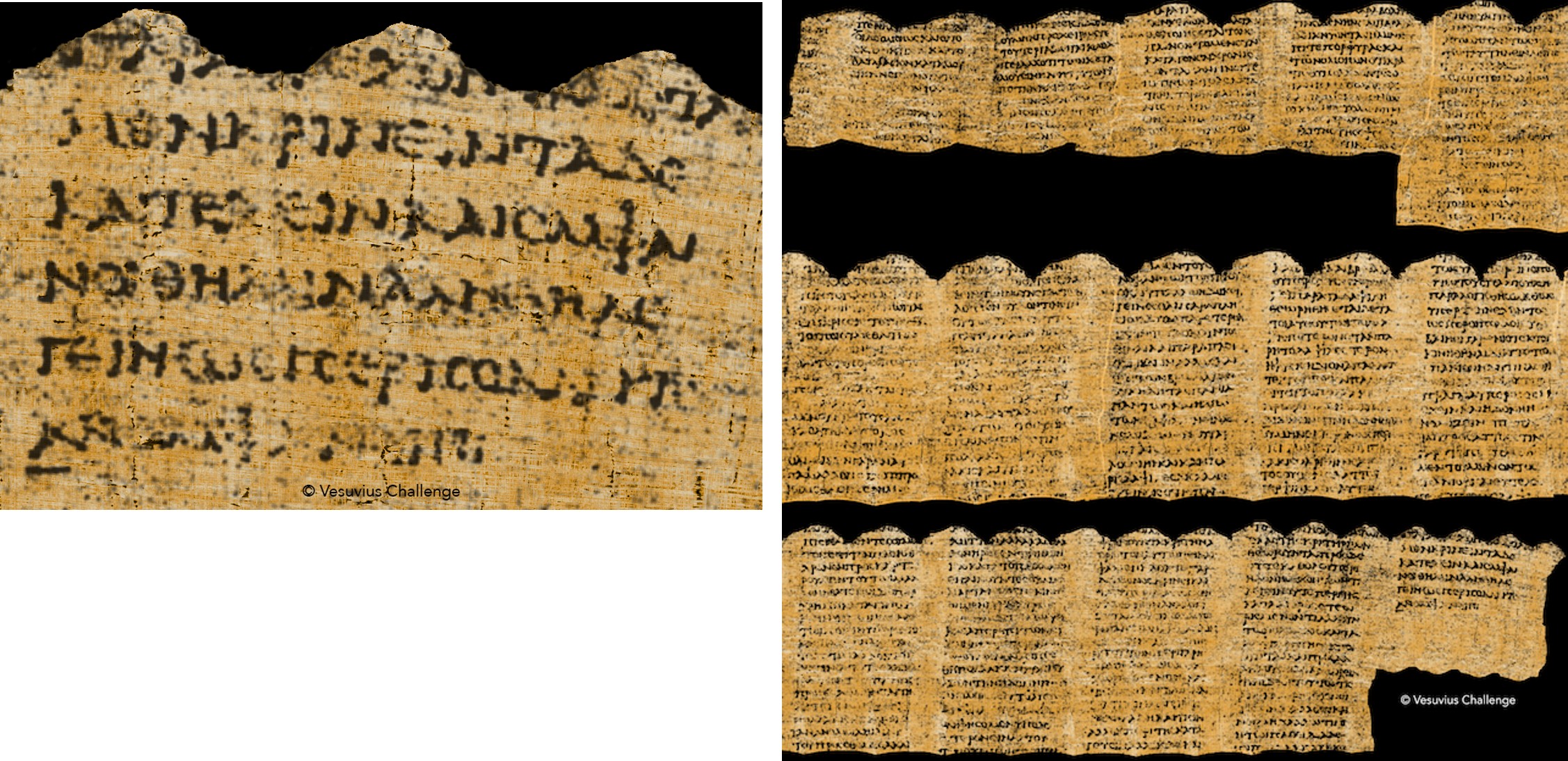
- Student researcher Luke Farritor used machine learning methods to identify the first clearly readable letters hidden within one of the unopened scrolls.
- The revealed Greek word, “porphyras,” referred to purple dye or purple-colored cloth, a luxury item in the Roman world.
- Another participant, Youssef Nader, independently used a different technique to examine the same section of text and produced even clearer imaging results.
- Scholars later confirmed additional Greek words and phrases hidden within the scans. For the first time in nearly 2,000 years, words from unopened Herculaneum scrolls had become readable without physically opening the artifacts themselves.
- The early successes quickly grew into much larger breakthroughs. Researchers have now virtually unwrapped an entire unopened scroll, recovered more than 70 columns of text from another, identified two previously unknown books, and recovered enough text to produce new scholarly editions.
- Hundreds of unopened scrolls remain, and some scholars suspect the Villa of the Papyri contains additional buried rooms that may hold an even larger library waiting to be excavated.
- The long-term goal extends far beyond recovering a few isolated words. As advances in imaging and artificial intelligence continue, researchers hope to reconstruct lost philosophical works, recover previously unknown literature, and better understand how people in the Roman world thought about science, philosophy, ethics, and everyday life.
Credit: Courtesy of Vesuvius Challenge©
From Shovels to Supercomputers
- For centuries, archaeology depended largely on excavation and careful observation of artifacts uncovered from the ground.
- Today, technologies such as radiocarbon dating, CT scanning, LiDAR, and artificial intelligence are transforming how scientists study the past.
- These tools allow researchers to map hidden cities, identify buried structures, and even read scrolls too fragile to physically open.
- More than 2,000 years after the eruption of Mt. Vesuvius buried Herculaneum beneath ash and mud, modern technology may finally allow ancient voices to be heard again.
Episode Script
Imagine you could step into a library of ancient Rome and read the Egyptian Book of the Dead. Or Homer’s Odyssey. Perhaps the first translations of the Gospels.
One day soon, you may be able to do just that.
That’s because archeologists found a room filled with Roman papyrus scrolls.
They had been covered in volcanic ash, like in Pompeii, and the heat had carbonized them -- basically turned them to charcoal.
Various attempts to read the scrolls, peeling apart their brittle layers, had destroyed some. Thankfully, many were preserved, waiting for some new technology … which may now have arrived.
A computer scientist used x-ray tomography to create highly detailed 3D scans of the scrolls. Then used software to digitally “unroll” them, creating flattened pages that would be readable…
Except, their ink had burned the same color as the charred papyrus. So he posted his scans online and invited scientists around the world to have a go.
Using new machine learning and AI, several researchers – including some students -- made out letters. Then words. And eventually whole passages.
The growing global team has now deciphered a few entire scrolls, and already found a book that was never known to exist. And they’re just getting started.
Their work will not only yield a better understanding of Roman life. They may discover things that “re-read” the history of the ancient world.