Credit: By Made available by Eric Cravens, Assistant Curator, National Ice Core Lab. - This image was copied from wikipedia:en. Transwiki approved by: w:en:User:Dmcdevit, Public Domain, https://commons.wikimedia.org/w/index.php?curid=2760916
Background
Synopsis: Around the world, specialized frozen libraries are safeguarding ice cores, fragile cylinders of ancient ice and air that record Earth’s environmental history. Carefully preserved and cataloged, these icy archives allow scientists to study past conditions and search for clues about how Earth’s systems have changed over time. Like any great library, their true value may lie in the knowledge they hold for future generations.
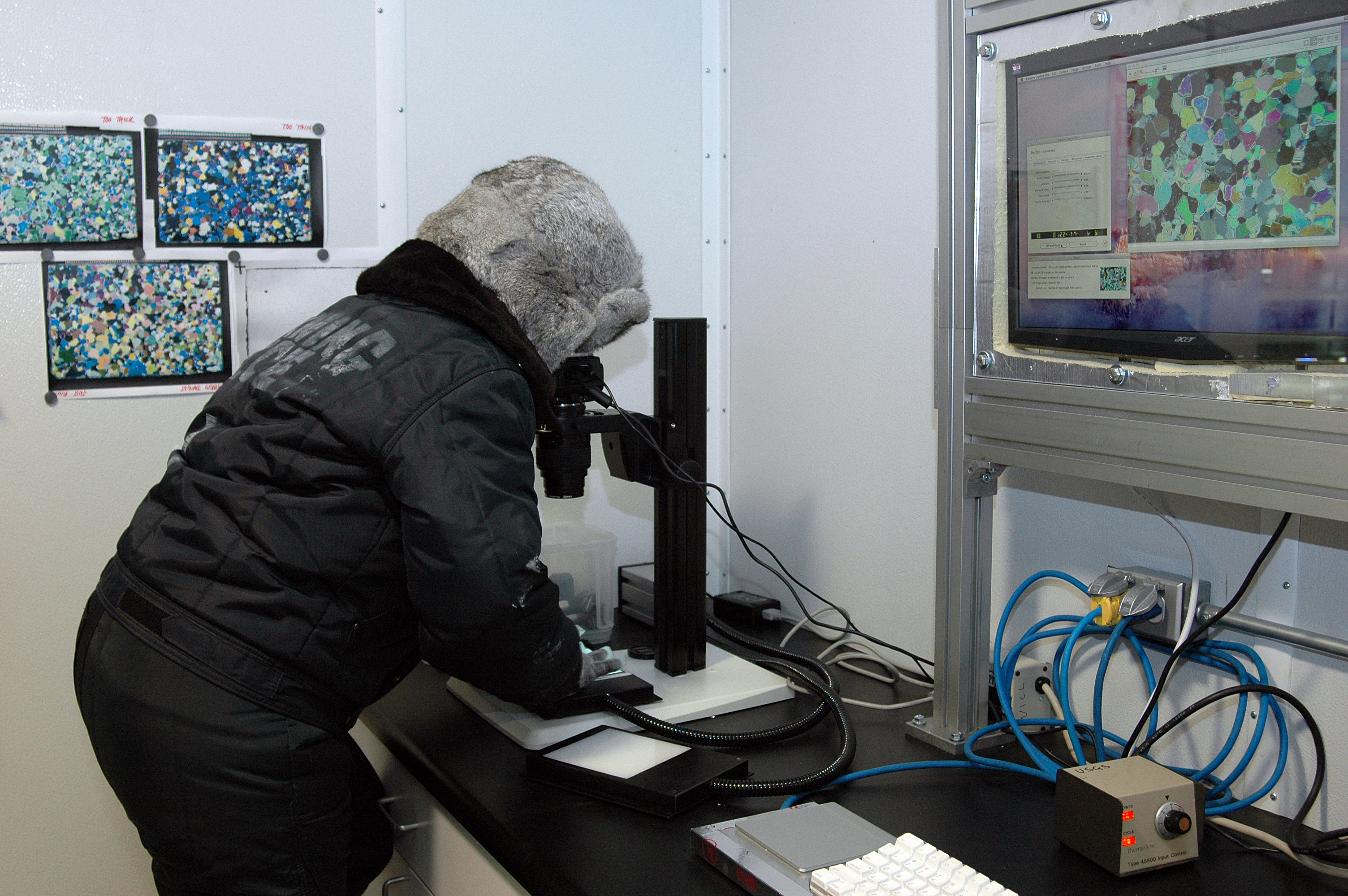
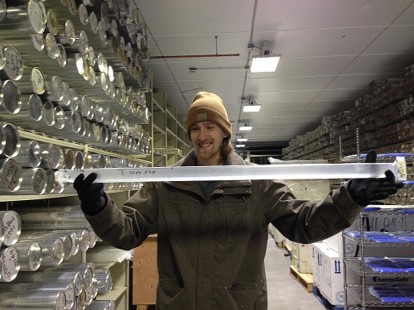
- Imagine standing in a room the size of a basketball court but instead of a sweltering gymnasium, the temperature inside is -33oF (-36oC). Now imagine that rising 12 feet (3.7 m) above the floor, are stacks and stacks of tubes, a collection of carefully curated ice samples from frozen Earth.
- Welcome to the U.S. National Science Foundation Ice Core Facility (NSF-ICF) located in Lakewood, Colorado, a facility that stores, studies, and curates ice cores, formed by snowfall, from glaciers around the world.
- This massive 55,000 cubic foot (1557 m3) complex, along with a second 12,000 ft3 (340 m3) room held at -11oF (-24oC), serves as a library for scientists, where they can check out and study ice core samples without having to visit remote field locations.
- Each tube holds a fragile column of ancient ice, drilled from glaciers and ice sheets from the Antarctic, Greenland, Arctic, and other glaciers.
- Here, the “books” are made of ice, and the “pages” are layers of snow from thousands of years ago.
- Several previous EarthDate episodes shared the details about what is written within the pages of these ice books.
- Core of the Realm (ED-102) unveiled the story of ice cores that provided information about the atmosphere including pollution from Roman smelting and agricultural pollen, or lack thereof, during the Black Plague.
- Life on Ice (ED-35) told the tale of ancient microbes found on ice sheets from Greenland and the Antarctic.
- Secrets Under Ice (ED-361) shared the mystery of the planned and secretive U.S. military base in Greenland with the surprising finding that Greenland wasn’t always under ice.
Credit: By Dargaud - Own work, CC BY-SA 4.0, https://commons.wikimedia.org/w/index.php?curid=87167115
- Just as people visit libraries for different reasons, scientists study ice cores to uncover many stories as well.
- Each ice core holds an array of information about complex climatic and environmental histories, providing a look at the past and a glimpse of the future.
- Mineral dust can describe evidence of drought.
- Black carbon, along with trace amounts of other elements, chronicles times of widespread fire.
- Varying concentrations of oxygen isotopes provide the legend for periods of temperature change.
- Presence of carbon dioxide, methane, and other greenhouse gases narrate a tale of Earth’s atmosphere.
- Microscopic specks of pollen report the history of vegetation and how it has changed.
- Evidence of microbes provides a memoir of evolutionary change over the last 20,000 years.
- Thin layers of ash recount the drama of volcanic eruptions.
- Collectively, these ice cores chronicle the saga of Earth’s recent climatic past and provide scientists with essential clues to better understand how our planet’s systems have changed over time and how they may continue to change in the future.
- Each ice core holds an array of information about complex climatic and environmental histories, providing a look at the past and a glimpse of the future.
Credit: https://icecores.org/sites/default/files/2018-06/nsf-icf_cpl_thinsections.jpg
- Each core sample at the library is thoroughly cataloged in the NSF-ICF’s inventory system.
- Researchers can then browse the catalog by region, depth, or time, just like the different sections of a library.
- When a new sample arrives, protected by an insulated box, the cores are immediately transferred to the main archive freezer. Once the new addition is equilibrated to its new home at -33oF (-36oC), extreme care is taken as it is unpacked and inspected, prior to placing it among the racks of other ice cores.
- The library in Colorado is just one of many across the globe, entrusted with the care and protection of ice cores and their stories.
- The Neils Bohr Institute at the University of Copenhagen stores over 40,000 ice core segments that lay out an “undisturbed sequence back in time.” The University also provides logistical support for a project that is retrieving additional deep-core samples in Greenland.
- The collection at Japan’s National Institute for Polar Research has samples dating back 720,000 years, drilled at the Dome Fuji station, located inland on the Antarctic ice sheet. Additional samples from the Arctic and Greenland allow scientists to see patterns in environmental change across varied regions and over time.
- The Alfred Wegener Institute in Bremerhaven, Germany, plays a lead role in ice core drilling, especially in Antarctica and Greenland. The facility uses several ultra-cold labs where they conduct extensive analysis in-house, as opposed to shipping cores to research groups elsewhere.
- Taking a nod from ancient scrolls locked away in a vault, the international project Ice Memory plans to gather ice cores from shrinking glaciers and store them for long-term preservation within a natural freezer—a snow-covered vault in Antarctica. The project has completed the design phase but has not yet begun construction.
Credit: By Helle Astrid Kjær - Own work, CC BY 4.0, https://commons.wikimedia.org/w/index.php?curid=64276280
- Regardless of the location, each library takes extreme care to preserve the precious repository.
- Back-up power and alarm systems are in place to prevent thawing, and, if such a tragic event would occur, there exists a global coordination plan to rescue ice from rapidly melting sites.
- A failure of the temperature monitoring system at the University of Alberta in 2017 resulted in the partial melting of their ice core collection. Almost 13% of the collection, representing more than 80,000 years of evidence in 1.4 kilometers of ice, was impacted by the incident. Since then, a secondary monitor has been added to ensure the safety of the collection.
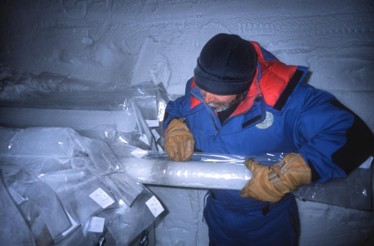
- But while these libraries are built to preserve their collections with utmost care, borrowing from them is a serious decision. Unlike traditional libraries, the act of checking out an ice core means that part of it will be lost as it is melted, sliced, or chemically altered in the process of analysis. Once used, the sample is gone forever.
- Ice cores are fragile and can be damaged or contaminated during drilling, storage, or analysis, making each sample irreplaceable and delicate to handle.
- At the NSF-ICF, staff members respond to researcher requests for specific ice core samples. The desired ice core is cut and packaged, with samples sent to one of many labs around the country.
- The longest U.S.-held ice core, a massive 3,405 meters (2.1 miles) in length, has been shared with fifteen different universities or laboratories, each receiving segments of the West-Antarctic Ice Sheet (WAIS). This ice core exposes roughly 68,000 years of Earth’s history.
Credit: By National Science Foundation - https://web.archive.org/web/20161217211725/https://www.flickr.com/photos/nsf_beta/page3, Public Domain, https://commons.wikimedia.org/w/index.php?curid=47662779
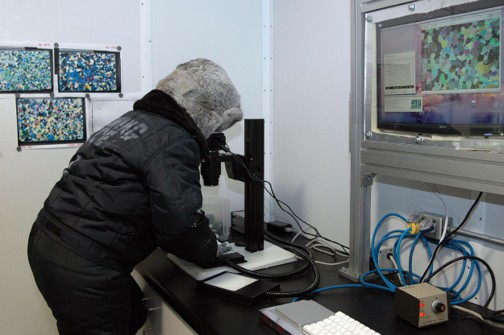
- Often, many researchers ask for the same sample, much like the demand for a popular book at the library. Plans to cut the ice core are devised so that each research team has a sufficient sample size for the various investigations. These might include gas analysis, chemical analysis, isotopic properties, or physical properties.
- To maintain the integrity of the library, smaller segments of each ice core are carefully preserved as archival samples.
- Because they come from remote and difficult-to-access locations, researchers must use each core carefully, knowing they may not get another chance to collect or analyze a similar sample.
- These frozen libraries are more than just storage spaces. They serve as guardians of Earth’s environmental memory. And while each ice core offers only one chance to be read, the knowledge gained from its fragile pages may help us better understand the chapters still to come.
Episode script
Around the world, a small group of secluded libraries contain some of the rarest and most fragile objects on Earth.
They’re staffed by scientists, equipped with redundant power supplies… and kept very, very cold.
That’s because the ‘books’ in these libraries are ice cores.
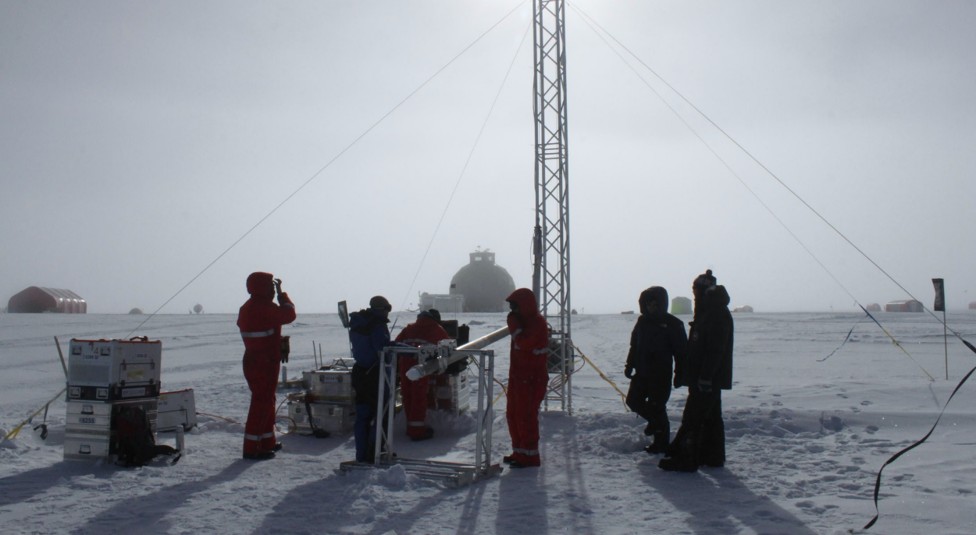
They’re collected in some of Earth’s harshest environments, like Antarctica and Greenland, at great cost, then transported frozen to these libraries.
Each core is one of a kind. And once it’s been read – small samples melted to reveal its secrets – it can never be replaced.
But those secrets make all this worthwhile. Because the glaciers and ice sheets the cores came from have captured, over endless seasons, the history of our planet.
Layers of ash reveal the timing, and geological makeup, of ancient volcanic eruptions.
Pollen samples reveal global plant populations, as they’ve changed over millennia.
Black carbon deposits tell of forest fires.
Trapped isotopes of oxygen and other gases paint a picture of past atmospheres.
The top layers, representing the most recent few thousand years, record humans’ influences on Earth: traces of agriculture, industry or war that carried on winds and settled on the ice.
These ice cores, and the libraries that preserve them, are simply irreplaceable, providing a nearly 3-million-year window into Earth’s past.
Now that’s some cool science.