
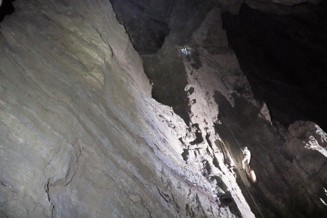
Credit: By Petr Lyubimov - Own work, CC BY-SA 4.0, https://commons.wikimedia.org/w/index.php?curid=75578528
Background
Synopsis: Located within the Arabika Massif of the Caucasus Mountains in the Republic of Georgia, Veryovkina and Krubera are the two deepest known caves on Earth. Their ongoing exploration is providing new insights into cave formation, groundwater systems, and life in one of the planet's least explored environments.
Earth’s Record Holders
- There are many record-setting places on Earth including both natural and man-made features.
- In the Himalayan Mountains, Mount Everest towers to a height of 8,849 meters (29,032 feet).
- The Western Pacific Ocean is home to the Mariana Trench which plummets to 10,035 meters (35,876 feet) below the ocean surface.
- The deepest mine is found in South Africa. The Mponeng gold mine reaches over 4,000 meters (2.5 miles) below the surface and is considered a feat of engineering.
- Kentucky’s Mammoth Cave is known as the longest cave in the world with over 685 km (426 miles) of explored and mapped passages.
- Vietnam’s Hang Son Doong Cave holds the record for the largest cave, based on volume, with some caverns so large they could house skyscrapers or large aircraft.
- Some records are clear and undisputed, but others are not.
- The top four deepest caves are all located within the Caucasus Mountains in Abkhazia, an autonomous region in the Republic of Georgia.
- The record for the deepest cave is an ongoing rivalry between two caves located just kilometers apart in the Gagra Range.
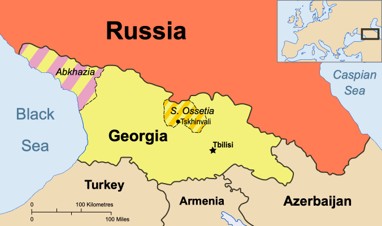
Credit: By Ssolbergj & creator of source map. - Own work + Image:Caucasus-ethnic en.svg. Image renamed from Image:Georgia, Ossetia, Russia and Abkhazia.svg, CC BY-SA 3.0, https://commons.wikimedia.org/w/index.php?curid=4860257
The Deepest Caves on Earth
- Like a pair of world-class athletes, Veryovkina and Krubera caves have traded records as explorers push farther into each cave system.
- Rising above the eastern edge of the Black Sea, the steep slopes of the Gagra Range hid the entrance to the caves for years.
- Both were eventually discovered by Soviet explorers in the 1960s, but exploring the great depths of the neighboring caves didn’t occur until decades later.
- Expeditions faced tremendous obstacles and challenges.
- Both Veryokina and Krubera have small entrances on the surface, just 3x4 meters and an even smaller 2x3 meter opening respectively. This makes getting equipment for explorations inside the cave difficult.
- Each cave then continues to protect its hidden interior, requiring explorers to begin the descent with a series of vertical shafts from the opening.
- The vertical drops continue with many shafts exceeding 100 meters (328 feet).
- Active streams, waterfalls, pools, and flooded passages support the high, nearly 100% humidity levels.
- Temperatures range from 2-7oC (35-45oF), depending on depth.
- Explorers must plan for several days or even a couple weeks of enduring the perilous conditions in total darkness and meeting the challenge of long rope descents, and potential flooding.
- Kubera Cave has been studied more extensively and held the world-record depth for nearly two decades. It was the first cave known to exceed 2,000 meters in depth.
- Veryovkina surpassed Krubera in 2018 with an expedition seeking to go further into the caves and earn the title of world’s deepest.
- Veryovkina currently bears the crown at 2,212 meters, just 13 meter deeper than Kubera.
- At more than 2.2 km (1.4 miles) below the surface, both caves are deeper than six Eiffel Towers (330 m), and deeper than the Grand Canyon (1,857 m).
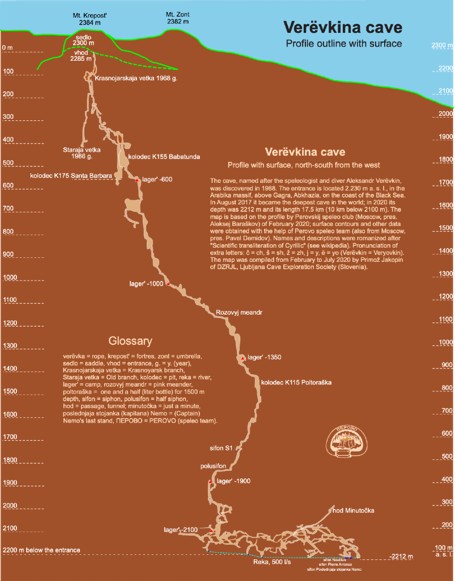
Credit: By PJakopin - Own work, CC BY-SA 4.0, https://commons.wikimedia.org/w/index.php?curid=130841885
Why Here?
- The EarthDate episode Amazing Caves explains how slightly acidic groundwater can dissolve limestone and carve underground passageways.
- The same process created Veryovkina and Krubera caves but in an even more dramatic fashion.
- The Arabika Massif is a rugged limestone mountain block in the western Caucasus that rises thousands of meters above the Black Sea.
- These mountains are still being shaped by tectonic forces that have tilted the limestone beds almost vertically. The resulting faults, fractures and bedding planes provide pathways for water to move directly downward.
- Starting at a high elevation above the Black Sea, rain and snowmelt seep into the cracks in the rock and dissolve the limestone, creating long, vertical crevices and openings within the massif.
- The result is one of the most extensive deep-cave systems on Earth. In fact, dye tracing experiments showed that water entering the caves can travel many kilometers underground before emerging near the sea.
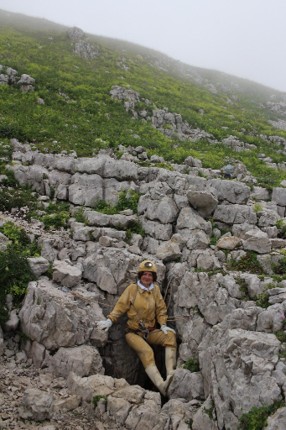
Credit: By PJakopin - Own work, CC BY-SA 4.0, https://commons.wikimedia.org/w/index.php?curid=121663144
Dangerous Discoveries
- Exploring Veryovkina and Krubera requires far more than curiosity and climbing skills.
- Reaching the deepest explored sections can take several days, with explorers carrying food, ropes, camping gear, and scientific equipment through the maze of shafts, passages, underground streams, and waterfalls.
- Camps have been established deep inside both caves because the journey took too long to complete in a single trip.
- Temperatures remain just above freezing, humidity approaches 100%, and communication with the surface is extremely limited.
- Yet ropes, cold, and exhaustion are not the greatest threats. Water is.
- The same water that spent millions of years carving these underground passages continues to flow through them today.
- During a 2018 expedition in Veryovkina Cave, explorers reached the deepest known section of the cave at the time and established a camp near a turquoise lake at the bottom.
- While the team was underground, heavy rainfall at the surface caused water levels inside the cave to rise rapidly.
- A warning from teammates higher in the cave alerted the group below that conditions were becoming dangerous.
- The explorers abandoned much of their equipment and began climbing towards higher ground as water surged through sections of the cave.
- After a difficult ascent, the team eventually reached safety.
- The incident served as a powerful reminder that these caves are not isolated voids beneath the mountains.
- They are active parts of a vast groundwater system, where weather on the surface can influence conditions more than a mile underground.
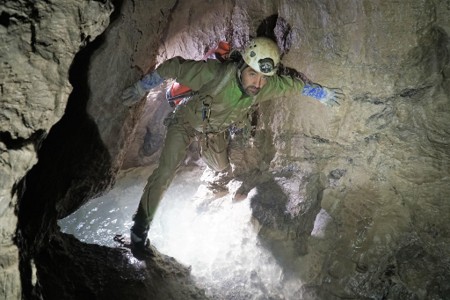
Credit: By Petr Lyubimov - Own work, CC BY-SA 4.0, https://commons.wikimedia.org/w/index.php?curid=75578530
Continuing Exploration
- Even today, Veryovkina and Krubera continue to reveal new passages while guarding many of their secrets from explorers who venture inside.
- New expeditions regularly return to both cave systems, searching for unexplored tunnels that could extend their depths and perhaps shift the record once again.
- But the goal is more than setting records. Researchers are using these caves to study the groundwater systems that carved them and the specialized organisms that survive in their dark, isolated passages.
- More than a mile beneath the surface, these caves remain among the least explored landscapes on our planet.
- On a world that appears thoroughly mapped, these caves continue to hold unexplored passages and unanswered questions.
Episode Script
The Gagra Mountains rise high above the Black Sea, in the country of Georgia. And there, separated by just a few miles, are the world’s two deepest caves.
From narrow openings, they descend a mile and half – deeper than the Grand Canyon -- with long, connected shafts going almost straight down, to networks of tunnels at the bottom.
Only the world’s elite cavers can explore them. Besides over a mile of vertical descent – and later, ascent -- temperatures are barely above freezing. Humidity is a constant 100%. And darkness is absolute.
But the biggest danger is water.
Like most caves, these were formed by slightly acidic water percolating through limestone.
But here, tectonic forces pushed up massive layers of limestone to form the mountains, and turned them nearly vertical in the process.
Over many centuries, snowmelt and rainwater ran through cracks and bedding planes between the vertical layers, creating the caves’ spectacular forms.
And the water keeps running today, sometimes in flash floods that cascade down cave shafts, which could trap cavers in flooded tunnels at the bottom.
Yet down they go, searching for ever deeper passages. Not just to break the record for the world’s deepest cave.
But to better understand the groundwater systems that move water from the high snowfields, through the mountains themselves, to the sea below.
And to explore some of Earth’s final frontiers.