
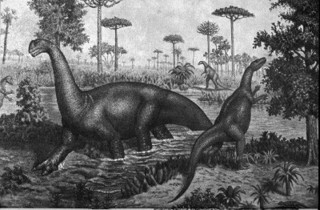
Credit: By John M. Good, Gilbert F. Stucker, Theodore Elmer White - The Dinosaur Quarry. Dinosaur National Monument, Colorado-Utah. 1958, John M. Good, Gilbert F. Stucker, Theodore Elmer White., Public Domain, https://commons.wikimedia.org/w/index.php?curid=155738069
Background
Synopsis: How did massive dinosaurs share the same landscape without exhausting their food supply? Calcium isotopes preserved in fossil teeth reveal that species divided resources in different ways, a pattern known as niche partitioning. These chemical clues show how ancient ecosystems were structured and how multiple species coexisted side by side.
A Crowded Jurassic Landscape
- Dry, rocky terrain is the image often associated with Utah today, but it wasn’t always that way.
- During the Jurassic period, roughly 201 to 145 million years ago, this region was filled with rivers and wetlands.
- Volcanic mountains rose to the west, and the Rocky Mountains had not yet formed.
- More than 100 species of vertebrates lived here, including about 25 different types of dinosaurs.
- Many were massive, plant-eating dinosaurs with enormous appetites, yet somehow, they lived side by side without exhausting their food supply.
- How?
What Dinosaurs Ate
- Despite popular images of fierce predators, most dinosaurs were plant eaters. Meat-eating dinosaurs made up only a small fraction of species, much like ecosystems today.
- Herbivores moved across the landscape feeding on ferns, conifers, ginkgoes, and other ancient plants.
- To understand what dinosaurs ate, paleontologists have relied on clues preserved in fossils.
- One of the most common approaches is to study teeth and jaw structure.
- Carnivores had sharp, serrated teeth and powerful jaws for slicing flesh and bone.
- Herbivores typically had flatter teeth suitable for crushing and grinding plants. Some species chewed very little, while others had complex jaw movements that allowed for more efficient processing of vegetation.
- Occasionally, fossils preserve direct evidence of diet. Some skeletons contain remains of partially digested food. Evidence of seeds, leaves, or even bone fragments reveal what an animal ate shortly before it died.
- Scientists also study coprolites, or fossilized dung, which can contain bits of bone, plant material, or other remains that provide clues about diet.
- Each of these methods offers valuable insights. But they often capture only a single meal or general feeding style, making it difficult to determine how multiple species living in the same place divided up food resources.
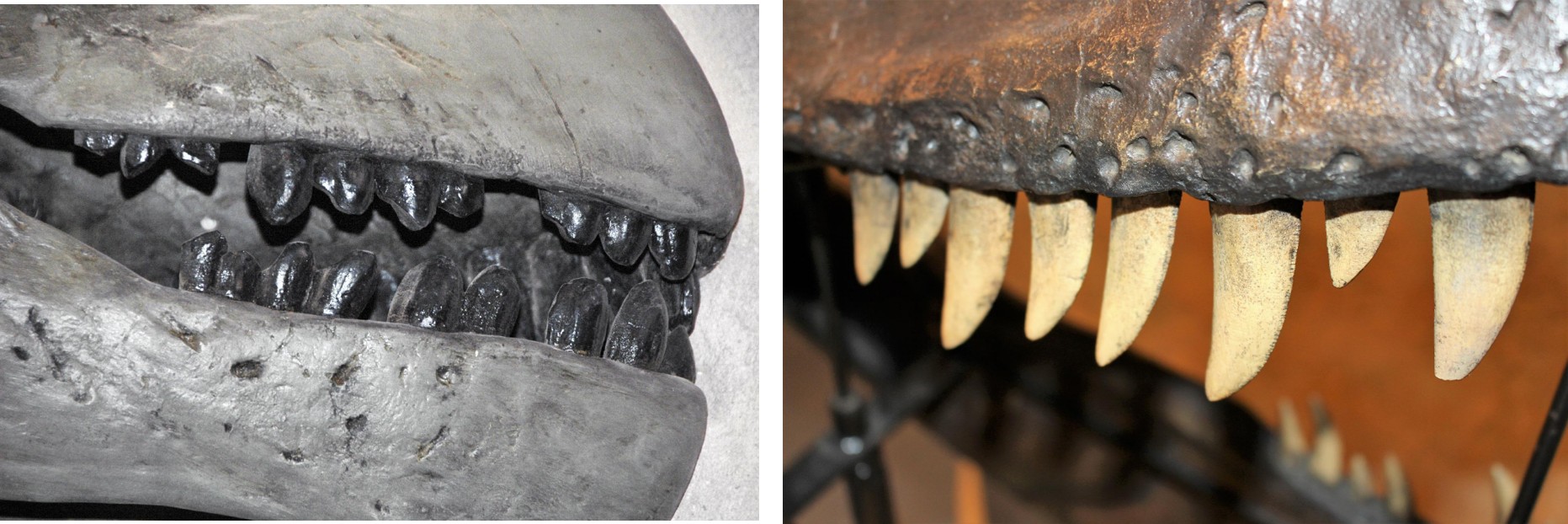
Credit (left image): By James St. John - https://www.flickr.com/photos/47445767@N05/49857203113/, CC BY 2.0, https://commons.wikimedia.org/w/index.php?curid=95170826
Credit (right image): By Emőke Dénes - kindly granted by the author, CC BY-SA 4.0, https://commons.wikimedia.org/w/index.php?curid=76042461
A Hidden Clue in Calcium
- A group of researchers from the University of Texas at Austin set out to better understand relationships between dinosaur species by taking a new look at their teeth.
- Calcium atoms come in different versions with slightly different masses, known as isotopes. Common calcium isotopes include calcium-40 (Ca-40) and calcium-44 (Ca-44). The ratio between these isotopes is influenced by how calcium is processed in soil, plants, and animal tissues.
- Different plants, and even different parts of the same plant, such as seeds or bark, can have distinct calcium isotope signatures.
- All animals need calcium to build bones and teeth, and they obtain it through the foods they eat.
- Bones are porous, constantly breaking down and rebuilding, and can be altered after burial, making them an unreliable record of original calcium in fossils.
- Tooth enamel, however, is extremely dense and resistant to chemical change, preserving its original composition even after millions of years.
- The researchers analyzed calcium isotope ratios in tooth enamel to look for clues about ecosystem structure. Because calcium moves through food chains in predictable ways, these ratios can reveal differences in diet among species living in the same environment.
Credit: By Vulturesong - Own work, CC0, https://commons.wikimedia.org/w/index.php?curid=165121169
What the Isotopes Revealed
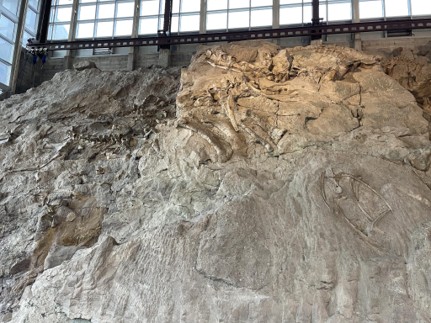
- The team needed a community of dinosaurs known to have lived together and found one at Dinosaur National Monument in northeast Utah.
- They examined tooth enamel from five species including Allosaurus, Camarasaurus, Camptosaurus, Diplodocus, and Eutretauranosuchus, to better understand the trophic structure of the ecosystem.
- The trophic structure describes how species interact through feeding relationships, including predation, competition, and specialization.
- These fossils were preserved in the Upper Jurassic Carnegie within the Morrison Formation.
- Researchers collected enamel samples from previously removed specimens and directly from fossils still embedded in the quarry wall.
- By combining isotope data with what scientists already know about these animals’ teeth and anatomy, the researchers were able to reconstruct likely diets for each species.
- A common assumption has been that large herbivores coexisted by feeding at different heights in the forest canopy. However, the calcium isotope data revealed a more complex picture.
- The herbivores showed distinct isotope signatures, indicating that they consumed different types of vegetation, not just plants at different heights.
- Camptosaurus likely focused on softer plant parts, such as leaves and buds.
- Camarasaurus appears to have fed more on tougher, woody vegetation, including conifers.
- Diplodocus shows evidence of a more varied diet, likely including both tougher plants and ground-level vegetation such as ferns and horsetails.
- The carnivores also showed differences in their isotope signatures.
- Eutretauranosuchus likely fed on aquatic prey, such as fish.
- Allosaurus occupied a higher trophic position and likely preyed on larger terrestrial animals, including herbivorous dinosaurs.
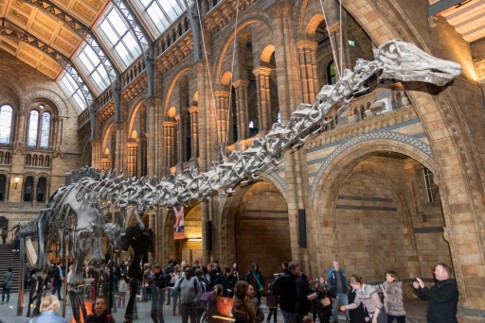
Credit: By Dronepicr - Imported from 500px (archived version) by the Archive Team. (detail page), CC BY 3.0, https://commons.wikimedia.org/w/index.php?curid=71470614
Sharing a Prehistoric Ecosystem
- Together, these differences reveal niche partitioning within the ecosystem, where species occupy different roles by using resources in different ways. Rather than competing for the same food, they divided available resources, allowing multiple large animals to coexist in the same environment.
- So how did so many massive dinosaurs live side by side without starving each other?
- They weren’t all competing for the same food. Each species carved out its own place in the ecosystem, dividing resources in ways that allowed them to coexist.
EarthNote: Darwin’s Finches and Niche Partitioning
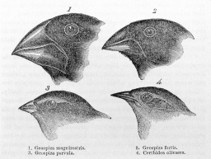
A more recent and well-known example of niche partitioning comes from Darwin’s study of finches on the Galápagos Islands. These birds evolved a wide range of beak shapes and sizes, allowing them to feed on different types of food. Some eat large, hard seeds, others feed on smaller seeds, and some specialize in insects or other food sources.
Because each species uses food resources in a slightly different way, they avoid direct competition and are able to coexist in the same environment.
This pattern is important beyond just finches. Niche partitioning helps explain how many similar species can live together without one driving the others to extinction. By reducing competition, it promotes biodiversity and can even drive evolution, as species develop specific traits that allow them to take advantage of different resources.
Darwin’s finches display a range of beak shapes adapted to different food sources, a classic example of niche partitioning. Credit: https://wellcomecollection.org/works/nknsyhrt CC-BY-4.0, CC BY 4.0, https://commons.wikimedia.org/w/index.php?curid=36013218
Episode Script
What do Galapagos finches and dinosaurs have in common?
Niche partitioning.
And what exactly is that?
When Charles Darwin first visited the Galapagos Islands, he noticed there were many species of finch. They all looked similar, except for their beaks.
He watched as they used their different beaks to eat different foods. Large, strong beaks cracked seeds. Sharp, pointy beaks poked insects out of holes.
Darwin realized the birds had diversified to eat those different foods. They partitioned their niches. In this way, many finches could live in the same place without competing for the same resources.
Paleontologists have long thought that dinosaurs did the same thing.
Most dinosaur environments had large numbers of herbivores and a few carnivores – just as today. They must also have partitioned their food sources to avoid competition.
Sure enough, new analysis of dinosaur teeth proved just that.
In Utah, in a quarry wall at Dinosaur National Monument, scientists found a huge jumble of fossils of many species. They took samples of tooth enamel across species and compared it to the calcium isotopes that were found in fossilized plants and other animals of the area.
They found that different herbivores specialized in different types of plant matter. Ferns, or conifers. Soft leaves, or tough bark.
While the carnivores specialized … in different types of herbivores.