Credit: By Galen Rathbun - USFWS Digital Library. Published by DIVISION OF PUBLIC AFFAIRS, U.S. Fish and Wildlife Service, Public Domain, https://commons.wikimedia.org/w/index.php?curid=15517547
Background
Synopsis: Florida is home to hundreds of natural springs where groundwater flowing through limestone rises to the surface at a constant temperature. These clear waters support unique ecosystems of fish, birds, reptiles, and aquatic plants. In winter, they also provide an important refuge for manatees seeking warmer water.
When Rivers Begin to Cool
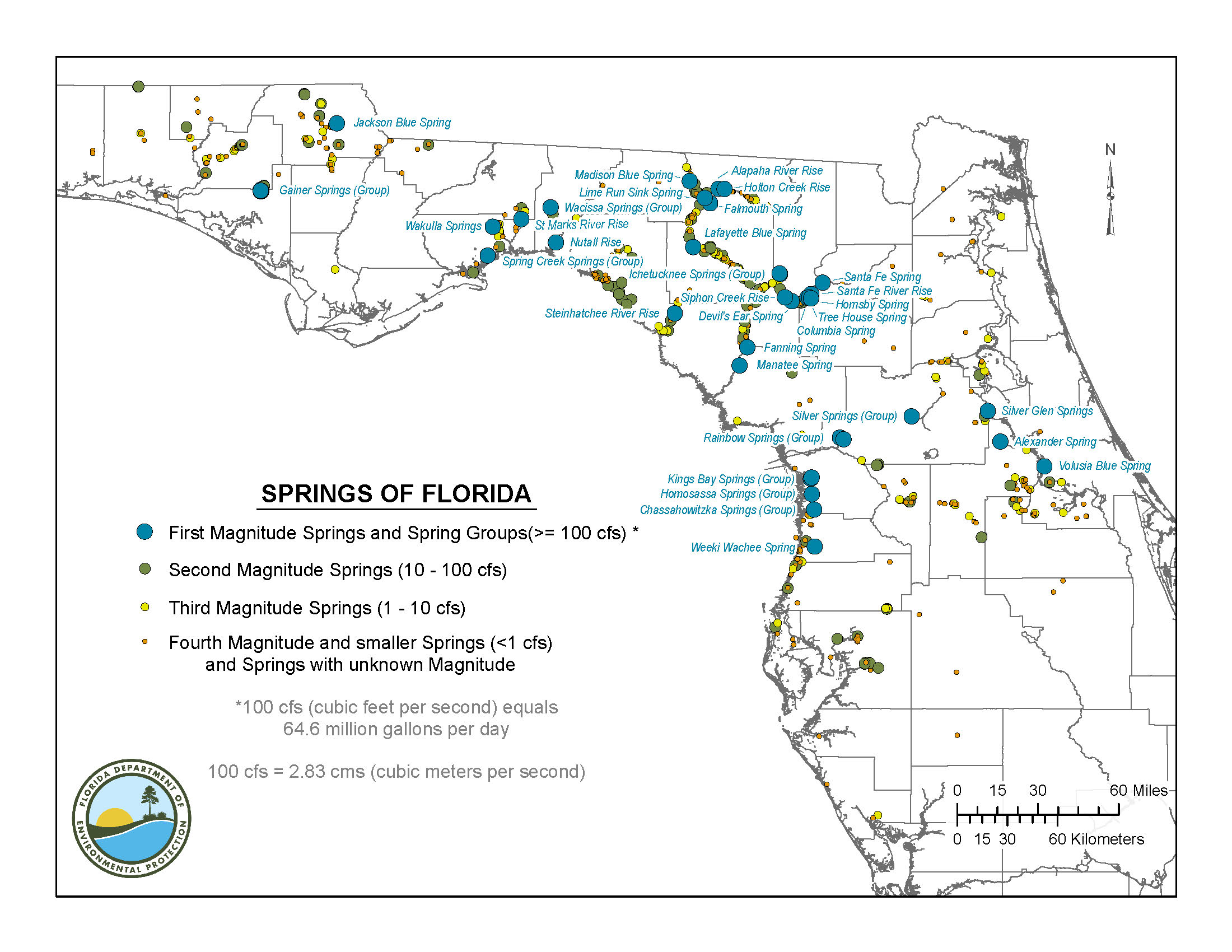
- As temperatures begin to change in the winter and Florida rivers begin to cool, hundreds of large gray shapes begin moving upstream from coastal waters.
- These gray masses are manatees, the cow of the sea, searching for warm waters.
- Hundreds gather at places like Blue Spring along the St. Johns River, where the water stays a comfortable 72oF (22oC) year-round.
- But the warmth of these springs does not come from the sun.
Springs Galore
- Manatees are unique and amazing creatures, but their existence in Florida could not be possible without the bountiful number of warm springs.
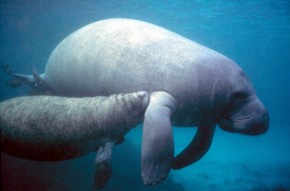
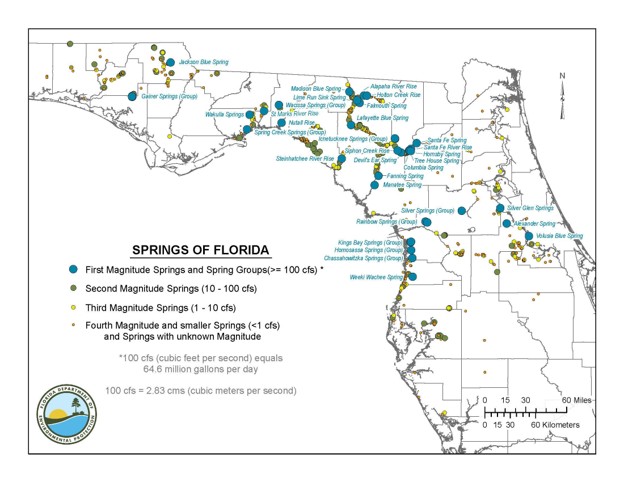
- The Sunshine State is home to more than 700 natural springs, more than any other state in the U.S.
- Springs vary greatly in discharge, from small seeps to massive springs releasing hundreds of millions of gallons of water each day.
- Twenty-seven of these springs account for roughly 76% of the total flow and are classified as first-magnitude springs.
- With an average flow rate of 100 ft3/s or 64 million gallons/day (242 millions liters/day), just one of Florida’s first-magnitude springs could fill an Olympic-size swimming pool in 15 minutes!
- What is the source of these many springs? Beneath the state lies a vast underground reservoir known as the Floridan Aquifer, where rainwater collects and slowly flows through limestone rock.
- When that groundwater finds a path to the surface, a spring is born.
Credit: https://floridadep.gov/sites/default/files/Springs%20of%20Florida_Magnitudes_Figure%20Final.jpg
The Limestone Beneath Florida
- The aquifer exists because millions of years ago, small sea creatures were deposited when the region was a warm, shallow sea.
- The tiny sea creatures sank to the ocean floor when they died. Here, they became lithified and formed calcium carbonate limestone. (See the EarthDate episode Amazing Caves).
- The Florida limestone is relatively young, at 50-60 million-years-old. Similar limestone formations in Kentucky are about 430 million-years-old.
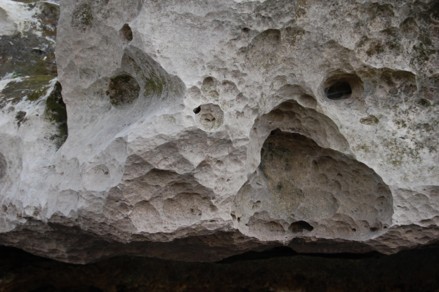
- This younger Florida limestone is soft and white and contains many fossils.
- In many parts of Florida, layers of clay deposited by ancient Appalachian rivers act as confining layers, slowing the movement of water into and out of the aquifer.
- The Ocala Uplift is a broad arch in the limestone bedrock of north-central Florida, centered near the city of Ocala and extending toward the Suwannee River to the northwest and the Orlando region to the southeast.
- Over the last few million years, the regions around the uplift have been weathered by erosion. This results in the limestone bedrock lying within 0 to 50 feet of the surface.
- This generates a major recharge zone for the aquifer. Nearly all surface water diverts underground through cracks and crevices in the karst topography.
- Lakes and rivers are absent along the uplift. But to the east and west are found plenty of Florida’s ubiquitous springs.
- As rainwater accumulates in the aquifer, pressure builds, and the water flows slowly downhill. At lower elevations, the pressure pushes out the water from the aquifer to the surface.
Credit: By Charlie A. Smith - Own work, CC BY-SA 3.0, https://commons.wikimedia.org/w/index.php?curid=69498367
Warm Water Springs
- Water in the aquifer travels deep within the limestone base, as much as 3,300 feet (1,000 meters). Here it is heated geothermally from Earth’s natural interior temperature. The deeper the water travels, the warmer it gets.
- As water moves through the natural fractures, the warmed water rises to the surface, dissolving rock and gaining calcium, while cooler, more dense water sinks.
- Most Florida springs maintain a constant temperature of 72oF (22oC), regardless of the time of year. While this may not seem exceptionally warm, when compared to chilly winter air, the constant temperature of the springs is very unlike the cooler lakes and rivers, and air temperature.
- A few springs do experience deeper circulation and result in consistently higher temperatures. Warm Mineral Spring in North Port holds a consistent 85-87oF (29-30oC) due to the deeper circulation.
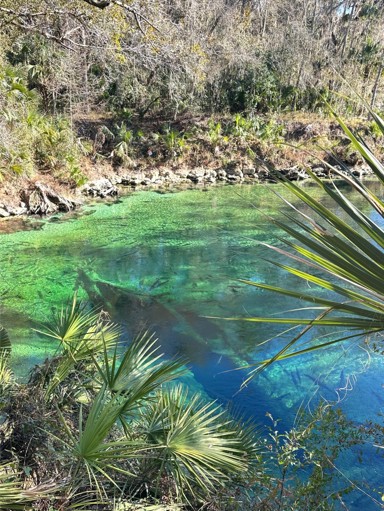
Credit: Lynn Kistler, Blue Spring State Park, February 2026
A Winter Refuge
- In the winter, when temperatures begin to drop in coastal waters and inland rivers and lakes, manatees are one of many species that seek refuge in the warm springs.
- If water temperatures drop below 68oF (20.6oC), manatees can develop cold stress, which weakens their immune system and can lead to illness.
- Affected animals may develop skin lesions, lose weight, and become less active.
- The springs become a haven and a literal lifesaver. Groups of manatees first move inland to rivers and, if the water there is still too cool, they continue to migrate in search of warmer spring-fed waters.
- Some springs are more likely to host large gatherings of manatees, including Blue Spring in Volusia County. At the state park here, hundreds of males, females, and young veer off from the St. Johns River and enter the crystal-clear spring run.
- Volunteers daily track the motion of the group as they move in and out of the spring stream. A record of 859 manatees was counted in the half-mile long stream in January of 2026.
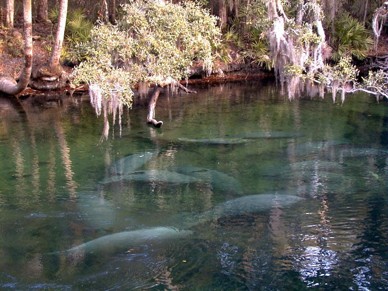
Credit: By Mwanner at en.wikipedia, CC BY-SA 3.0, https://commons.wikimedia.org/w/index.php?curid=17877427
A Year-Round Oasis
- While the manatees steal the show during the cooler winter months, Florida’s springs support a remarkable variety of life throughout the year.
- The steady temperature and exceptionally clear water create ideal conditions for fish, plants, birds, reptiles, and mammals both in the spring itself and the surrounding spring-shed ecosystem.
- Many fish species gather in the warm water runs, especially during the colder months. Native species such as gar, snook, sardines, amberjacks, and striped bass often share the waters with invasive species of tilapia and armored catfish.
- Some marine fish can even tolerate these freshwater springs because the water contains relatively high levels of dissolved minerals, including calcium, that allow certain saltwater species to survive.
- The clear, mineral-rich waters also support abundant plant growth, even several feet below the surface. These aquatic plants provide food and shelter for fish, turtles, and amphibians.
- Birds frequently gather along spring-fed rivers where fish are plentiful. Herons stalk the shallows, while double-crested cormorants dive as deep as 25 feet below the surface to chase fish underwater. Osprey and bald eagles often circle overhead, scanning the water for their next meal.
- Reptiles are also common residents of Florida’s spring ecosystems. Florida cooter turtles often bask on logs along the banks and can live up to 40 years. Alligators are frequently seen near the springs, particularly during the spring mating season from April through June.
- The forests and wetlands surrounding the springs support many mammals as well. River otters, beavers, armadillos, and even black bears may be found in the surrounding habitats, taking advantage of the water and food sources provided by these spring systems.
- Together, the springs and their surrounding landscapes form a thriving ecosystem sustained by groundwater flowing quietly through Florida’s limestone beneath the surface.
Natural Springs Under Threat
- Florida’s springs depend on a steady supply of groundwater flowing through the Floridan Aquifer. When that balance is disrupted, the health of the springs can suffer.
- Changes in rainfall can affect how much water enters the aquifer. Periods of drought reduce discharge and can slow the flow of springs, while heavy rainfall may temporarily increase spring discharge.
- Human water use can also influence spring flow. Large withdrawals of groundwater from the Floridan Aquifer for irrigation, drinking water, and industry can lower water levels underground. When the aquifer level drops below the spring outlet, less water reaches the surface and spring flows may decline.
- Water quality is another concern. Fertilizers and pesticides applied to agricultural fields, lawns, and landscapes can seep into the ground during rainstorms and enter the aquifer. These nutrients eventually emerge in the springs
- Elevated levels of nitrogen and phosphorus can stimulate growth of algae in spring runs. Thick algal growth can reduce water clarity and lower dissolved oxygen levels, stressing fish, amphibians, and aquatic insects.
- Wastewater from septic systems and sewage leaks can also contribute nutrients that degrade water quality in springs.
- Non-native species present another challenge. Invasive fish such as tilapia and armored catfish can compete with native species for food and habitat, altering the balance of the spring ecosystem.
- Springs located near Florida’s coasts may also face increasing saltwater intrusion as sea levels rise. Higher salinity can stress freshwater plants and animals that are not adapted to saltier conditions.
- Even the animals that depend on springs can face dangers. Boat propellers in rivers and coastal waters can injure or kill manatees, leaving scars that are often visible on their backs.
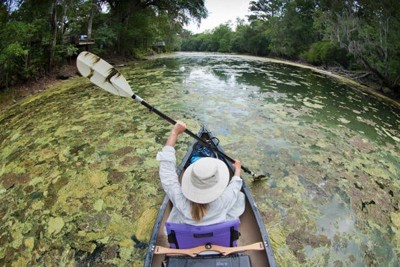
Credit: By John Moran - U.S. Environmental Protection Agency (2013-03-19). "Federal Nutrient Water Quality Standards for the State of Florida's Lakes and Flowing Waters Outside of the South Florida Region (Inland Rule)." http://water.epa.gov/lawsregs/rulesregs/florida_inland.cfm, Public Domain, https://commons.wikimedia.org/w/index.php?curid=21569489.
Geology Beneath, Life Above
- Florida’s springs are the surface expression of a vast underground system shaped by millions of years of geology. Rainwater slowly dissolves the limestone beneath the state, filling the Floridan Aquifer and carving pathways for groundwater to move.
- When that groundwater emerges as a spring, it brings clear, steady-flowing water that remains nearly the same temperature year-round. These stable conditions create ideal habitats for aquatic plants, fish, turtles, birds, and many other species.
- From thriving spring ecosystems to winter gatherings of manatees, the biodiversity of these waters depends on the quiet movement of groundwater through Florida’s ancient limestone. This relationship shows how closely Florida’s unique geology and its living ecosystems are connected.
EarthNote: Meet the Manatee
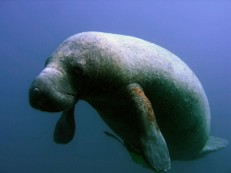
Manatees are large aquatic mammals that can grow 10-13 feet (3-4 m) long and weigh 800-1,200 pounds (360 – 540 kg). Despite their size, manatees are gentle plant-eaters, feeding mostly on seagrasses and freshwater plants. An adult manatee can eat 100 – 150 pounds of vegetation each day, about 10-15% of its body weight.
Manatees continually replace their teeth because the aquatic plants they eat often contain sand or grit that quickly wears them down. New molars grow at the back of the jaw and slowly move forward like a conveyor belt, replacing worn teeth in a process known as “marching molars.”
A group of manatees is often called an aggregation. Male manatees are called bulls, females are cows, and young manatees are known as calves. Female manatees usually give birth to a single calf every 2 – 5 years after a pregnancy that lasts about 12 months. Calves stay close to their mothers for one to two years while they learn where to find food and warm-water refuge.
Manatees can live 40 – 60 year in the wild. Some individuals have lived even longer in protected environments. Although they move slowly most of the time, manatees can swim 15-20 miles per hour in short bursts. They are also capable travelers. Some Florida manatees migrate hundreds of miles each year between coastal waters and inland rivers and springs.
Manatees must surface to breath every 3 – 5 minutes when active, but when resting they can remain underwater for up to 20 minutes. Manatees are closely related to elephants and hyraxes, not whales or dolphins as many people assume.
There are three species of manatees worldwide: the West Indian manatee (which includes the Florida population), the Amazonian manatee, and the West African Manatee. Today, roughly 8,000 manatees live in Florida, a significant increase from several decades ago due to conservation efforts.
Episode Script
A large manatee can top 1000 pounds and eat 15% of its weight in seagrass each day.
That may sound hardy, but manatees are actually very sensitive. There are three species, all adapted only to the constant warm waters of the tropics.
But the West Indian manatee has found a way to survive Florida winters by taking advantage of the state’s geology.
As temperatures drop, manatees leave coastal waters and swim up rivers toward headwater springs.
Florida has hundreds of springs, more than any other state, and some are huge, pumping out millions of gallons a day.
The springs are fed by rainwater that percolates through Florida’s limestone bedrock, flows underground, is heated by geothermal energy, then emerges to form warm, clear pools that feed rivers.
The spring pools are home to large ecosystems of many species -- including, in winter, manatees, who come by the hundreds to spend the cold months lounging, and eating.
Like so many things in nature, the springs are under pressure from human development. Florida cities and agriculture pull water from the aquifer, reducing flow into the pools. Fertilizer seeps into the groundwater and enters the springs, clogging them with algae.
Despite that, the manatees’ numbers are increasing, due to conservation efforts by Florida preservation groups. A success story of shared resource use that can hopefully sustain these remarkable creatures long into the future.