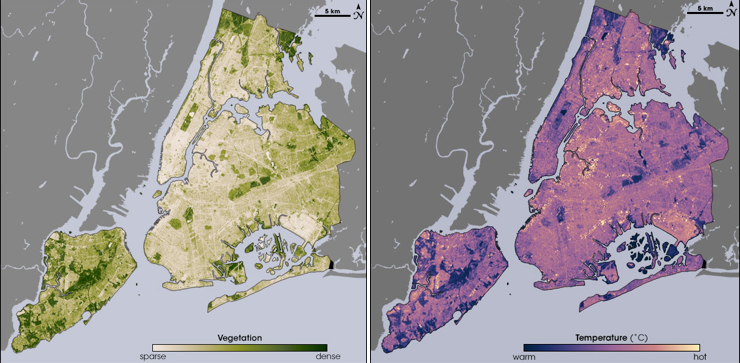
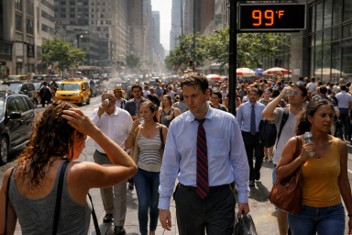
Credit: Generated by AI (DALL·E/OpenAI).
Background
Synopsis: Summers in cities can be dangerously hot due to the urban heat island effect. This added heat increases health risks, strains energy systems, and impacts air and water quality. Understanding how urban heat forms and how cities can reduce it, is key to making urban environments safer.
What is an Urban Heat Island?
- For many, summer means hot. And for those living in urban areas, it is even hotter.
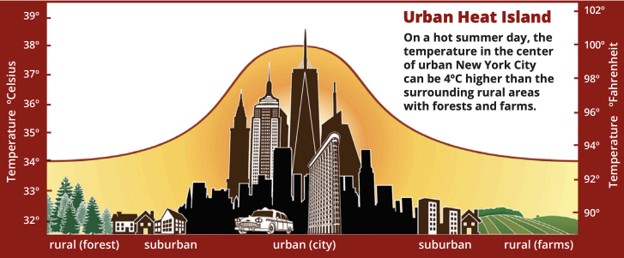
- Urban areas can be as much as 10oF (5-6oC) warmer than surrounding rural areas, especially at night.
- City-dwellers can attribute this added heat to the urban heat island (UHI) effect.
- Many factors influence the formation of urban heat islands with primary contributors including heat-absorbing surfaces such as darkly paved roads, concrete buildings and sidewalks.
- Dark surfaces absorb more of the Sun’s energy, while lighter, more reflective surfaces bounce more energy back into the atmosphere. This difference in reflectivity contributes to higher temperatures in cities.
- Any cooling effect from evapotranspiration is diminished due to the abundance of hardscape and the lack of trees and other green spaces.
- Tall buildings prevent air from flowing and hot air gets trapped in “urban canyons”.
- Additional heat in urban areas is generated from large volumes of vehicle exhaust and waste heat from air conditioners.
- Urban heat islands are often strongest at night, when natural areas cool quickly but built surfaces continue releasing stored heat.
Effects of Urban Heat Islands
- Increased urban temperatures cause several negative effects.
- First and foremost is the effect on human health, including increased risk of respiratory ailments, heat stroke, heat exhaustion, and even death.
- Those who affected include the elderly, young children, people with chronic disease, outdoor workers, and individuals without access to air conditioning.
- Hotter cities also strain energy systems. For every 2oF (1.1oC) increase in temperature, electricity demand for air conditioning increases by 1 - 9%, depending on access and use.
- This surge can lead to brownouts or blackouts.
- Greater electricity production typically emits more greenhouse gases and particulate pollution and forms more ground-level ozone, degrading air quality.
- Urban heat can also harm water ecosystems. Stormwater runoff flows off hot pavement into streams and storm drains at elevated temperatures, encouraging bacterial growth and stressing aquatic life. Some urban streams have measured temperatures up to 18oF (10oC) higher due to heated runoff.
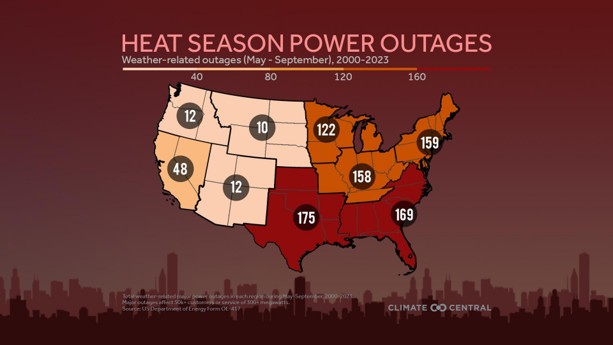
Credit: Climate Central, climatecentral.org
Remediating the Effects of Urban Heat Islands
- Cities are attempting to remediate the UHI effects by various initiatives, including the use of a reflective paint to dissipate heat. (ED281 – Super Cool Cities). This is primarily done to cool pavement but could also be used on building exteriors.
- Other projects include:
- Increasing trees and vegetation: Plants lower temperatures by providing shade and cooling air through evaporation from their leaves.
- Urban forests were an average of 3.0oF (1.6oC) cooler than non-green urban areas based on evidence from hundreds of studies.
- Installing Green Roofs: Adding a layer of vegetation on a rooftop reduces rooftop temperature and provides many of the same benefits as adding trees and vegetation.
- Green roofs lower cooling demand, increase energy efficiency, and can create park-like spaces.
- Installing Cool Roofs: Using highly reflective material reflects both sunlight and heat away from a building. Cool roofs reduce air conditioning use and lower indoor temperature by as much as 2.2 – 5.9oF (1.2 - 3.3oC).
- A cool roof not only cools a specific building but can also lower temperatures of surrounding areas.
- Increasing trees and vegetation: Plants lower temperatures by providing shade and cooling air through evaporation from their leaves.
- Employing Smart Growth Strategies: Policies that encourage mixed land use, open space, walkable neighborhoods, compact building design, and multiple modes of transportation can all reduce the urban heat island effects.
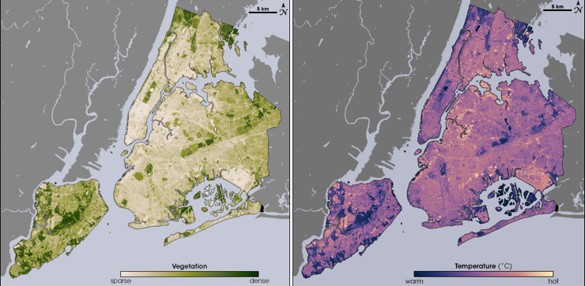
Credit: https://assets.science.nasa.gov/dynamicimage
Looking Ahead
- The urban heat island effect is a growing challenge as cities expand, and populations increase.
- Understanding how and why cities heat up is the first step toward reducing risks to human health and infrastructure.
- With thoughtful design and planning, cities can limit extreme heat while creating more comfortable and resilient places to live.
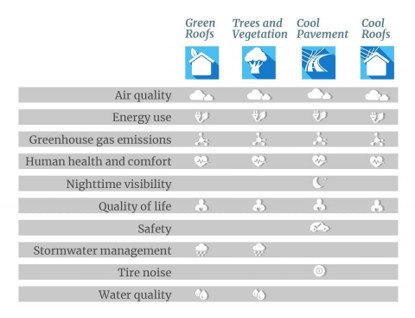
Credit: https://www.epa.gov/sites/default/files/styles/colossal/public/2018-08/greenroofcobenefits.jpg?itok=7tf2V_vF
Episode Script
Summer in the city. It’s sweltering. The sun beats down all day. Its heat is absorbed by concrete buildings and blacktop, which hold that heat at night -- and into the next day.
The heat builds over weeks and months, keeping summer city temperatures much higher than their surrounding suburban and rural areas. Cities can be 10 degrees Fahrenheit hotter, or more!
That’s what’s called an urban heat island.
People respond by turning down the thermostat on their air conditioning. Exhaust from AC units and heat from nearby power plants further warm the air.
The increased electric load can lead to brownouts, or blackouts. And if people lose power, and air conditioning – or if they don’t have it to begin with – the high urban temps can be deadly.
Thousands of people in normally temperate cities in Europe and Asia have died over the past years in summer urban heat waves.
So, city planners are working to cool these heat islands. Methods can include so-called ‘cool roofs,’ which use white paint or reflective materials to radiate the sun’s heat, rather than absorb it.
Cool roofs can reduce indoor building temperatures by a few degrees Fahrenheit. Green roofs, planted with gardens or even trees, can double that reduction.
Likewise, creating more urban green space cools cities, as plants give off water vapor to provide evaporative cooling to their leaves, and the air.
Remarkably though, these deadly heat islands may save more lives than they’re endangering – and we’ll talk about that on another EarthDate.