

Credit: ChatGPT (OpenAI) and DALL·E, composite image generated 2025.
Background
Synopsis: Urban heat islands are known for making cities dangerously hot in summer. But new research shows they can also warm cities in winter, reducing cold-related deaths. This dual effect reveals that urban heat islands are not simply a problem to eliminate, but a system to manage carefully based on climate and season.
More Than a Summer Story
- In a previous episode, we explored how cities heat up in the summer, often reaching temperatures much higher than surrounding areas.
- Those higher temperatures can strain energy systems and pose serious risks to human health.
- But the urban heat island (UHI) effect does not only influence summer conditions.
- The same features that trap heat during the day and release it at night continue to affect temperatures throughout the year.
- This raises an important question: could the heat retained by cities ever be beneficial?
Urban Heat Islands in Winter
- A recent study revealed a surprising benefit to the urban heat island effect.
- Researchers combined satellite-measured temperature data, climate data, and socioeconomic information for over 3,000 cities around the world. The goal was to estimate how living in a city affects temperature exposure compared to living in rural or less-dense areas. They wanted to know how the temperature exposure relates to risk of death across both hot and cold seasons.
- By examining both heat-related mortality and cold-related mortality, they hoped to answer the key question, does the warming from the urban environment make summers more dangerous and winters safer?
- In winter, heat leaking from buildings, called anthropogenic heat, can warm the surrounding air, further increasing the UHI effect and raising nighttime temperatures.
- The results showed that this winter warming reduces cold-season deaths more than it increases heat-season deaths. Globally, the reduction in cold-related mortality outpaced the increase in heat-related mortality by more than 400%!
- Cold-related mortality includes hypothermia, cardiovascular stress, and respiratory illnesses that worsen in cold temperatures.
- In other words, in many non-tropical cities, the “extra heat” trapped by buildings, pavement, and human activity during cold months saves more lives than are lost to heat in warm months.
- The benefit is especially strong in cities at higher latitudes or colder climates. In some of those places, the cold-related deaths prevented were more than eleven times greater than those associated with heat..
Location Matters
- The study authors caution that the “net benefit” (fewer deaths overall) from urban heat islands is not guaranteed everywhere.
- It depends a lot on where the city is (climate zone, latitude), how cold its winters are, and how hot its summers are. Another factor is how people live in relation to building types, heating, and vulnerability to temperature extremes.
- Because of these differences, efforts to reduce urban heat may be beneficial for summer but could unintentionally increase winter mortality in high-latitude cities.
- The authors suggest employing a seasonally adaptive design rather than a one-size-fits-all approach. One proposal is to develop roofs with reflectivity that can change with the season, having darker roofs that absorb heat in winter and lighter roofs that reflect heat in summer.
- Other smaller studies support the cold-weather benefits of urban heat islands, but this meta-analysis of over 3,000 cities has brought the matter to the forefront.
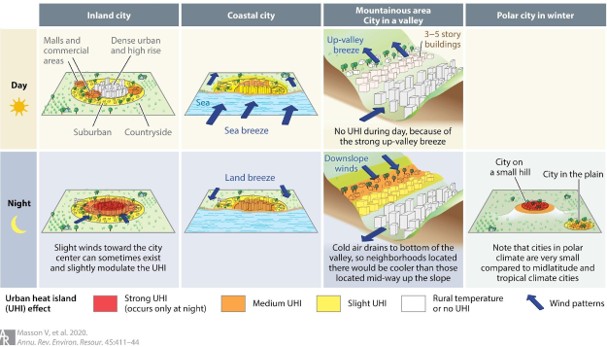
Credit: By Valéry Masson,1 Aude Lemonsu,1 Julia Hidalgo,2 and James Voogt3 - https://www.annualreviews.org/doi/full/10.1146/annurev-environ-012320-083623, CC BY 4.0, https://commons.wikimedia.org/w/index.php?curid=101313486.
The Road Ahead
- The common story of the urban heat island as always harmful is (in terms Dr. Scott Tinker has communicated for many years) completely factual, but not factually complete. In many places, the warmth it brings in winter may save lives by reducing cold stress and cold-related illness.
- Because of this dual nature of urban heat islands, urban planning and mitigation strategies should be both season- and region-sensitive.
- If cities aim only to “cool down” for summer, they inadvertently increase winter health risks. Adaptive solutions that help in both seasons should be a primary consideration in the urban design.
Episode Script
On another episode, we told you about urban heat islands. Buildings and asphalt absorb summer heat -- from sun and air, cars and trucks, power plants and air conditioning -- and hold it, driving city temperatures far higher than surrounding areas, sometimes to devastating effect.
Urban heat islands have killed thousands. But new studies of over 3,000 cities around the world show they’ve saved many more! That’s because heat islands also hold heat in winter, as buildings, transportation and industry ‘leak’ heat into the environment.
The result, just as in summer, is that cities can be 10 degrees Fahrenheit warmer. That means less energy required for heating homes and buildings. And, it means many fewer deaths from hypothermia, heart attacks and respiratory illness.
The studies show that, in the global average, urban heat islands saved four times as many lives in the winter as were lost in the summer. In cold climates, it was 11 times as many!
Tropical cities may not enjoy these benefits – since their winters are not cold enough to kill. But overall, this suggests city planners should adapt regionally to urban heat islands.
Warmer cities should try to mitigate heat effects... while colder cities may want to encourage them!
Cities that experience both temperature extremes – and many do – may investigate changing roof colors and other flexible solutions that could reflect heat in summer, and absorb it in the winter. Changing, like nature, with the season.