
Credit: AI-generated image (ChatGPT/DALL·E, OpenAI)
Background
Synopsis: Meals around the world seem diverse, yet much of what we eat comes from a surprisingly small number of crops. Efforts are underway to both protect these staples and broaden the plants that support our food supply.
Holiday Foods Around the World
- The table is set for a holiday feast as your mouth waters for turkey, potatoes, stuffing, corn and other familiar foods.
- On the other side of the world, a family celebrates Lunar New Year with fish, dumplings, and sticky rice balls.
- But beneath this variety lies a much simpler global diet.
A World Built on a Few Crops
- Many plants are cultivated for food in many forms including grains, vegetables, fruits, and seed oils.
- Other plants are cultivated for livestock feed, fiber for textiles and paper, or for ornamental use.
- Estimates of edible plant species range from 7,000 to more than 300,000. Yet we rely on only a small fraction of them for food.
- Roughly two-thirds of all plant-based food production comes from just nine species including sugar cane, potatoes, soybeans, oil-palm fruit, sugar beet and cassava.
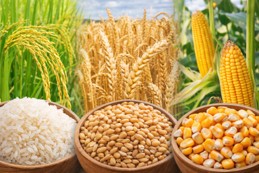
- Rice, maize (corn), and wheat alone provide more than half of the food energy from crops.
- Production of crops, and these three staples in particular, has changed dynamically since the start of industrial agriculture.
- In developed nations, the use of fertilizers and irrigation, along with improvements in machinery and equipment, have increased crop yields.
- For example, wheat yields increased from 14.4 bushels per acre in 1915 to 48.6 bushels per acre by 2023. Corn rose from 28.1 to 177.3 bushels per acre over the same period.
- Global trade also spreads the abundance worldwide. The biggest corn exporters include the U.S., Brazil, Argentina, Ukraine, and France. India, Thailand, Vietnam, and Pakistan lead in rice exports. Russia, Australia, Canada and the U.S lead in wheat exports.
- Global transport and increased farming efficiency make our food supply seem abundant.
- But relying on such a limited number of crops comes with real risks.
A Narrowing of Our Food Supply
- The EarthDate Episode, Yes, We Had No Bananas, highlighted a major problem with growing crops with very little genetic diversity.
- A fungus that affected genetically similar potato crops across Ireland in the mid-1800s led to famine, death, and vast migration.
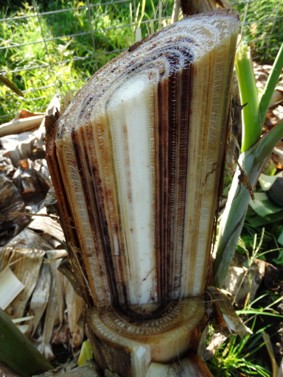
- Other fungal pathogens destroyed first the Gros Michel and then the Cavendish variety of banana crops.
Credit: By Scot Nelson - https://www.flickr.com/photos/scotnelson/24629827168/, CC0, https://commons.wikimedia.org/w/index.php?curid=164458572
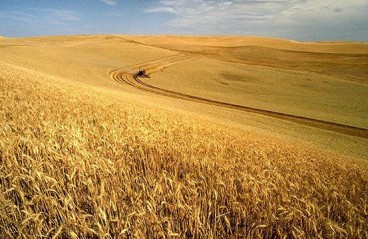
- Growing a single crop, or even a single variety of a crop, over large areas is known as monoculture.
- This approach is efficient and produces a uniform, desirable product but comes with tradeoffs.
- Crops are more susceptible to disease due to the lack of genetic diversity.
- Soil can become degraded, often requiring more fertilizer and irrigation.
- Even when many varieties exist, modern farming often relies on just a few, and sometimes only one variety, across vast areas.
- This narrowing of diversity extends beyond individual fields to the global food system.
- Rice is a staple food for much of the world’s population, with most global production coming from a few major groups of Oryza sativa, especially indica rice types grown in tropical and subtropical regions. These varieties are a primary food source for billions of people worldwide.
- Bread wheat (Triticum aestivum) is used for everything from pasta to pastries and accounts for a majority of global wheat production.
- Dent corn (Zea mays), often called maize outside the United States, makes up the vast majority of global corn production. This “field corn” develops hard kernels with a variety of uses from grinding to make corn meal or flour, to feed for livestock, and even convert it to fuel.
Credit: By Unknown author - ars.usda.gov - Image Number K1441-5, Public Domain, https://commons.wikimedia.org/w/index.php?curid=16012
Expanding Our Food Options
- Genetically similar crops are more vulnerable to disease, and growing conditions are shifting with changes in temperature and rainfall.
- Scientists and farmers are exploring ways to improve the crops we rely on and expand the range of plants we grow.
Improving Existing Crops
- One approach focuses on strengthening the crops that already dominate global diets.
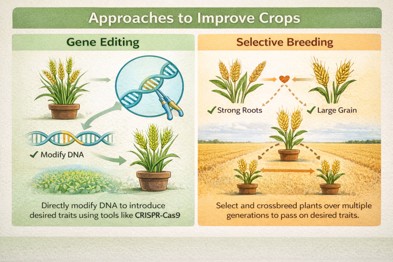
- Scientists are using tools such as gene editing, which directly modifies plant DNA, to introduce traits like drought tolerance, disease resistance, or improved nutrition, often by drawing on characteristics found in wild relatives of these plants.
- While gene editing has raised questions, it is being explored as one way to help crops withstand changing environmental conditions.
- Plant breeders have long relied on wild relatives of crops like wheat and rice to reintroduce genetic diversity that has been lost through generations of selective breeding.
- These efforts aim to make widely grown crops more resilient without changing the foods people already depend on.
Credit: AI-generated image (ChatGPT/DALL·E, OpenAI)
Expanding Crop Diversity
- Another approach is to broaden the range of crops used for food by increasing attention to plants that have long been grown regionally but are not widely traded or studied.
- Often called “orphan crops” or “underutilized crops,” these plants are staples in parts of Africa, Asia, and South America but are less familiar in Western diets.
- Many of these crops are well adapted to local environments and can tolerate heat, drought, or poor soil conditions better than some major global crops.
- Examples include:
- Teff, a tiny grain grown in Ethiopia, is rich in nutrients and grows well in dry conditions.
- Millet and sorghum, widely grown in parts of Africa and India, are highly tolerant of heat and low rainfall.
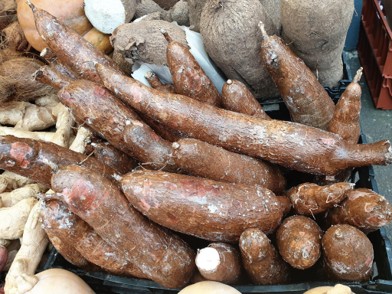
- Cassava, a root crop grown in tropical regions, can survive in poor soils where other crops struggle.
- Breadfruit, cultivated in tropical regions, produces large yields on trees that require relatively little maintenance.
Credit: By Emőke Dénes - kindly granted by the author, CC BY-SA 4.0, https://commons.wikimedia.org/w/index.php?curid=87643571
- Some crops that were once regionally grown have already gained wider recognition.
- For example, quinoa, originally cultivated in the Andes, has become more common in global markets due to its high protein content and ability to grow in challenging conditions.
- Some of these crops are gaining renewed attention and are sometimes referred to as “Cinderella crops,” as they move from being overlooked to becoming more widely recognized for their potential.
- One example is bush mango (Irvingia gabonesis), a tree native to West and Central Africa that is not related to the mango, despite its name.
- In countries such as Nigeria, Cameroon, and Malawi, bush mango is prized not only for its fruit but also for its seeds, known as ogbono or dika nuts, which are rich in fat and protein.
- These seeds can be dried and ground into a paste or powder used to thicken traditional dishes such as ogbono soup or processed into foods like dika bread.

Credit: By Bukky658 - Own work, CC BY-SA 4.0, https://commons.wikimedia.org/w/index.php?curid=103398907
A Broader Food Future
- Expanding the number of crops used for food, while also improving the resilience of existing ones, could help create a more stable and adaptable food system.
- A more diverse mix of crops can reduce the risk of widespread crop failure, support regional agriculture, and introduce new flavors and nutrients into diets around the world.
- The foods served at holiday tables such as Lunar New Year celebrations, may continue to reflect tradition. They could also gradually incorporate a wider variety of crops beyond the few that currently dominate global diets.
- What feels like a diverse feast today may, in the future, draw from a much broader range of plants.
Episode Script
Scientists estimate there may be 300,000 edible plant species on Earth.
But just three account for half of all food crops, everywhere. They are wheat. Rice. And corn.
This is an advantage – growing monoculture crops makes for efficient farming.
But it’s also risky. Because a disease could wipe out an entire monoculture; like when a fungus killed the Irish potato crop… and more than a million people who depended on it.
So botanists are working to protect the world’s food supply, in two ways.
First, through gene editing. They’re introducing genes from hardy, wild species, into the DNA of domestic monoculture.
Some people don’t like the idea of genetically modified crops. But studies have found them to be safe, just as nutritious – and more disease resistant.
The second method is to introduce more species into agriculture -- hardy crops that are already nutritious staples in small regions.
Like teff, an Ethiopian grain that tolerates drought.
Cassava, a root crop in tropical regions that thrives in poor soil.
Breadfruit, which produces large yields with little tending.
Some species, like quinoa, have already entered mainstream agriculture -- and diets.
So if you see other new options, like millet or bush mango, give them a try – to diversify your diet, and the global food system.
I’m Scott Tinker, with our 500th episode of EarthDate, now on over 500 stations! Thank you for listening.