

Credit: By Bett Duncan - Own work, CC BY-SA 4.0, https://commons.wikimedia.org/w/index.php?curid=120652993
Background
Synopsis: Cyanobacteria began making oxygen early in Earth’s history, but it didn’t stay in the atmosphere. As the days gradually grew longer, more oxygen was able to escape, making the air breathable.
- Billions of years ago, Earth spun much faster than it does today with one full rotation taking only six to ten hours.
- Each day was short, and the planet’s skies were filled with methane, carbon dioxide, and sulfur gases. But no oxygen.
- Simple life existed in the oceans as cyanobacteria, using sunlight to make energy and release oxygen.
- But there was a problem. The days were too short.
- As discussed in a previous EarthDate episode, Essential Algae, cyanobacteria started making oxygen nearly 3 billion years ago.
- But this early oxygen was used up as quickly as the bacteria could produce it during photosynthesis.
- Iron dissolved in sea water used the oxygen to form iron oxides that precipitated out of solution and fell to the ocean floor.
- Dark layers of magnetite and red layers of chalcedony, an iron-rich silica, created what is known as banded iron formation (BIF), locking up the newly formed oxygen.
- No oxygen accumulated in the atmosphere for hundreds of millions of years.
- The short days limited how long photosynthesis could occur, and as a result, how much oxygen could escape microbial mats, dense layers of cyanobacteria, and enter the environment.
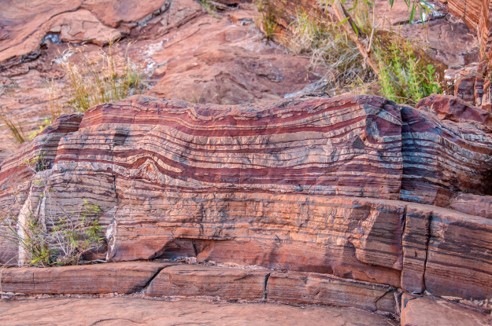
Credit: By Graeme Churchard from Bristol, UK - Dales GorgeUploaded by PDTillman, CC BY 2.0, https://commons.wikimedia.org/w/index.php?curid=30889569
- To better understand how early Earth oxygen levels began to rise, researchers from the University of Michigan turned to an unusual place, sinkholes at the bottom of Lake Huron in the Great Lakes.
- These underwater sinkholes are low in oxygen and rich in sulfur, creating chemical conditions similar to those on early Earth.
- They are home to modern cyanobacterial mats, thick layers of microbes that photosynthesize. These mats mimic ancient life billions of years ago.
- The researchers conducted experiments both in the natural environment of Lake Huron and in the lab.
- In the controlled lab setting, they simulated different day lengths. They tested very short days, like early Earth, to today’s 24-hour cycle.
- They measured gross oxygen production or how much oxygen the microbes made. They also measured net oxygen export; a measure of how much oxygen actually escaped the mat into the water or air.
- It turns out that cyanobacteria like to sleep in. During the early morning hours, they produce very little oxygen, taking a few hours before ramping up oxygen production.
- The study revealed that on short days, the oxygen was reabsorbed or consumed within the microbial mat before it could escape.
- In longer days, oxygen had more time to accumulate and diffuse out of the mat into the surrounding environment.
- This showed that day length, controlled by Earth’s rotation speed, directly affects how much oxygen reaches the atmosphere.
- It suggests that as Earth’s rotation slowed and as days grew longer, cyanobacteria could export more oxygen.
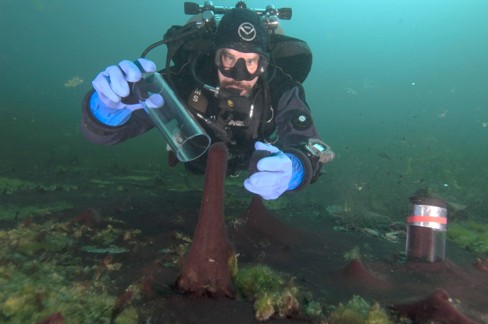
Credit: NOAA, Thunder Bay National Marine Sanctuary
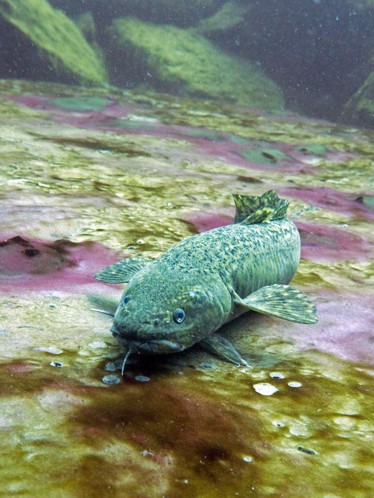
Credit: John Slayer, Force Blue
- The Moon’s gravity creates tides that pull on Earth’s rotation, gradually slowing it down over time.
- This process, called tidal friction, also causes the Moon to drift away a little each year.
- For more on how this works, see the EarthDate episode, The Day’s Getting Longer.
- Eventually, enough oxygen began escaping into the environment to change Earth’s atmosphere.
- This led to the Great Oxygenation Event, around 2.4 billion years ago, when atmospheric oxygen levels rose significantly for the first time.
- It transformed Earth’s chemistry, depleted iron in the oceans, and enabled new metabolic strategies like aerobic respiration.
- But oxygen levels remained relatively low for over a billion years.
- Later, a second major increase in oxygen, called the Neoproterozoic Oxygenation Event, occurred between 800 and 550 million years ago.
- This rise in oxygen is linked to changes in nutrient cycles, tectonic activity, evolving photosynthetic life, and Earth’s increasing day length.
- The event supported the emergence of more complex, multicellular organisms, including the first animals.
- Both oxygenation events likely depended not just on oxygen-producing microbes, but also on longer days that gave oxygen more time to escape microbial mats and accumulate in the atmosphere.
- This led to the Great Oxygenation Event, around 2.4 billion years ago, when atmospheric oxygen levels rose significantly for the first time.
- As Earth’s rotation continued to slow, each day gave cyanobacteria, and later algae, more productive hours.
- The oxygen we breathe today is thanks to more than just microbes.
It also took planetary mechanics. The Moon slowly pulled away, tides reduced Earth’s spin, and days became longer, giving life the time it needed to change the air. - What seemed like a small shift of just a few extra hours of daylight, was enough to help reshape an entire planet.
- The oxygen we breathe today is thanks to more than just microbes.
Episode script
Billions of years ago, the globe spun twice as fast as today; a complete rotation took just 6 hours.
Then Earth’s rotation slowed, and that’s why you’re here listening to this episode. Let me explain.
The atmosphere of early Earth was made up of methane, CO2 and sulfur gases. But no oxygen.
Eventually, as noted on a prior EarthDate, cyanobacteria, blue-green algae, began to produce oxygen through photosynthesis.
At first, the amount of oxygen they released was so small that it was absorbed by iron in seawater, and no oxygen entered the atmosphere.
Scientists researching this phenomenon found a similar low-oxygen, high-sulfur environment in sinkholes at the bottom of Lake Michigan, where modern blue-green algae grows.
There, and in a lab mimicking that environment, they tested the effects of day duration on oxygen production.
Turns out blue-green algae is dormant in the morning. In a short day, it was nearly dark again by the time it started producing oxygen.
And that small amount was reabsorbed by the algae before it could enter the water.
As days lengthened, the algae had enough time to produce enough oxygen to escape.
Over millions of years, oxygenated water first gave rise to aerobic sea life.
Then an oxygen-rich atmosphere allowed land creatures to develop and thrive, which eventually led to…
you, and me, and a radio show called EarthDate.