
Credit: Image generated using ChatGPT, May 27, 2025, Fiery radon in dark atmosphere
Background
Synopsis: Radon is an invisible, odorless gas that quietly poses serious health risks, yet many people remain unaware of its dangers. A combination of scientific research and unexpected discoveries have paved the way toward reducing the impact of this silent killer.
- Radon is a naturally occurring element that forms during the breakdown of uranium and thorium, two other natural elements in Earth’s crust.
- As a noble gas, radon is odorless, tasteless, and colorless, making it undetectable to human senses. However, with the proper equipment, radon is found to be present in air, water, and soil.
- Radon was discovered in 1900 by the German physicist Friedrich Ernst Dorn while he was researching the natural radioactive decay of radium, radon’s predecessor.
- Radon is a radioactive gas, with the most common isotope, Radon-222, having a half-life of 3.8 days. Half-life is the interval of time required for one-half of the atomic nuclei of a radioactive sample to decay.
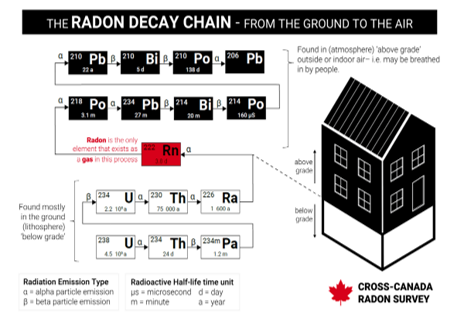
- The process of radon formation begins when uranium-238 decays through multiple steps, eventually forming radium which then undergoes fission to become radon.
- Radon has been used to treat some types of cancer and to decrease the symptoms of autoimmune diseases like arthritis.
- Radon is also used in geologic and hydrologic research as it can be tracked in air masses and in groundwater. Recent studies suggest that variations in radon concentration can signal impending seismic activity.
Credit: https://crosscanadaradon.ca/wp-content/uploads/2024/10/Slide14-1200x1063.png
- Despite these beneficial applications, radon is more widely recognized for its health risks.
- When radon makes its way to the surface, radon atoms get trapped in the lungs when you breathe.
- As the radon continues to undergo radioactive decay, it releases smaller particles along with small bursts of energy. This energy can damage lung tissue and lead to lung cancer over time.
- Radon is the number one cause of lung cancer in non-smokers and is the second leading cause of lung cancer in the United States.
- Smokers are estimated to be 25 times more vulnerable to the risks of radon compared to non-smokers.
- Radon contributes to between 3% and 14% of all lung cancers worldwide, depending on national radon levels and smoking rates.
- Scientists have a higher level of certainty about the risks of radon than those associated with most other cancer-causing substances.
- Radon’s health risks were first recognized in uranium miners by Dr. Wilhelm Hueper, a pathologist with the U.S. National Cancer Institute.
- His 1942 report linked radon to the premature deaths of over 50% of European miners within 10-20 years of employment.
- Despite the finding, there were minimal changes to safety regulations at the time.
- In the 1980’s, radon exposure made its way into public consciousness in an entirely new context, the home.
- During the winter of 1984, Stanley Watras, a construction engineer, triggered radiation alarms at a soon-to-be nuclear power plant located in eastern Pennsylvania, even though no nuclear material was on-site.
- The radiation was traced to radon decay products on Watras’s clothing, originating from his nearby home.
- An investigation revealed that his home had an unusually high radon concentration of 2,700 pCi/L (picoCuries per liter) in the indoor air, while the EPA recommends safe levels under 4.0 pCi/L.
- Because the radon levels were so high, the family was forced to move out and the EPA moved in and used the Watras’s home to test multiple radon mitigation systems.
- The level of radiation in the Watras home was the highest ever recorded inside a building and breathing the air in the home would be equivalent to smoking 135 packs of cigarettes a day.
- This random event led to the development of radon testing and mitigation technology and highlighted residential radon exposure as a significant public health issue.
- Radon exposure is not just a problem in the United States but is a widespread global issue, rooted in the geology beneath our feet.
- Soil and bedrock naturally contain small amounts of uranium and thorium. As these radioactive elements decay, the radon formed can travel through air pockets in the soil and into homes and buildings.
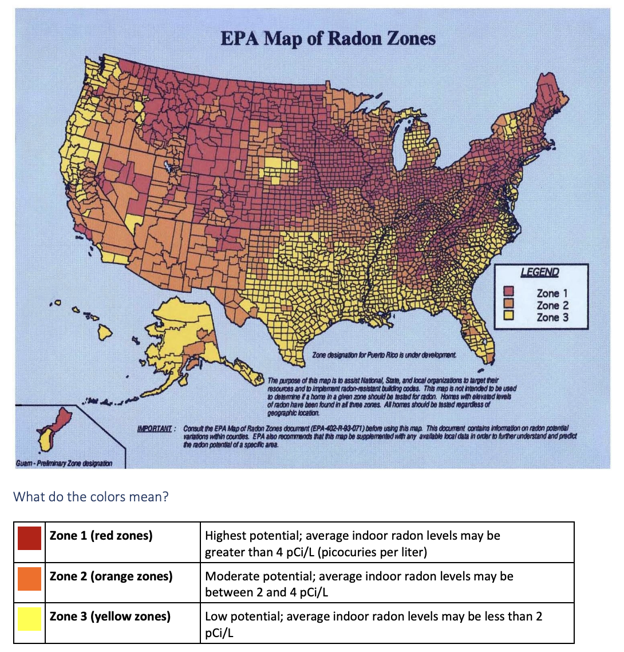
- The amount of radon released varies depending on the underlying bedrock with some areas experiencing a high potential for damaging radon levels.
- Rocks that are derived from continental crust—particularly granites, pegmatites, and certain metamorphic rocks—tend to have higher concentrations of uranium and thorium.
- When these rocks weather, they release tiny amounts of these elements into the soil, where radon can form and migrate upward.
- In contrast, sedimentary rocks such as limestone or sandstone generally contain less uranium and produce lower levels of radon, unless they include mineralized zones or volcanic ash layers.

Credit: https://pubs.usgs.gov/gip/7000018/report.pdf, page 13
- While geology sets the stage for how much radon is produced, several other factors influence how much of that gas accumulates indoors.
- Building construction and materials — The type of foundation—such as a basement, crawlspace, or slab—affects how easily radon can enter a structure. Cracks, joints, and openings around pipes or drains can serve as entry points.
- Ventilation — Poor ventilation and tightly sealed homes allow radon to build up to higher concentrations. Increasing airflow helps dilute and vent the gas outdoors.
- Weather and seasonal factors — Cold weather often increases indoor radon levels, as windows are closed and heating systems draw more air from the ground. Changes in atmospheric pressure, temperature, and precipitation can also alter how radon moves through soil and buildings.
- Soil and site characteristics — Certain ground conditions make it easier for radon to travel toward the surface and into buildings:
– Soils with high permeability
– Well-drained or typically dry soils
– Soils that form deep cracks during dry periods
– Locations on hills or slopes
– Thin soils with bedrock near the surface
– Presence of limestone caverns or fractured rock beneath the site
Credit: https://www.epa.gov/system/files/documents/2024-05/radon-zones-map_text_link.pdf
- Despite this potential widespread exposure, there are simple measures to take to reduce your risk.
- First and foremost, is to stop smoking to protect the lungs.
- The next step to reduce exposure is to eliminate the radon risk in homes and buildings.
- Do-it-yourself home test kits offer a convenient and affordable way to get a general idea of radon levels.
- Professional tests are more reliable and accurate and may offer insight about potential radon entry points and radon mitigation.
- Any amount of radon in the home is too much, so reducing radon inside the home or building will always reduce the risk of lung cancer.
- Radon levels are measured in units of picocuries per liter (pCi/L) or in Becquerel per cubic meter (Bq/m3). (1 pCi/L is equivalent to 37 Bq/m3).
- Levels above 4 pCi/L are considered high and require immediate action. The average radon level in American homes is about 1.3 pCi/L, according to the EPA.
- In Canada, the average household radon level was 84.7 Becquerel per cubic meter (Bq/m3) which is equivalent to 2.29 pCi/L. One in five residential buildings contain radon levels at or higher than 200 Bq/m3, the concentration considered the actionable threshold.
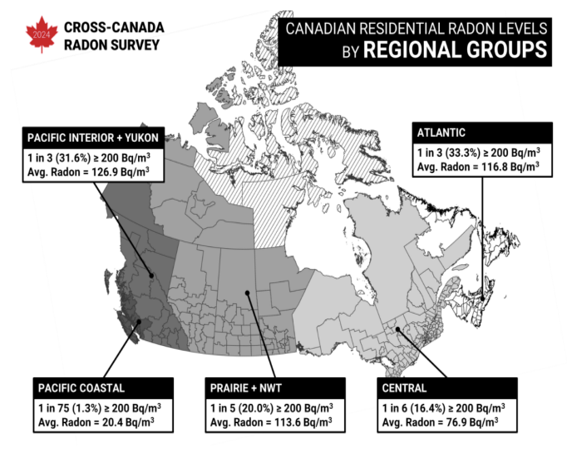
the Prairie + NWT region of Canada also experiences high average radon concentrations.
Credit: https://crosscanadaradon.ca/survey/#:~:text=The%20average%20radon
%20level%20of%20a%20Canadian,on%20data%20from%20the%202021%20Canada%20Census.
- There are several methods used to reduce the concentration of radon in a home or building. Some of these can be done by the homeowner while others require the services of a professional.
- Seal cracks in floors and walls to prevent radon from seeping into the space.
- Improve the ventilation in the home by opening windows and using fans.
- Active systems use fans to draw radon gas from beneath the foundation and exhaust it outdoors. These systems are typically more expensive but are generally more reliable and effective, reducing radon concentrations by 50-99%.
- Passive systems rely on natural air pressure differences to vent radon. These typically involve installing a vent pipe from the basement to the roof, often without a fan. They can reduce radon concentrations by 30-70%.
- Radon might be a silent threat, but knowledge and action can make it less of a danger. If you haven’t already, test your home for radon as it is the only way to know if you’re at risk. With simple and affordable testing kits, you can protect yourself and your loved ones from this dangerous gas. Stay informed, take action, and ensure your home is a safe place to live.
- For more information on testing, mitigation, and radon resources, visit the Environmental Protection Agency’s website or contact your local government today.
Episode script
In 1984, an engineer walked into a nuclear power plant under construction and set off radiation alarms.
But there was no nuclear material yet on site. Where was the radiation coming from?
Testing revealed the man was carrying it, on his clothes.
Where did he become so contaminated? Turns out, at home.
Scientists visited his house and found levels of radon gas 600 times higher than normal – the highest level ever measured inside a building.
They immediately moved the man and his family out. Then began testing ways to mitigate the gas.
Radon starts as uranium, which decays to become other elements and eventually radon -- the only element in that chain that occurs naturally as a gas.
It’s odorless, colorless…and common, in small quantities, in air, water, and soil -- especially above bedrock that contains trace amounts of uranium.
But there, it can leach into basements where it concentrates and becomes a health hazard. Radon is the leading cause of lung cancer in non-smokers – and is even more dangerous to smokers.
A quick Google search can tell you if your area is prone to indoor radon accumulation.
If so, buy a do-it-yourself testing kit. If you find high levels, hire a professional.
They may recommend sealing all cracks in basement floors and walls, or ventilating under the foundation.
With some simple precautions, you’ll be much safer.