
Credit: By Walter from Tampa/St Petersburg, Florida - DSC_2645_pp, CC BY 2.0, https://commons.wikimedia.org/w/index.php?curid=65255243
Background
Synopsis: LEDs have transformed lighting by producing more light with less electricity and far less wasted heat.
Out of the Dark
- For thousands of years, people relied on fire for light. Lamps burned oils from plants or animals. Candles made from wax lit homes, streets, and workplaces. These early forms of light depended on Earth materials, but they also produced smoke, soot, heat, and constant fire risk.
- As cities grew and people demanded more light after sunset, inventors searched for a safer and more reliable way to illuminate the world. Electricity offered a new possibility.
- The EarthDate episode, Illuminating Incandescent Bulbs, explores how inventors such as Joseph Swan and Thomas Edison helped develop practical electric lighting.
- Over the next century, scientists and engineers would continue searching for ways to create the same amount of light using far less energy.
The Problem with Incandescent Bulbs
- Early electric lighting worked by heating a thin filament inside a glass bulb until it glowed. These incandescent bulbs produced a warm, steady light that transformed homes and cities.
- At first, carbon filaments were used, but inventors later replaced them with tungsten, a metal that could withstand much higher temperatures. Tungsten produced brighter light and lasted longer, becoming the standard for incandescent bulbs in the early 1900s.
- But incandescent bulbs had a major weakness. Most of the electricity flowing into the bulb did not become visible light. Instead, it became heat.
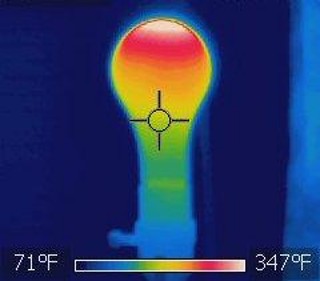
- Anyone who has touched an old incandescent bulb knows just how much heat it produced. The glowing filament inside could reach temperatures of about 4500oF (2482oC). The bulb was essentially a tiny electric heater that happened to produce some light.
- Even modern incandescent bulbs convert only a small fraction of their energy into visible light. Much of the electricity is wasted as heat energy escapes into the room.
- As electricity demand increased during the twentieth century, this inefficiency became increasingly important. Scientists began searching for ways to produce light without heating materials to extreme temperatures.
Credit: By Zaereth - Own work, CC0, https://commons.wikimedia.org/w/index.php?curid=20400759
Fluorescent Lighting Changes the Equation
- One solution came from experiments with electricity and gases. In the late 1800s, scientists discovered that electric current passing through certain gases could create light.
- By the early 1900s, inventors developed lamps using mercury vapor inside glass tubes. When electricity energized the gas, it produced ultraviolet radiation. A phosphor coating inside the tube absorbed this radiation and converted it into visible white light.
- This process allowed fluorescent lamps to produce far more light with much less heat than incandescent bulbs.
- By the 1930s, fluorescent lighting was spreading through factories, offices, schools, and stores. During World War II, the need for efficient industrial lighting accelerated its use even further.
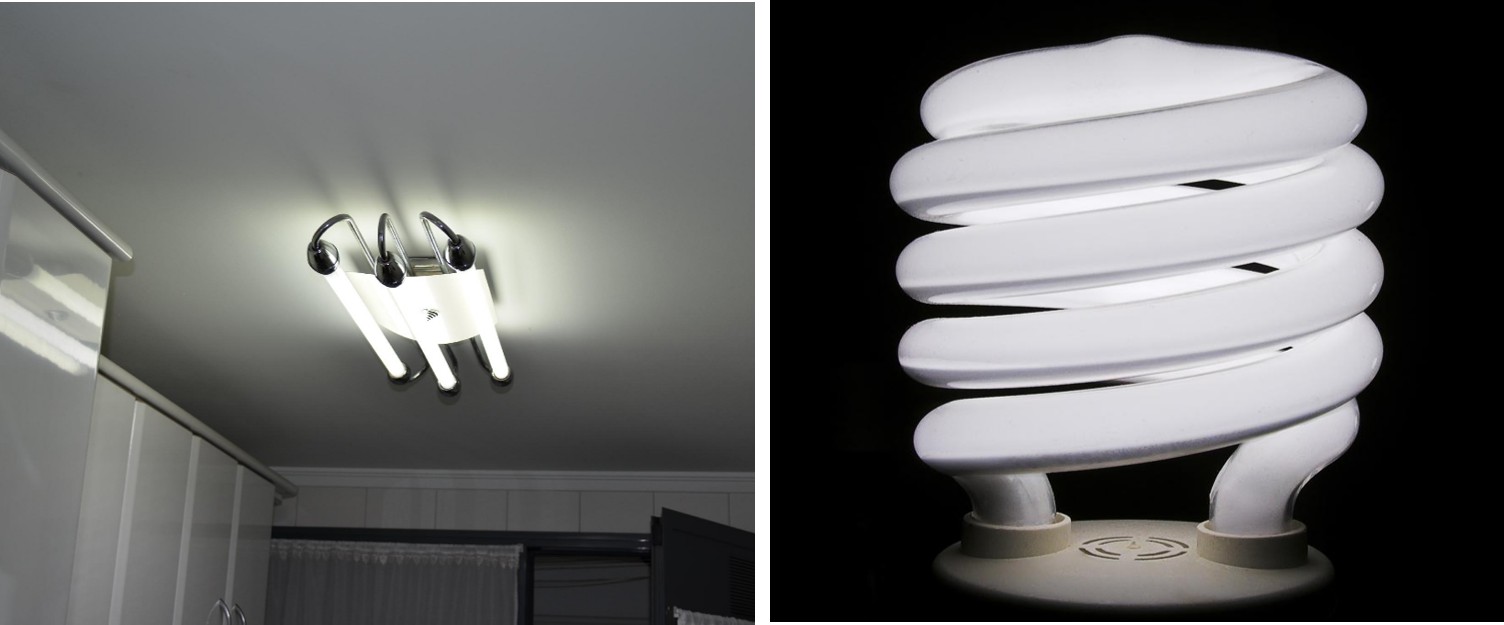
- Compact fluorescent lamps, or CFLs, later brought this technology into homes. These bulbs used coiled fluorescent tubes with built-in electronics that allowed them to fit into ordinary light fixtures. Many even used the same screw base developed by Edison in the early days of electric lighting.
Fluorescent bulbs used about 75 percent less energy than traditional incandescent bulbs while lasting much longer. Their widespread use helped reduce electricity demand in homes and commercial buildings around the world.
Credit (left image): By Alan - Self-photographed, CC BY-SA 3.0, https://commons.wikimedia.org/w/index.php?curid=23454258
Credit (right image): By http://en.wikipedia.org/wiki/User:PiccoloNamek - http://en.wikipedia.org/wiki/File:Compact-Flourescent-Bulb.jpg, CC BY 3.0, https://commons.wikimedia.org/w/index.php?curid=8689967
LEDs and the Rise of Solid-State Lighting
- Scientists continued searching for a way to produce light without heated filaments or gas-filled tubes.
- That breakthrough came with semiconductors.
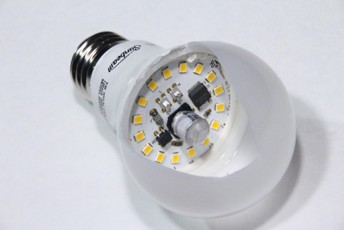
- Light-emitting diodes, better known as LEDs, produce light when electricity passes through specially designed semiconductors materials. This process, called electroluminescence, creates light directly with very little wasted heat.
- Early LEDS developed in the mid-1900s produced only small amounts of colored light (typically green and red) and were mostly used as indicator lights in electronics.
- A major breakthrough came in the 1990s when researchers developed efficient blue LEDs. This made bright white lighting possible and opened the door to a new generation of highly efficient bulbs.
- Unlike incandescent bulbs, LEDs do not rely on heating a filament. Instead, electrons moving through semiconductor materials release energy directly as light.
- This allows LEDs to produce far more visible light using much less electricity.
- The efficiency of lighting is often measured in lumens per watt, meaning how much light is produced for each unit of energy.
- Traditional incandescent bulbs typically produce about 15 lumens per watt. Compact fluorescent bulbs may produce around 70 lumens per watt.
- Modern LED bulbs can produce more than 100 lumens per watt.
- In other words, LEDs can provide the same amount of light while using only a fraction of the electricity required by older bulbs
Credit: By Loadmaster David R. Tribble, Own work, CC BY-SA 4.0, https://commons.wikimedia.org/w/index.php?curid=101149484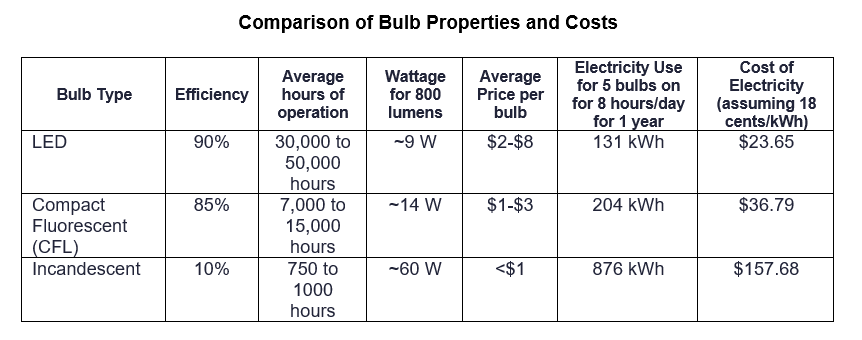
https://www.energystar.gov/sites/default/files/asset/document/LBR_2017-LED-Takeover.pdf
https://www.gelighting.com/inform/guide-energy-efficient-light-bulbs
https://www.powerwizard.com/blog/a-breakdown-of-energy-efficient-light-bulbs/
https://www.electricchoice.com/electricity-prices-by-state/
Small Bulbs, Big Energy Savings
- Lighting may seem like a small part of daily life, but collectively it uses enormous amounts of electricity. Lighting accounts for roughly 6 percent of electricity use in homes and about 17 percent in commercial buildings.
- Because lighting is used everywhere, even small efficiency improvements can have a major impact on energy demand.
- As the table above shows, consider five traditional 60-watt incandescent bulbs used for eight hours each day. Over the course of a year, those bulbs would consume nearly 900 kilowatt-hours of electricity. Replacing them with LED bulbs could reduce that energy use by more than 80 percent.
- The savings extends beyond electricity bills. More efficient lighting also reduces the amount of fuel needed to generate electricity at power plants. Lower energy demand can reduce stress on electrical grids and decrease emissions associated with electricity generation.
- The shift from incandescent bulbs to LEDs represents one of the largest improvements in everyday energy efficiency in modern history.
Light From Earth
- Every form of lighting depends on materials drawn from Earth. Early lamps burned oils and waxes. Incandescent bulbs relied on tungsten filaments sealed in glass.
- Fluorescent lamps used mercury vapor and phosphor coatings. LEDs depend on carefully engineered semiconductor materials made from elements such as gallium, iridium and rare earth elements.
- The story of lighting is not simply the story of one invention. It is a continuing progression of materials, engineering, and energy efficiency.
- Over time, scientists and inventors have learned how to produce more light while using less energy. From fire to filaments to semiconductors, each advance has changed how people live, work, and use electricity after dark.
"Efficiency is the most important step we can take in energy.”
Dr. Scott Tinker, from the video Science of Energy Efficiency.
Episode Script
LEDs are everywhere today. But what does L. E. D. stand for anyway?
Luminous Efficiency Device? Less Electricity Demanded?
Not quite – though both correctly describe Light Emitting Diodes. They make more light, from less electricity, than any other technology.
Incandescent bulbs of the 20th century heat a metal filament until it glows white hot. They produce light, but much more electricity is converted into, and wasted as, heat.
Fluorescent tubes pass energy through a gas that glows. They consume less electricity, but their light is not so attractive, they must be disposed of properly, and the bulbs can be fragile.
So scientists kept pushing for something better, and invented LEDs in the 1960s. The initial technology was basic and expensive, but worked the same way it does today:
Electricity flows through a two-layered semiconductor. One layer has an excess of negatively charged electrons.
The electricity forces electrons to jump to the other positively charged layer to equalize. As they do, they release a small amount of energy as light.
Multiply that over millions of electrons and these diodes can emit a great deal of light, with very little energy wasted as heat.
They’re such a step up over old bulbs, that LEDs now make up half of global lighting, and growing.