
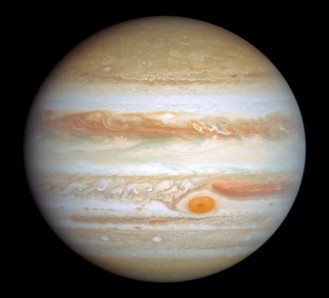
Credit: By NASA/STSCI (S.T.A.R.S) -https://hubblesite.org/, Public Domain, https://commons.wikimedia.org/w/index.php?curid=159176801
Background
Synopsis: An enormous, atmospheric storm on Jupiter is responsible for the planet's distinct red spot. Identified for centuries, we are still learning about the formation, causes, and longevity of this unique feature on the gas giant, Jupiter.
The Planets
- My Very Educated Mother Just Served Us Nine Pizzas.
- If this expression sounds familiar, you can probably recall the correct order of the planets: Mercury, Venus, Earth, Mars, Jupiter, Saturn, Uranus, Neptune, and Pluto.
- Throughout our education, we’ve learned small facts about these worlds. Mars is the red planet, Saturn has rings, Pluto may or may not be an actual planet, and Jupiter is the largest.
- But one of these planets has a feature so large and long-lasting that astronomers have been tracking it for centuries.
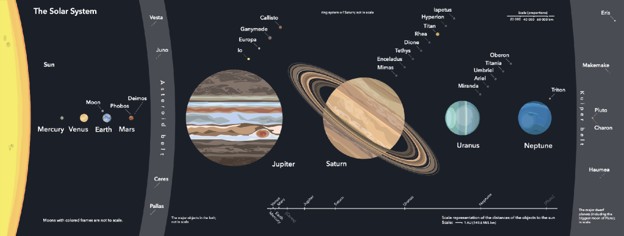
Credit: By © Beinahegut / This file was derived from: The Solar System.svg, CC BY-SA 4.0, https://commons.wikimedia.org/w/index.php?curid=155313923
Jupiter Fun Facts
- As the largest planet of our Sun, Jupiter was named after the king of the ancient Roman gods.
- It was formed 4.6 billion years ago by dust and gases left over from the Sun’s formation and is the oldest of the planets.
- Jupiter is eleven times wider than Earth. If it were hollow, 1000 Earth’s could fit inside.
- Jupiter is more massive than all the other planets combined.
- Despite this large size, it has the shortest day in the solar system, taking just 9.9 hours to make one rotation.
- Jupiter is 5.2 times further from the Sun than Earth and takes 12 Earth years to make a complete orbit.
- The massive planet has 95 officially recognized moons, although more are frequently discovered. The four largest are Io, Europa, Ganymede, and Callisto. They were first observed by Galileo Galilei in 1610 with the aid of an early version of a telescope.
- Jupiter is a gas giant and does not have an actual surface. It is composed primarily of hydrogen and helium, much like the composition of the Sun.
- Rings around Jupiter were a surprise, discovered in 1979 by NASA’s Voyager 1 spacecraft. The ring system may be the result of dust created when meteoroids collide with Jupiter’s smaller and innermost moons.
- Jupiter’s atmosphere gives the planet its appearance of vivid and colorful stripes and spots. Three distinct layers of clouds span roughly 44 miles (71 km) with the innermost layer possibly made of water ice and vapor, the middle layer perhaps made of ammonium hydrosulfide crystals, and the outermost layer probably made of ammonia ice.
- The colors that emerge from these clouds might be streams of sulfur and phosphorus-containing gases that originate from Jupiter’s warmer interior.
- The fast rotation generates strong jet streams that sort clouds into dark and bright horizontal bands.
A Storm Bigger Than Earth
- Jupiter’s fast rotation and thick atmosphere do more than create colorful bands. They also drive powerful winds that race around the planet at incredible speeds.
- Where these winds collide and shear past one another, enormous storms can form. These storms are far larger and longer lasting than anything on Earth.
- One of these storms has been raging for centuries. It is so large that our entire planet could fit inside it.
- This gigantic storm, known as the Great Red Spot, is an anticyclone. The storm is composed of a swirling region of high pressure where air circulates in the opposite direction of hurricanes on Earth.
- While Earth’s hurricanes are low-pressure systems with rising air, Jupiter’s Great Red Spot is a high-pressure system with sinking air at its center.
- Anticyclones on Jupiter have colder temperatures at their tops and warmer temperatures deeper below, the opposite structure of cyclones on the planet.
- Data collected from NASA’s Juno probe has revealed that these storms are not just wide, but also deep.
- The Great Red Spot extends over 200 miles (350 km) beneath the cloud tops, reaching far below the region where sunlight warms the atmosphere. This makes it not just a surface feature, but a massive, towering system embedded deep within Jupiter’s atmosphere.
- On Earth, even the largest hurricanes typically span about 62 - 600 miles (100 -1,000 km) and reach only about 9-10 miles (15 km) in height. By comparison, Jupiter’s Great Red Spot stretches roughly 10,100 miles (16,400 km) wide and extends about 200 miles (350 km) deep, making it not just larger, but vastly more massive and long-lived than any storm on Earth.
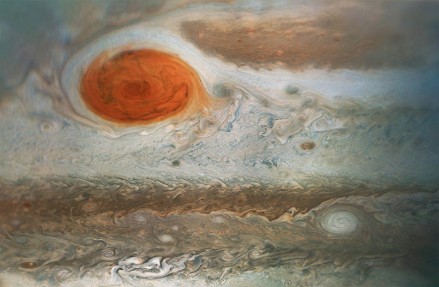
Credit: By NASA/JPL-Caltech/SwRI/MSSS/Gerald Eichstädt/Seán Doran - https://www.jpl.nasa.gov/spaceimages/details.php?id=PIA21985, Public Domain, https://commons.wikimedia.org/w/index.php?curid=68486981
Why Is It Red?
- For many years, scientists thought the red color of the Great Red Spot came from chemicals such as phosphorus rising from deep within Jupiter’s atmosphere.
- Newer research suggests a different explanation. The storm’s color may be more like a sunburn, the result of chemical reactions driven by ultraviolet (UV) light from the sun.
- At the top of the storm, gases such as ammonia and acetylene are present in the upper cloud layers. When these gases are exposed to UV radiation, they react to form reddish-colored compounds.
- Data from NASA’s Cassini spacecraft, which captured detailed images and spectra of Jupiter, supports this idea. The observations suggest that only a thin upper layer of the storm is red, sitting above lighter-colored clouds below.
- Researchers describe this as a “crème-brûlée” model, visualized as a thin, burnt layer on top with a smoother, lighter interior beneath.
- Over the past 10-years, the Great Red Spot has appeared to darken slightly. This may indicate changes in the concentration of UV-reactive gases like acetylene and ammonia in the upper atmosphere.
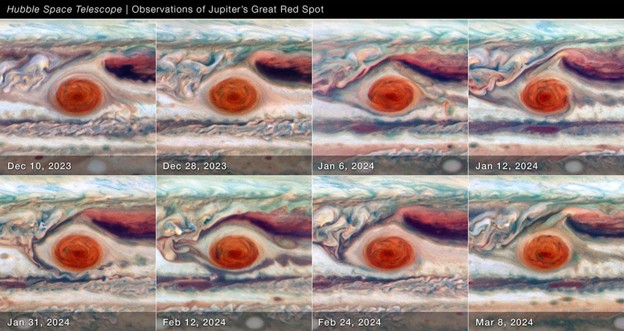
Credit: NASA https://assets.science.nasa.gov/dynamicimage/assets/science/missions/hubble/releases/2024/10/STScI-01J9452WNQYZHTP4Z28PV82YDP.tif?w=2000
Will It Always Be There?
- As omnipresent as the Giant Red Spot seems, close observations since the 1930s have witnessed changes in both the size and shape of Jupiter’s massive storm.
- Measurements dating back to the late 1800s estimated the Giant Red Spot with a width of 25,500 miles (41,000 km).
- In 1979, NASA’s Voyager I and 2 measured a width of 14,500 miles (23,330 km) and evidence points to a continual shrinking size for the Red Spot.
- Images from the Hubble Space Telescope have also revealed daily changes in the anticyclone.
- Variations in UV light result in changes to the brightness of the red coloration. This would indicate that less UV light is being absorbed by the gases in Jupiter’s upper atmosphere.
- Far more challenging to explain is the variation in the motion of the spot. Scientists studied high-resolution images from Hubble over a 90-day period and observed an oscillation in the size and movement of the Great Red Spot. Some likened it to a jiggling bowl of gelatin but could not propose a reason for this motion.
- Some predict that the spot will continue to shrink, eventually becoming more stable but with a less-elongated shape.
- Other research suggests that the spot could disappear within 10-20 years, while others believe it could last for hundreds more.
From its immense size to its surprising depth and chemistry, the Great Red Spot shows that Jupiter’s atmosphere operates very differently from Earth’s. Studying it helps scientists better understand weather, energy, and motion on planets across our solar system and beyond.
Episode Script
Jupiter is more massive than all other planets in the solar system combined, and a thousand times larger by volume than Earth. It even has a single storm that’s wider than our planet. And it’s been raging for centuries.
It’s Jupiter’s great red spot.
And it’s actually an anticyclone, very much the opposite of hurricanes on Earth. It spins the opposite direction. It’s a high pressure rather than low pressure event. And is warmer rather than colder below.
And it’s huge – 10,000 miles across. The storm’s winds dwarf any on Earth. That’s partly because Jupiter, despite its monumental size, rotates much faster than any other planet.
And why is the storm red? New research suggests that the very top of the storm has ammonia and other gases that become ‘burned’ by UV exposure in Jupiter’s thin upper atmosphere, changing color.
The red spot appears to be getting redder over the years, suggesting a changing gas composition. Which begs the question, will it last?
Measurements taken in the 1800s suggest a width of 25,000 miles. NASA’s Voyager probes in the late 70s recorded a width of 14,000 miles, 40% larger than today.
This has led some scientists to predict Jupiter’s great storm may shrink out of existence in just a few decades. Even the greatest don’t last forever.