Credit: By Vishwanatha Badikana - Own work, CC BY-SA 4.0, https://commons.wikimedia.org/w/index.php?curid=148909918
Background
Synopsis: Sweden sends less than 1% of its waste to landfills, instead recycling much of it and burning the rest to produce heat and electricity. This highly efficient system has produced an unusual outcome. The country needs to import trash to fuel its energy systems. This system also raises questions about emissions and long-term waste-to-energy solutions.
Waste in Sweden
- Of the 4,100,000 tons of municipal waste generated in Sweden annually, less than one percent ends up in a landfill.
- Yet the country has such a desire for trash that it imports it from other countries including Italy, United Kingdom, Norway, and Ireland.
- Literal boatloads of trash are shipped to Sweden.
- Why would a country run out of garbage, and then import more?
Waste in Most Countries
- Around the world, much of what we throw away ends up in landfills.
- In developed countries, these are often modern landfills, like those described in a previous EarthDate, What a Waste!. These sites are engineered, regulated, and monitored, using liners and leachate collection systems to reduce environmental impacts.
- In many other regions, waste ends up in a dump with few safeguards, allowing pollutants to contaminate water, soil, and air.
- Whether in landfills or open dumps, organic waste breaks down and produces methane, a potent greenhouse gas.
- Water that percolates through landfills becomes contaminated as it extracts pollutants from the landfill waste, forming a toxic liquid called leachate.
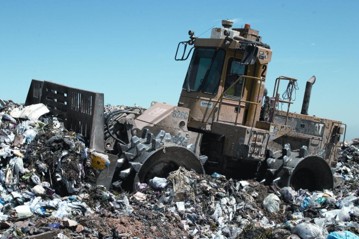
- In the U.S., nearly half of all waste is sent to landfills, where it is buried, and largely out of sight.
Credit: By Ropable - Own work, Public Domain, https://commons.wikimedia.org/w/index.php?curid=530271
Sweden’s Management of Waste
- Recycling has existed for centuries, often driven by necessity during times of war or economic hardship. By the 1970s, it had grown into a broader environmental movement.
- Sweden began building its modern waste system in the 1980s by requiring the sorting of materials such as glass, paper, and cardboard. Plastics were added in the 1990s, along with the expansion of local recycling stations.
- Over time, national policies placed the responsibility on manufacturers to design products and packaging that use fewer resources and are easier to reuse or recycle.
- This approach reflects a circular system, where materials are reused and repurposed rather than discarded.
- Landfilling household waste was largely phased out in the early 2000s, pushing the country to find other ways to manage what remained.
- Public participation has been essential to the system’s success.
- A deposit system gives money back for returned bottles and cans.
- Recycling stations are located within easy reach of most homes.
- Students learn about recycling at an early age.
- Mobile collection programs gather harder-to-recycle materials such as clothing, metals, batteries, and paint.
- Incentives such as vouchers encourage participation.
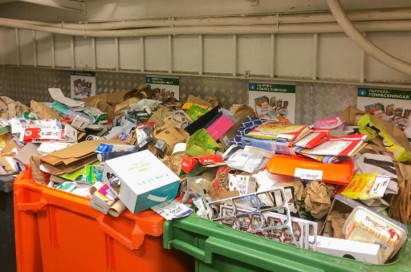
- As a result of these combined efforts, roughly half of Sweden’s waste is recycled.
- Even food waste is collected separately from homes and businesses, creating another stream of usable material.
- Some of this food waste is used to generate biogas or biofertilizer.
- What cannot be reused or recycled does not go to a landfill. It becomes something else entirely.
Credit: By Frankie Fouganthin - Own work, CC BY-SA 4.0, https://commons.wikimedia.org/w/index.php?curid=97136655
Waste to Energy
- Sweden’s non-recycled waste does not go to a landfill. Instead, it is sent to incinerators where it is burned to generate heat and electricity.
- The country began developing its waste-to-energy program during the post-war boom of the 1940s.
- As housing expanded, communities were connected to district heating networks. Rather than each home having its own boiler or furnace, heat was pumped to individual homes and businesses from a central location.
- As the network grew, some facilities were adapted to also generate electricity, reducing reliance on coal, natural gas, and oil.
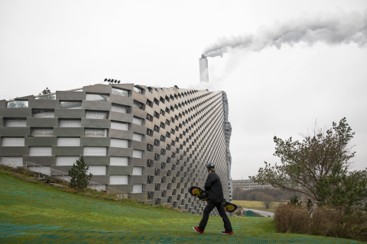
- Today, Sweden operates about 34 waste-to-energy plants that supply nearly 1.5 million households with heat and about 800,000 households with electricity.
- With a population of around 10 million, this represents a meaningful share of the country’s energy system.
- Most of Sweden's electricity still comes from hydroelectric and nuclear power, but waste-to-energy plays an important role in managing waste while recovering energy.
Credit: By News Oresund - 2019-11-27_Amager Bakke_Copenhagen Hill, CC BY 2.0, https://commons.wikimedia.org/w/index.php?curid=101319514
Not Enough Trash
- Sweden’s success in reducing landfill waste has created an unexpected challenge. The country needs more trash.
- As recycling efforts expanded, less material remained to fuel waste-to-energy plants.
- At the same time, the European Union has set a goal of sending no more than 10% of municipal waste to landfills by 2035.
- To meet this target, some countries export their waste, with Sweden acting as a major destination.
- Sweden now imports nearly 2 million tons of waste per year and is paid to take it, generating tens of millions of dollars in revenue.
- Other countries are beginning to build their own waste-to-energy systems, which could reduce the need for exports in the future.
Tradeoffs and Questions
- While Sweden’s system greatly reduces landfill use, waste-to-energy it is not without debate.
- Burning waste releases carbon dioxide and other pollutants, although modern plants are designed to limit emissions.
- Some critics argue that relying on waste as a fuel source may reduce incentives to recycle or to reduce waste in the first place.
- Others point out that building and maintaining these facilities can create a long-term need for a steady supply of waste.
- At the same time, waste-to-energy avoids many of the long-term environmental risks associated with landfills, including methane production and groundwater contamination.
- As more countries adopt similar systems, the balance between recycling, waste reduction, and energy recovery continues to evolve.
A System That Uses Everything
- In Sweden, trash is not simply thrown away. It is sorted, reused, recycled, and even turned into energy until almost nothing remains.
- What begins as waste becomes part of a system designed to use every resource to its fullest.
EarthNote: How Does Trash Become Energy?
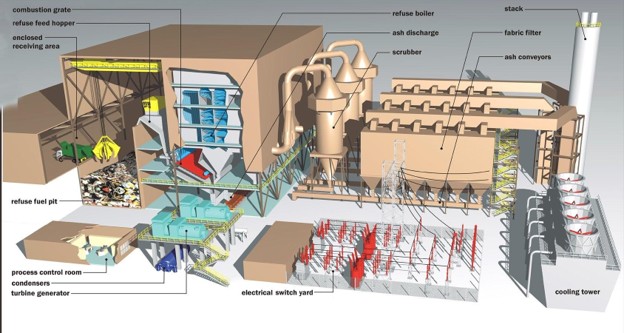
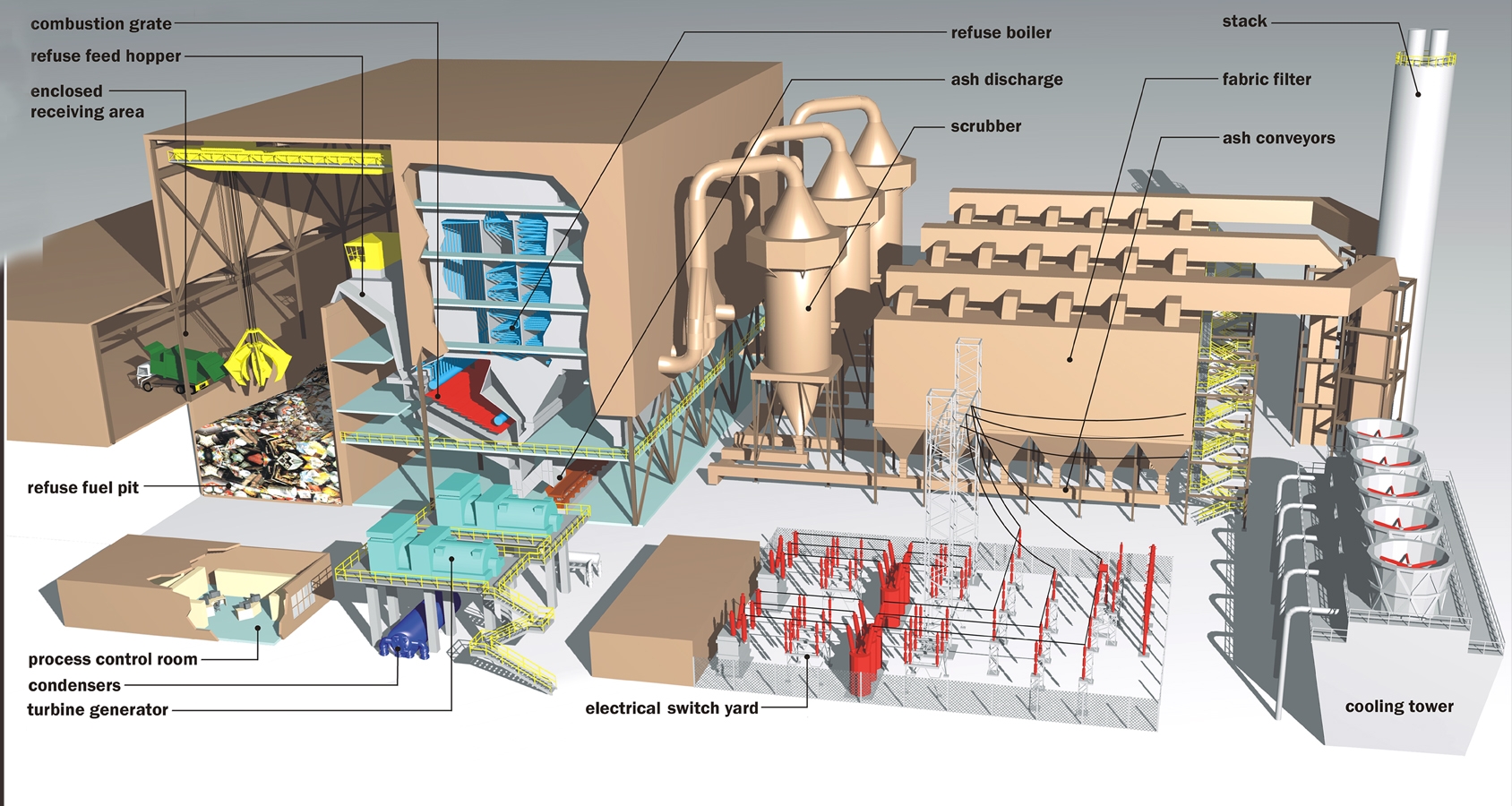
Waste-to-energy facilities function much like other thermoelectric power plants, but with a different fuel source. Waste is delivered to the plant and burned at high temperatures, often above 850°C, in an incinerator. These high temperatures help ensure more complete combustion and reduce the formation of harmful compounds. The heat released from combustion produces pressurized steam, which spins a turbine connected to a generator to produce electricity.
Modern waste-to-energy plants use a series of pollution control systems similar to those found in fossil fuel power plants. Electrostatic precipitators or fabric filters remove soot and fine particles from the exhaust. Chemicals such as lime are used to neutralize acidic gases, and activated carbon helps capture heavy metals and other pollutants.
Some of the heat produced is also used in district heating systems, where hot water or steam is distributed to nearby homes and buildings. Facilities that generate both electricity and heat, known as combined heat and power systems, can operate more efficiently by using energy that would otherwise be lost.
After combustion, ash remains. Larger bottom ash can contain materials such as metals, glass, and ceramics that can be recovered and reused. Magnets and sorting systems help separate these materials, and the remaining ash is sometimes used in construction materials such as concrete or asphalt. Smaller particles, known as fly ash, are typically treated as hazardous waste and handled separately.
Modern waste-to-energy plants include several processes to limit emissions, such as removing particles, neutralizing gases, and capturing harmful pollutants before they are released.
Credit: https://pinellas.gov/wp-content/uploads/2022/04/WTE-Graphic-Representation.jpg
Episode Script
In America, we’re number one! In many things. Some are not so good. Like garbage. Each American makes 1500 pounds of it a year.
Two-thirds could be recycled, but isn’t. Most goes to landfills.
Who’s number one in recycling? Sweden. Just 1% of their garbage is landfilled.
In the 80s, Sweden began building a circular economy for garbage. They tasked manufacturers to devise ways to handle their packaging after it was used.
And they created robust consumer recycling programs and education. Now half their waste is reused or recycled.
The other half goes to incinerators. They burn that garbage to make electricity, and the hot wastewater is pumped to houses to heat them.
In this way, they supply 15% of Sweden’s power and 10% of its heat.
Yet, incineration isn’t perfect. It produces emissions, like CO2 and other gases. Sweden’s plants capture most of them.
And to keep its incinerators running, Sweden now needs more garbage than it makes – so they import it -- from other EU countries for a fee. Then recycle some and burn the rest.
Could the US reduce our garbage streams like Sweden? They’re a tiny country, a third the size of Texas. And the U.S. has different regulations in all 50 states.
Still, we could do much better with recycling and economic reuse. And every year there are more programs to help us do just that.