
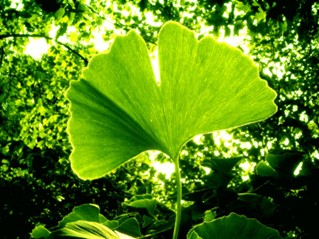
Credit: Public Domain, https://commons.wikimedia.org/w/index.php?curid=637842
Background:
Synopsis: The Ginkgo, a living fossil from the age of dinosaurs, survived near extinction to become a global symbol of beauty and resilience. Its unique history, from temple gardens to Hiroshima’s “survivor trees,” tells a story of endurance across hundreds of millions of years.
A Unique Specimen
- When dinosaurs roamed the Earth, this tree was already here and it’s still with us today. The ginkgo (Ginkgo biloba) is often called a living fossil, a particular term for a species with no close relatives that has changed little over millions of years!
- Today, its fan-shaped leaves and golden autumn color make it one of the most recognizable trees in the world.
A Living Fossil
- Palaeobotanical evidence shows that ginkgo’s lineage dates back more than 200 million years, to the Late Permian-Early Jurassic Period.
- This means it was already thriving when many dinosaurs first appeared, and it has persisted through multiple mass extinctions.
- Fossilized leaves and reproductive structures from extinct ginkgo species look remarkably similar to modern Ginkgo biloba.
- It is the only living member of the plant division Ginkgophyta, and is neither a conifer nor a flowering plant, but something entirely unique among seed plants.
- In the distant past, ginkgo species were widespread across what is now North America, Europe, and Asia.
- Ginkgo shares “living fossil” status with rare animals like the coelacanth, a fish thought to be extinct for millions of years until it was rediscovered in 1938.
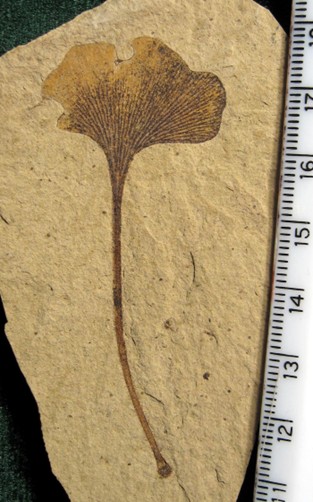
Credit: By Kevmin - Own work, CC BY-SA 4.0, https://commons.wikimedia.org/w/index.php?curid=3574717
Ginkgo Across the Earth
- Global cooling during the most recent Ice Age began to wipe ginkgo from most of its native range.
- Fossil evidence shows it disappeared from North America around 7 million years ago and from Europe about 2.5 million years ago.
- It survived only in small areas of eastern China, possibly because people, particularly Buddhist monks, cultivated and protected it in temple gardens.
- These temple trees became enduring symbols of peace, longevity, and resilience in Chinese culture.
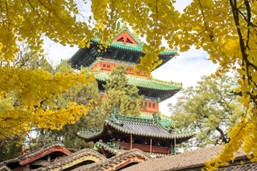
Credit: By Windmemories - Own work, CC BY-SA 4.0, https://commons.wikimedia.org/w/index.php?curid=155632633
- From its refuges in China, ginkgo spread to Korea and Japan centuries ago through cultural and religious exchanges.
- By the late 1600s, European plant collectors had obtained ginkgo seeds and trees, fascinated by its unusual leaves and ancient lineage.
- Ginkgo reached Europe in the late 17th century and North America in the 18th century.
- It quickly became a popular ornamental tree because of its extraordinary tolerance for urban challenges including being resistant to pollution, tolerant of compacted soils and road salt, and largely pest- and disease-free.
- Cities like New York, Tokyo, and Paris planted ginkgo as a street tree for its hardiness and fall beauty.
Atomic Endurance
- Over millions of years, ginkgo has withstood major ice ages, heat waves, and dramatic shifts in Earth’s climate.
- One of its most famous tests of endurance came in 1945 in Hiroshima, Japan.
- In August of 1945, ginkgo trees across the city were covered in leaves. When the atomic bomb dropped, it took just seconds for the leaves to be burned, the bark stripped away, and the tree torched from the heat.
- By the next spring, green growth started to appear, contrary to the belief that no life could exist in the hell-scape for at least 75 years.
- Though heavily damaged, several of these trees still exist today and are known as hibakujumoku, or “survivor trees,” and are still revered and cared for today.
- Some ginkgo trees in China are estimated to be more than 3,000 years old.
Biological Staying Power
- Scientifically, ginkgo’s resilience runs deeper than simple toughness. It is built into how the tree ages, grows, and repairs itself.
- Ginkgo trees show little evidence of biological aging, even after centuries of growth.
- Their cells continue dividing and repairing damage without the typical decline seen in most organisms.
- Growth may slow with age, but internal defense and repair systems remain active.
- This allows ginkgo trees to survive extreme trauma—fire, radiation, storms—and regrow rather than shut down.
- Ginkgo’s resilience is expressed by:
- A strong resistance to insect pests and plant diseases.
- The capacity to tolerate drought, flooding, and extreme temperatures.
- The ability to efficiently recover from physical damage, such as broken branches or trunk injury.
One-of-a-Kind
- This extraordinary endurance is matched by a set of unusual biological features that make the ginkgo unlike any other tree on Earth.
- The leaves have a distinct fan shape with veins that repeatedly split into two. This feature, known as dichotomous venation, is rare in the plant kingdom.
- Ginkgoes are also called the maidenhair tree because its leaves resemble the delicate leaflets of the maidenhair fern (Adiantum pedatum)
- Ginkgo trees are dioecious, meaning individual trees are either male or female.
- Male trees produce small pollen cones,
- Female trees produce ovules that develop into seeds after pollination.
- The seeds of the female trees are covered by a fleshy layer that contains the compound butyric acid. This organic compound is detected when the seed falls and decays, releasing the putrid smell of vomit, characteristic of butyric acid.
- In pre-historic times, large now-extinct animals may have eaten and dispersed the seeds. Experts are unsure how seeds are dispersed today but do know that seeds do move around.
- After the smell has dissipated, the pistachio-like seed is highly nutritious and would be a favored snack for animals.
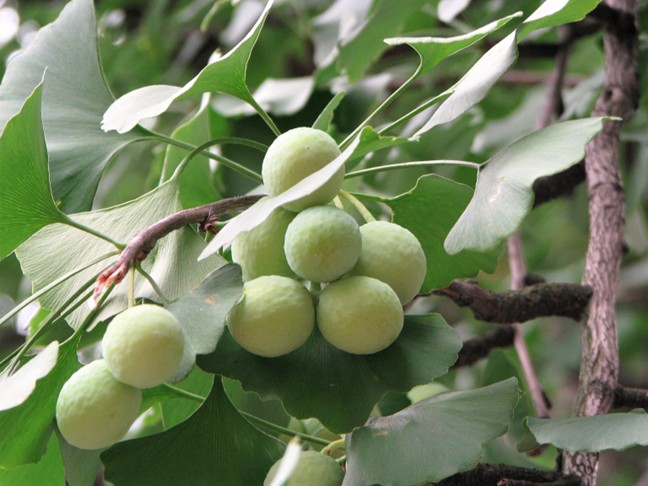
The fleshy covering of the seeds on the female ginkgo tree gives off a putrid smell. Due to this unpleasant odor, male trees are planted more frequently, especially in urban settings.
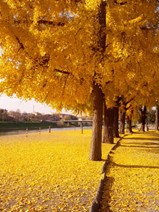
Credit: By Agnieszka Kwiecień, Nova - Own work, CC BY-SA 4.0, https://commons.wikimedia.org/w/index.php?curid=74101519 - Each fall, ginkgo leaves turn a vivid, uniform yellow before dropping. The leaves typically drop within a short time, creating a striking carpet of gold beneath the tree.
- The word “ginkgo” comes from the Japanese ginkyo, meaning silver apricot, a reference to the pale seeds of the female tree.
- The spelling of ginkgo was the result of a phonetic error by a 17th century German physician when recording the Japanese name.
- The Swedish botanist, Carl Linnaeus later adopted the mistaken spelling as the official scientific name, Ginkgo biloba.
- The leaves have a distinct fan shape with veins that repeatedly split into two. This feature, known as dichotomous venation, is rare in the plant kingdom.
Credit: This photo was taken by Susanna Giaccai. - Own work, CC BY-SA 3.0, https://commons.wikimedia.org/w/index.php?curid=22944951
Ginkgo’s Human Connection
- Beyond its distinctive biology, the ginkgo has also played an important role in human culture, valued for its beauty, symbolism, and traditional medicinal uses.
- In China and Japan, the edible inner kernels of ginkgo seeds are eaten in small amounts, often during festivals or as part of traditional dishes.
- Seeds must be prepared carefully because they contain toxins in higher doses.
- In Chinese medicine, gingko seeds and leaves have been used for centuries to improve lung function, halt diarrhea, and reduce heart palpitations.
- The ginkgo roots have been reported to aid in kidney function.
- In Western culture, ginkgo leaf extract is widely sold as a dietary supplement, especially promoted for memory improvement and cognitive health.
- Large, well-designed clinical studies have found no consistent proof that ginkgo supplements improve memory or prevent dementia in healthy adults.
- Ginkgo’s distinctive leaves appear in paintings, jewelry, architecture, and design motifs around the world.
- In Japan, the ginkgo leaf is used in city symbols, such as Tokyo’s official emblem, representing resilience and peace.
- In China and Japan, the edible inner kernels of ginkgo seeds are eaten in small amounts, often during festivals or as part of traditional dishes.
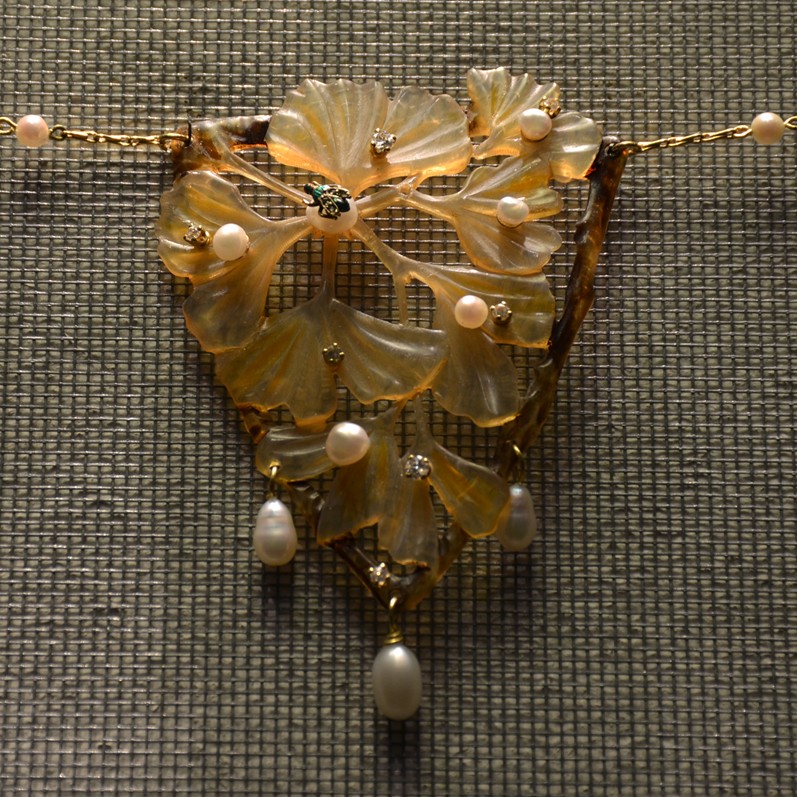
Credit: By Vassil - Own work, CC0, https://commons.wikimedia.org/w/index.php?curid=48689584
A Tree for the Ages
- From the age of dinosaurs to the modern city street, ginkgo has persisted through deep time and global change.
- It came close to vanishing in the wild, but human admiration, and perhaps a bit of luck, ensured its survival and global spread.
- Today, ginkgo thrives on six continents, connecting urban life to Earth’s distant past.
- Planting a ginkgo is like planting a living link to ancient history, a tree that may outlive many generations to come.
Episode Script
Two hundred million years ago, the ginkgo tree evolved to be very stinky, because there was a creature that loved it.
The ginkgo is unlike any other tree; not a conifer, not a flowering deciduous.
When pollen from the male ginkgo fertilizes an ovule of the female, it produces a round yellow fruit full of butyric acid, which smells -- especially when it falls and rots on the ground – like, well, vomit.
But there must have been a dinosaur or other creature that found this smell appetizing. So it would eat the fruit and disperse the seed for another stinky tree to grow.
This strategy was so successful that the ancient ginkgo propagated all over the temperate world.
But then an asteroid wiped out the dinosaurs, including the ginkgo-eating creature. Later, global cooling wiped out the ginkgo, everywhere except China.
There it was eventually embraced by Buddhist monks who planted and cared for ginkgoes at monasteries, admiring their hardiness, extreme long life, and bright yellow autumn foliage.
The monks propagated the ginkgo and carried it throughout Asia. From there it made its way west and again thrives in every part of the temperate world, in a form nearly identical to 200 million years ago.
Now the ginkgo is popular in urban environments, where it can withstand air pollution, drought and heat. But it’s the non-fruiting males that are planted. Because today, no one loves a stinky tree. I’m Scott Tinker.
Editor’s Note: The script refers to ginkgo “fruit.” Botanically, ginkgo is a gymnosperm, meaning it produces seeds, but not fruit. These seeds have a fleshy outer coating that can resemble fruit.