
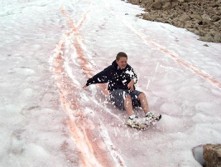
Credit: By Kory J. Collier - Own work, CC BY-SA 3.0, https://commons.wikimedia.org/w/index.php?curid=27751680
Background
Synopsis: Snow may seem monochromatic, but it can appear in shades of pink, green, yellow, brown, and black. These unusual colors reveal the presence of algae, dust, ash, pollution, and other materials that can provide clues about environmental conditions and even influence how quickly snow melts.
Snow White and Glacier Blue
- The EarthDate episode True Blue describes the reflective properties of water crystals that result in snowflakes appearing white.
- That episode also explains how bubbles trapped in glacial ice become compressed as layers of snow continue to grow, resulting in ice that appears blue.
- But sometimes, snow isn’t white and can appear in a surprising range of colors.
- These strange colors are often providing clues to us about the environment and even change how fast snow melts.
The Pink Snow Mystery
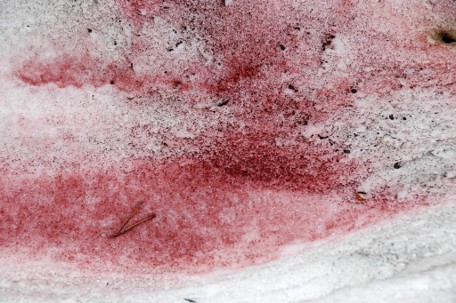
- Pink, watermelon colored snow has been documented as far back as the 4th century BC when Aristotle described “reddish” snow he found in the mountains.
- The unusual snow has been reported across the globe in Yosemite, the Rocky Mountains, the Alps, Himalayas, and even Antarctica.
- Many have also described the pink snow as having a faint smell like watermelon.
- This unusual color is more than a curiosity but signals a biological presence.
- The pink color is attributed to the growth of cold-loving algae, including species historically identified as Chlamydomonas nivalis.
- Like many algae, Chlamydomonas nivalis contains chlorophyll and appears green when viewed under a microscope.
- As temperatures warm and liquid water becomes available, they begin growing and reproducing much more rapidly. During this growth phase, the red pigment, astaxanthin appears.
- Astaxanthin helps protect the algae from the intense sunlight and ultraviolet radiation, giving the now its distinct pink color.
- Algal growth increases after melting begins in the late winter and spring.
- White snow has a very high albedo or reflectivity, but pink snow lowers the albedo, absorbs heat and, as a result, will melt faster.
- One study estimated that albedo decreased by as much as 13% and highlights the significance of this ‘bio-albedo’ effect on accelerating snow melt.
- As the snow melts, more water provides even better conditions for algae growth, generating a positive feedback loop, forming even more pink Chlamydomonas nivalis algae.
Credit: By James St. John - https://www.flickr.com/photos/47445767@N05/37619792241/, CC BY 2.0, https://commons.wikimedia.org/w/index.php?curid=129024027
A Lawn of Green Snow
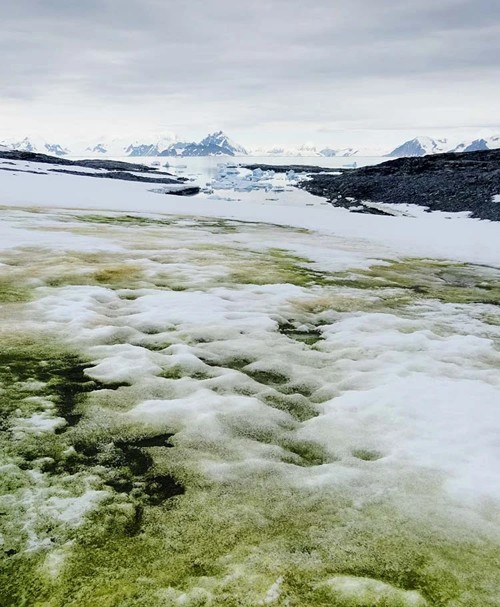
- Different species of snow-loving algae have been observed in the Antarctic.
- Chlorophyll in the algae produces blankets of green algae large enough to be seen by satellite data collected by the European Space Agency.
- The large patches of snow were found in slightly warmer environs along coastlines of Antarctica. Like the pink algae, wet, melting conditions favor algal growth.
- Another significant factor in the development of green snow is the presence of penguin and bird populations.
- Their excrement, known as guano, contains high concentrations of nitrogen, phosphorus, and potassium, essential nutrients for plant growth.
- Most of the algal blooms were spotted near either penguin colonies or other bird nesting sites.
- Albedo is also impacted by the green snow, decreasing reflectivity and increasing the rate of snow melt.
Credit: By Gray, A., Krolikowski, M., Fretwell, P. et al. - Gray, A., Krolikowski, M., Fretwell, P. et alhttps://doi.org/10.1038/s41467-020-16018-w, CC BY 4.0, https://commons.wikimedia.org/w/index.php?curid=90591757
Yellow Snow (Not That Kind)
- The musician and songwriter Frank Zappa warned us to “watch out where the huskies go, and don’t you eat that yellow snow.” Turns out, that may be good advice even if there aren’t huskies around.
- Yellow, orange, and brown snow have been observed in many varied locations and can result from pollen, dust, sand, and other particles carried through the atmosphere.
- If yellow snow is present in spring, it could be the result of pollen from flowering trees.
- The yellowish-green pollen that coats cars and triggers spring allergies, can also coat late spring snowfall, producing ‘yellow snow.’
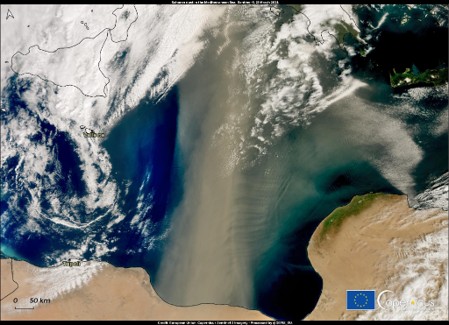
- Sometimes, dust becomes incorporated into storm systems and falls to the ground with the snow.
- Dust deposition can be a localized or global event.
- In the U.S., dust from the Colorado Plateau, the Four Corners region, often gets deposited on the western slope of the Rocky Mountains.
- Across North America, some dust has traveled high in the atmosphere, traveling from China, and depositing in the west.
- Globally, satellite data have shown dust-laden winds from the Saharan desert deposited yellow-brown snow on ski slopes in Portugal and Spain.
- Another report described a dust event that sent dust all the way to the Alps.
- In each of these events, the dust-darkened snow lowers the albedo by as much as 40%, warming the surface, increasing melt rates, and having an impact on seasonal snowpack.
Credit: By Contains modified Copernicus Sentinel data 2021, Attribution, https://commons.wikimedia.org/w/index.php?curid=136509653
The Darkest Snow of All
- Black snow forms when dark materials such as soot, volcanic ash, dust, or pollution settle on the snow’s surface.
- In rare cases, industrial accidents can also discolor snow.
- Residents of Rumford, Maine, once reported widespread brown-black snow after a paper mill released a by-product known as spent black liquor.
- On glaciers, dark particles can mix with dust and microorganisms to form cryoconite, a dark material that accumulates on snow and ice.
- Unlike bright white snow, these dark materials absorb more sunlight and reduce the snow’s albedo.
- Studies have shown that soot-covered snow melts faster than clean snow because it absorbs more solar energy.
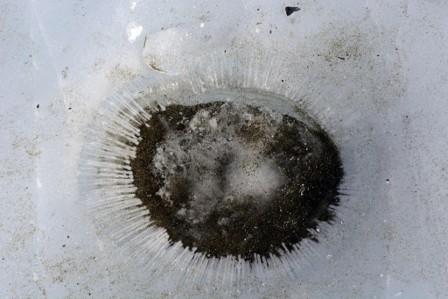
Credit: By Peter Rejcek, NSF - https://photolibrary.usap.gov/PhotoDetails.aspx?filename=taylor-glacier-blood-falls-cryoconite2.JPG, Public Domain, https://commons.wikimedia.org/w/index.php?curid=153854041
What Snow’s Colors Reveal
- Snow can change color when algae, dust, pollen, ash, soot, or other materials accumulate on its surface.
- Different colors can point to biological activity, atmospheric conditions, volcanic eruptions, wildfires, or pollution.
- Some of these materials darken the snow, causing it to absorb more sunlight and melt more quickly.
- What appears to be a simple change in color can provide valuable information about processes occurring both nearby and far away.
Episode Script
What color is snow?
It may start out white. But it can turn many other colors.
Like pink -- so-called watermelon snow. The first to write about it was Aristotle, 2400 years ago. Since then, it’s been documented in nearly every mountain range around the world.
The color comes from algae growing on the snow. It’s normally green, like most algae, but produces a red pigment when exposed to the high UV environment of snow fields.
Speaking of green, there are other snow-loving algae, especially in Antarctica, where they blanket such large areas that fields of green snow are visible in satellite images.
Snow on glaciers – really, the ice below the snow -- can appear blue as tiny air bubbles trapped within it refract blue light.
Orange, tan and brown snows get their colors from dust, carried by winds high into the atmosphere. From there, it comes down with the snow. Or can blow onto snow from continents away.
Black snow is caused by soot and ash deposited on the surface, from nearby volcanoes or even industrial fires.
All these colors tell us about the environmental conditions related to the snow. And because darker colors absorb sunlight, they cause the snow to melt faster.
Then there’s yellow. Sometimes it’s caused by pollen, and sometimes not. So as the Frank Zappa song goes, watch out where the Huskies go, don’t you eat that yellow snow.