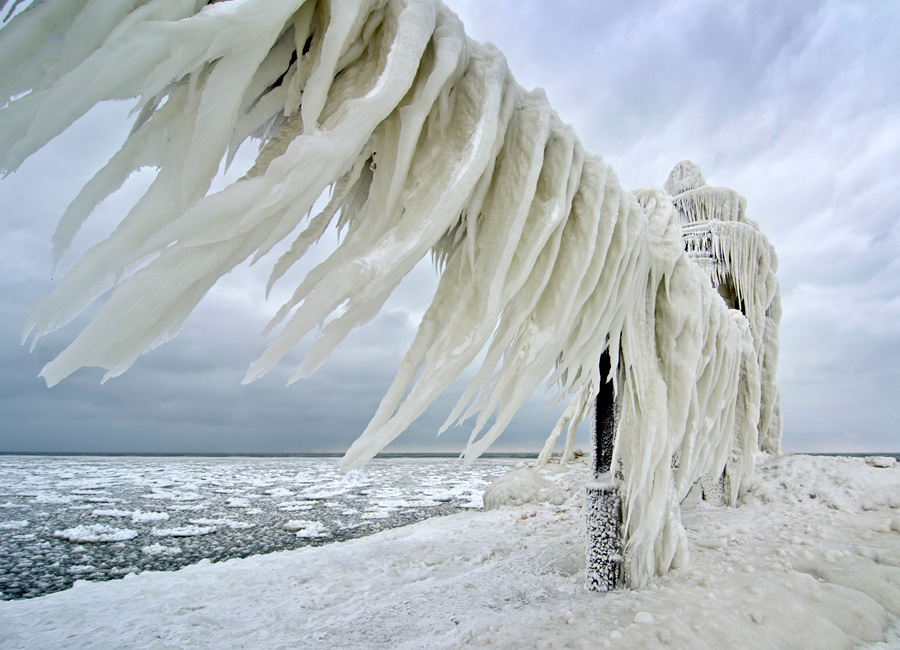

Credit: NASA, https://earthdata.nasa.gov/s3fs-public/imported/lakes_ice.jpg?VersionId=_j_hf.B2v30vyUCtHwfE2udO_TyQ9XbF
Background
Synopsis: Ice on the U.S. Great Lakes rarely forms as a smooth sheet. Instead, wind and waves shape it into a variety of unusual formations that reveal how ice develops in the moving water. These frozen landscapes are constantly changing, even in the coldest winter.
Winter’s Coming
- As winter sets in and the temperatures drop, the landscape begins to change. The ground hardens, and ice forms in ponds, streams, rivers, and lakes.
- We often picture that ice forming into a smooth, solid surface, stable enough for skating or ice fishing.
- But on the Great Lakes, ice can form very differently, creating a variety of unusual shapes, structures, and even, unusual color.
Great Lakes Ice
- Along the shores of the Great Lakes, ice seldom forms into smooth, flat sheets.
- Instead, it appears as clusters of round disks, smooth ice balls, or jagged ridges piled along the shoreline.
- These unique shapes are not random. Each reflects the conditions, and the motion of the water, during formation.
Lake Ice Formation
- The EarthDate episode Making the Great Lakes explains how this enormous freshwater system was carved by glacial ice.
- That glacial ice melted and receded beginning 20,000 years ago, but ice still plays an active role in shaping the lakes each winter.
- Unlike smaller lakes and ponds, the fresh water in the Great Lakes is constantly moving owing to currents and wave action.
- With a combined surface area across the five lakes of about 94,000 square miles (244,000 square kilometers), wind can generate large waves, similar to those in the ocean.
- As ice begins to form, it does so in moving water, leading to many unusual and dynamic ice features.

Credit: Kat Cameron, NOAA Great Lakes Sea Grant https://live.staticflickr.com/65535/55086550181_edd53358e3_z.jpg
Ice Creations
- One of the first types of ice to form is frazil ice. These are tiny, needle-like crystals that form in choppy waters during sudden cold. They have an appearance of floating slush or snow and often are the beginning stage of other ice types.
- As the frazil ice clumps together and accumulates along calmer shorelines, it forms shuga ice, which has a bumpy, granular look, like wet snow. Floating on the surface, this formation continues to grow if temperatures remain cold.
- Pancake ice is created after sheets of new ice form on the water surface. Wave motion breaks these sheets apart and keeps them moving. As they bump into each other, their edges round off, forming circular “pancakes” ranging in size from 12 inches (30 cm) to 10 feet (3 meters). Rims form on the edges of the pancakes as they move about.
- When pancake ice is pushed ashore, smaller pieces can be rolled repeatedly by waves in shallow water forming ice balls or ice eggs. Layer after layer freezes onto them, building smooth, rounded spheres. The shoreline may become lined with these spherical formations.
- Pressure ridges form when large sheets of ice are pushed together by wind and currents. With nowhere to go, the ice piles upward and downward into jagged ridges that can rise several feet above the surface and extend below the water. These ridges can make navigation difficult, even for large ships.
- Shelf ice can sometimes be seen along the shore, when larger sheets of ice get pushed inward and collide. Breaking waves and freezing spray build thick, uneven ice with cracks and holes.
- Holes in the shelf ice can form ice volcanoes, where the water is forced through openings and freezes, building cone-shaped mounds that can reach up to 20 feet (6 meters). These structures can appear solid but are often unstable.
- All these features form when wave motion, wind, and temperature changes shape ice in moving water.

Credit: By NPS photo - NPGallery, Public Domain, https://commons.wikimedia.org/w/index.php?curid=114348758

Credit: By John Winkelman - https://www.flickr.com/photos/johnwinkelman/albums/72157632958545458, CC BY 2.0, https://commons.wikimedia.org/w/index.php?curid=93962485
Blue Ice
- Most ice in the Great Lakes ranges from crystal clear to an opaque white coloration but blue ice occasionally forms. This phenomenon is rare and usually short-lived.
- The blue color comes from how ice interacts with light. The ice absorbs longer wavelengths like red and yellow, leaving shorter blue wavelengths to be reflected.
- This effect is strongest in ice that is very dense, thick, and free of bubbles, allowing light to travel deeper in the ice.
- In deeper parts of the lakes, low levels of chlorophyll containing algae can also make the surrounding water appear darker, enhancing the blue color of the ice.

Credit: By U.S. Fish and Wildlife Service - Midwest Region - Blue ice along the Straits of Mackinac, Public Domain, https://commons.wikimedia.org/w/index.php?curid=162754722
Great Lakes with Great Wind
- Powerful winds and waves are a defining feature of the Great Lakes, responsible for many shipwrecks, including the infamous SS Edmund Fitzgerald.
- The lakes’ vast surface area is often a meeting place for cold northern air from Canada to collide with warm, moist air from the Gulf of Mexico, creating intense storms with hurricane-force winds and waves that can rival those of the open ocean.
- These waves persist even as ice begins to form, preventing a simple freeze-over. Instead, ice is constantly forming, breaking apart, and refreezing.
Each Lake Is Unique
- Each of the five great lakes responds differently to the freezing conditions owing to differences in size, depth, and temperature.
- Lake Superior is very deep, so its water cools slowly, even when air temperatures drop. As a result, more open water remains during the winter, while ice forms in protected bays.
- Lake Michigan is strongly influenced by wind, often producing pancake ice and drifting ice fields.
- Lake Huron has a complex, rugged coast with many shallow, protected areas. Ice in these regions often remains attached to the shoreline, helping reduce erosion.
- Lake Erie is the shallowest of the Great Lakes and often freezes over with a thick continuous ice sheet.
- Lake Ontario is relatively deep and slow to cool, resulting in the least ice coverage, with most ice forming near shorelines.
- These differences lead to distinct patterns of ice formations across each lake.

Credit: Michigan Sea Grant (www.michiganseagrant.org) https://www.michiganseagrant.org/wp-content/uploads/2019/11/Great-Lakes-Depth-Profile-to-Scale-LV-2011-1800px-980x436.jpg
Beautiful and Dangerous
- The Great Lakes do not simply freeze and become still. Wind, waves, and temperature continue to shape the ice throughout the winter, creating a surface that is constantly changing.
- These formations can appear solid, but ice conditions vary widely, so caution is important when exploring them. Safety officials remind the public that there is no such thing as ‘safe’ ice.
Episode Script
Winter on the U.S. Great Lakes can be wild, rugged and brutal.
There, bitter cold, Arctic winds and ocean-size waves create some of the strangest ice formations on Earth.
Early in the season, the first to appear is frazil ice: tiny, needle-like crystals created when sudden cold hits the choppy water.
Frazil ice floats like slush on the surface, until it clumps together on shorelines to form shuga ice, looking like bumpy, wet snow.
Pancake ice forms as the water surface begins to freeze. Waves break the sheets into pieces, then bump them into each other, rounding their edges into circular “pancakes”- one to ten feet in diameter.
When these pancakes are pushed ashore, they break into small pieces that roll in the surf. Layers of water freeze on them as they roll, gradually becoming round ice balls. Shores can be lined with them!
As temperatures continue to drop, solid sheets of ice eventually form. When wind and waves ram them together, tall ridges push up – and down – where the sheets collide.
The moving ice sheets can be quite a danger to ships.
When a sheet is pushed ashore, it becomes shelf ice, which grows thicker as the wind blows freezing spray onto it.
Waves crash against the ice shelves and can wear holes in them. Water blasts up through them, gradually building ice volcanoes, sometimes 20 feet tall!
This great variety of ice is unique to the freshwater Great Lakes.