

Credit: By ПАТ "Укрпошта", Олександр та Сергій Харук - WADP Numbering System - WNS (http://www.wnsstamps.post/stamps/2017/UA/UA002.17.jpg), Public Domain, https://commons.wikimedia.org/w/index.php?curid=65377188
Background
Synopsis: Early humans lived through dramatic swings in climate during the Ice Age, but only Homo sapiens survived as other human species disappeared. Our success came from a combination of factors including the powerful use of language to share knowledge and cooperate. These strengths allowed our species to thrive in places that challenged every other branch of our ancient human family.
Human Ancestors Through Glaciation
- Earth has gone through several major icehouse phases, with global continent-scale ice sheets advancing and retreating over millions of years. An early EarthDate episode, From Greenhouse to Icehouse, explained the role of plate tectonics and atmospheric greenhouse gas concentrations driving these cycles.
- At a different timescale of about 100,000 years, Earth has seen glaciers advance in glacial periods (~80,000 years) and retreat in interglacial periods (~20,000 years). These are colloquially called Ice Ages.
- In the last 1 million years alone, approximately 10 of these Ice Ages have occurred.
- During the most recent Ice Age, the Pleistocene, glaciers spread across North America, Europe, and Asia, reshaping landscapes and forcing every species to adapt or disappear.
- Homo sapiens did not face this icy world alone. Several human relatives lived during this period, with each adapted to different environments.
- Neanderthals thrived in cold Eurasian climates with stocky builds, large brains, tools, clothing, and fire.
- Denisovans ranged from Siberia to Southeast Asia, carrying genes for high-altitude survival and dark pigmentation.
- Other species, like Homo erectus, who was a long-lived generalist hunter, the small-bodied Homo floresiensis of Indonesia, and the small-brained Homo naledi in southern Africa, occupied more limited ecological niches.
- But around 40,000 years ago, all these species disappeared except one.
Homo Sapiens Niche
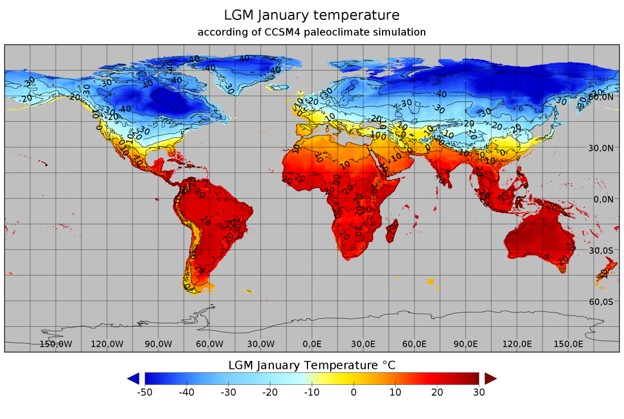
- Recent research helps explain why. A comprehensive climate analysis found that each human species had a specific “climate envelope,” a set of environmental conditions in which it could survive.
- As ice sheets grew and then retreated, rainfall patterns shifted, and ecosystems changed, these envelopes moved or disappeared.
- Species with narrow climate tolerances were hit hardest. Neanderthals, for example, depended on stable cold environments that shrank during rapid warming events.
- Others lived in isolated regions that became less habitable over time.
- Homo sapiens, however, proved exceptionally adaptable. The study shows that our species tolerated a wider range of climates, including drier and more variable environments, than any of our relatives.
Credit: By Merikanto - Own work, CC BY-SA 4.0, https://commons.wikimedia.org/w/index.php?curid=50061861
Meeting Challenges
- As climates shifted and habitats changed, Homo sapiens relied on ingenuity and adaptability to meet the demands of the Ice Age. Their success came from a combination of flexible diets, improved tools, effective shelters and clothing, and control of fire. Together, these strategies allowed early humans to survive conditions that overwhelmed their relatives.
- Flexible Diet.
- Humans were not limited to one type of food. They hunted large animals when they were available, but also gathered plants, roots, seeds, and berries.
- In coastal and river regions, they caught fish and shellfish.
- This ability to switch quickly among many food sources helped them endure sudden climate swings that caused other species to go hungry.
- Advanced Tools
- Toolmaking became more sophisticated as conditions grew harsher.
- Stone blades were crafted with greater precision, and early humans created composite tools with handles for safer and more efficient use.
- They made bone needles that allowed them to stitch fitted clothing, which protected them in cold environments.
- These innovations helped them process food more efficiently and hunt a wider range of animals.

Credit: By The Swedish History Museum, Stockholm from Sweden - Needle, CC BY 2.0, https://commons.wikimedia.org/w/index.php?curid=83243644
- Shelter and Clothing
- Homo sapiens built sturdy structures that shielded them from wind and snow.
- In some regions, mammoth bones formed the frames of homes that were covered with hides.
- Clothing fashioned from animal skins and sewn with bone needles provided insulation far beyond what other species had achieved.
- These technologies made it possible to live in regions that experienced long, severe winters.
- Control of Fire
- Fire was essential for Ice Age survival. It provided warmth, light, and a safe gathering place.
- Cooking made food easier to digest and increased the calories that humans could draw from each meal.
- Fire also allowed people to harden wooden tools and keep predators away.
- The combination of fire and shelter created a stable base from which groups could survive the harshest seasons.
- Mobility and Adaptation
- When climates shifted, humans could relocate quickly. Their flexible diets and portable toolkits allowed them to follow migratory herds, explore new landscapes, and adjust to changing ecosystems.
- This mobility gave them options when other species faced shrinking habitats.
The Power of Language and Communication
- Language may have been one of the most important tools early humans possessed. As Ice Age environments shifted and resources changed, the ability to share information became a crucial advantage. Communication helped groups coordinate hunts, plan for seasonal changes, teach new skills, and strengthen social bonds that supported survival.
- Language allowed humans to pass down information about landscapes, animal behavior, edible plants, and safe migration routes. This sharing of knowledge helped younger members learn quickly and reduced the risks that came with exploring unfamiliar territory.
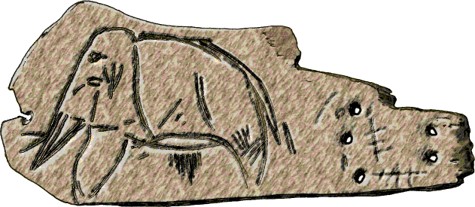
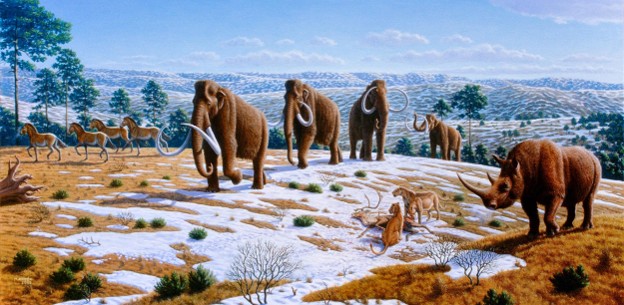
- Large prey such as mammoths required complex strategies and teamwork. Communication made it possible to assign roles, plan hunts, and adjust tactics. Groups that coordinated effectively had better access to food, hides, and bones for tools and shelters.
Credit: By José-Manuel Benito - Own work, Public Domain, https://commons.wikimedia.org/w/index.php?curid=700213
- New technologies, such as advanced stone blades, bone needles, or more efficient fires, spread through communities because people could explain and demonstrate how they worked. This rapid transfer of ideas accelerated innovation and strengthened group resilience during harsh winters or sudden climate changes.
- Language supported the formation of long-distance networks between small groups. These relationships allowed for the exchange of tools, materials, and cultural ideas. Social ties also provided support during difficult periods when food was scarce or families were forced to move.
- Storytelling, rituals, and shared beliefs helped cement group identity. These cultural practices built trust and cooperation, making it easier for communities to work together in challenging environments.
- Language gave Homo sapiens the ability to plan, adapt, teach, and connect. This communication web supported every other survival strategy, from toolmaking to migration, and it played a major role in helping our species endure the dramatic climate shifts of the Ice Age.
Credit: By Mauricio Antón - from Caitlin Sedwick (1 April 2008). "What Killed the Woolly Mammoth?". PLoS Biology 6 (4): e99.DOI:10.1371/journal.pbio.0060099., CC BY 2.5, https://commons.wikimedia.org/w/index.php?curid=11781070
Why Only One Human Species Endured
- The survival of Homo sapiens was not due to one trait but to a combination of advantages that worked together in a rapidly changing world.
- Climate pressures eliminated species that depended on narrow habitats or limited food sources.
- Homo sapiens succeeded because they tolerated a wider range of climates and adjusted quickly as environments shifted.
- Their flexible diets, advanced tools, protective clothing, fire use, and mobility allowed them to explore new regions and survive long winters.
- Their greatest strength may have been communication, which supported cooperation, innovations, and social networks that extended across landscapes.
- As the Ice Age intensified and climates swung between extremes, these combined abilities helped Homo sapiens endure when every other member of our ancient family eventually disappeared.
Episode Script
Imagine there was not one species of human…but many. One stronger. One smaller. All different, but closely related.
Around 40,000 years ago, that’s exactly how it was. Homo sapiens – us – shared Earth with several other Homo species. Then those other ones went extinct, and we carried on. The sole survivors.
Why? Because we could better adapt to changing climates. And that’s because of a few key qualities.
First, we had more flexible diets. We could eat large animals or small. Fish, fowl, or foraged plants.
One reason we could do that, is we also had better control of fire. Which allowed us to cook those various foods to extract more nutrients and calories.
We also had better tools, to more effectively butcher animals, and importantly, sew their hides into fitted clothing and covering for shelters -- which allowed us to endure the bitter cold of the Ice Age.
And because of those things, we were mobile. We could take our tools, clothing and shelters, flexible diets and fire to cook them, to different regions as climate patterns changed.
We also had dogs, for hunting. And to hear that amazing story, look it up on EarthDate.org.
But there’s one more Homo sapiens trait that may have mattered most of all. We had advanced language, to communicate the knowledge of all these things, to cooperate and collaborate, and to build the social cohesion required to weather difficult environments.